Edward Winter
This case was referred to by Yasser Seirawan (see page 26 of the Spring 2000 Kingpin) in the following terms:
‘Keene was caught red-handed plagiarizing copyrighted material from Inside Chess magazine for one of his potboilers [The Complete Book of Gambits].’
Under the title ‘The Sincerest Form of Flattery?’ John Donaldson wrote an article on pages 24-25 of Inside Chess, 3 May 1993 which began as follows:
‘Examples of plagiarism are not unknown in chess literature, but Raymond Keene has set a new standard for shamelessness in his recent work, The Complete Book of Gambits (Batsford, 1992). ... Unfortunately, Mr Keene has done nothing less than steal another man’s work and pass it off as his own.
A glance at pages 128-132 of his recent book, The Complete Book of Gambits, and a comparison with my two-part article on Lisitsin’s Gambit, which appeared in Inside Chess, Volume 4, Issue 3, pages 25-26, and Issue 4, page 26, early in 1991, reveals that not only did Mr Keene have nothing new to say about Lisitsin’s Gambit, he could hardly be bothered to change any of the wording or analysis from the articles that appeared in Inside Chess other than to truncate them a bit. What’s more, no mention of the original source was given in The Complete Book of Gambits, misleading the reader as to the originality of Mr Keene’s work.
Just how blatant was the plagiarism? Virtually every word and variation in the four and a half pages devoted to Lisitsin’s Gambit in Keene’s book was stolen.’


Above: part of John Donaldson’s article in Inside Chess; extract from pages 128-129 of Raymond Keene’s subsequent The Complete Book of Gambits.
Donaldson then compared the two texts in some detail, pointing out certain discrepancies:
‘The note in The Complete Book of Gambits is exactly the same except that “with equal chances” is changed to “with equal success”. A burst of originality on Mr Keene’s part, or just Fingerfehler? More originality is seen as “Sergievsky” becomes “Sergievyky” at Keene’s hands. Perhaps he would do better to just photocopy other people’s work and print that.
Mr Keene’s behavior is absolutely inexcusable.’
On the next page of Inside Chess there was a brief exchange of correspondence between Andrew Kinsman (the then Chess Editor of Batsford) and Donaldson. Kinsman wrote:
‘I have discussed this matter with Raymond Keene who informs me that a full credit for yourself and Inside Chess was prepared with the manuscript to go into the book. However, due to an oversight on his part this became detached and failed to appear in the book. It was not his intention to publish the piece without due acknowledgement.
Mr Keene offers his full apologies for this unfortunate oversight, which will be put right on the second edition (or the whole piece dropped if you prefer). Furthermore, he is happy to offer you, or any nominated charity of your choice, a share of the UK royalties on the book equivalent to the share that the Lisitsin section occupies in the book. We hope that such a settlement will be amenable to you.’
An extract from Donaldson’s reply (published immediately afterwards) is given below:
‘I would prefer that my work be omitted from any second edition of The Complete Book of Gambits and I suspect that if all the other victims of Mr Keene’s “unfortunate oversights” are accorded the same privilege, it will be a slender work indeed. (The complete lack of any bibliography for this book is typical of Keene.)
As for your generous offer of a share of the UK royalties, I would prefer a flat payment of $50 per page ($200) be sent to me at this address.’
Page 19 of the 14 June 1993 Inside Chess featured a lengthy letter from Keene which intimated that extracting any money from him would be considerably harder than Andrew Kinsman had suggested. Keene’s letter began:
‘… First of all, I must personally apologize for accidentally printing some of your material in my book on Gambits. This book was several years in preparation and, in an endeavour to be complete, I gathered together a huge amount of source material. In order to beat a last-minute deadline, there was a certain amount of rush. In this process, one of the Chapters I had written, plus the planned notes, including your material, slipped past the net and appeared in print. Of course, I regret this and I am broadly receptive to the proposal you make in your fax of 11 May.’ [Note added by the magazine: ‘That Mr Keene pay for material lifted without credit or permission from Inside Chess.’]
However, Keene went on to claim that Inside Chess itself had printed material of his without permission and, consequently, that:
‘I propose, as the most elegant solution, that both I and Inside Chess pay $200 each to two nominated charities. Alternatively we can just call it a draw.
I leave the choice to you.’
The Keene material in question had appeared two years previously in Cathy Forbes’ report on Hastings, 1990-91. On page 19 of the 14 June 1993 issue of Inside Chess she wrote:
‘In writing my report on Hastings 1990-91, I made extensive use of Ray Keene’s notes from the Hastings Bulletin. I did have permission to use this material, but I neglected to acknowledge the source in the article, which was an error of omission on my part.’
That letter was followed by one from Donaldson to Keene:
‘I’m afraid we will have to refuse your “draw” offer. The two situations are hardly the same. You gave Cathy Forbes permission to use the material in question in her story and she, in turn, gave us permission to use it and we paid her for it. Case closed. We don’t owe you two cents, much less $200.
Since you admit that you owe us for the material you appropriated from our pages, we would appreciate payment as soon as possible, though we understand your reluctance to establish a financially dangerous precedent in this area.’

Contents page, Inside Chess, 14 June 1993. ‘Ray interfectus est’ made fun of Raymond Keene, who had used the Latin text ‘Rex interfectus est’.
Inside Chess did not return to the subject until its 7 February 1994 issue (page 3), when a reader enquired whether Donaldson had ever received the claimed $200. The magazine reported that on 22 July 1993 Donaldson and Henry Holt and Company (‘Keene’s American publisher’) had …
‘… entered into an agreement to settle all claims arising out of Henry Holt and Company’s distribution of The Complete Book of Gambits … Henry Holt and Company agreed to pay Mr Donaldson an undisclosed amount, and agreed to refrain in the future from distributing copies of the book that contained the allegedly infringing material.’
At the Chess Café Bulletin Board on the Internet (a posting dated 30 May 2001) Keene provided another explanation of his conduct over the Gambits book (quoted in full below):
‘I left for a foreign trip while this book was being typeset and accidentally left a complete copy of the Donaldson article with the manuscript. It was a very minor sideline – hardly worth the pages that ended up being devoted to it when the typesetter dutifully put the whole article in! (1 Nf3 f5 2 d3 Nf6 3 e4 I think it was.) I did not agree to pay any damages – Batsford decided unilaterally that this was the simplest solution.’
We add that the book (on the imprint page) thanked ‘Byron Jacobs for his speedy and efficient typesetting’. It is also interesting to note from the above passage that even as late as 2001 Keene appeared unaware that Lisitsin’s Gambit begins 1 Nf3 f5 2 e4.
The remaining question is the extent of the ‘simplest solution’, i.e. the size of the damages which eventually had to be paid out because of Keene’s conduct. The amount of the final settlement was not the $200 which Donaldson had originally sought. It was $3,000.
(2966)
See also our feature article Lisitsin’s Gambit. The plagiarism affair was also discussed in ‘Ex Acton ad Astra’ on pages 18-33 of the Spring 2007 issue of Kingpin.
Addition on 11 February 2025:
In a remarkable attempt to deceive his readers, Larry Evans wrote two newspaper chess columns which chopped off the narrative of the Donaldson-Keene exchanges prematurely, thereby concealing the fact that Donaldson won hands-down:


Sunday Patriot-News (Harrisburg), 19 September 1993, page G10
A) Below is the text of C.N. 4682 (posted on 29 October 2006):
‘“The world’s biggest-selling book” is the boast on the back cover of Guinness World Records 2007 (London, 2006). Two pages include entries on chess: page 99 has a couple of dozen words about Sergei Karjakin being the youngest grandmaster, while page 137 offers brief features on the smallest and largest chess sets, as well as the following: “On 25 June 2005, 12,388 simultaneous games of chess were played at the Ben Gurion Cultural Park in Pachuca, Hidalgo, Mexico.” That is all. The four entries from the 2006 edition have been dropped.
Although poker has five entries on page 136, games such as draughts and bridge receive no treatment at all, and the editorial team’s interests are evidently on a different plane. For example, pages 8-9 document such pivotal attainments as “most heads shaved in 24 hours”, “fastest time to drink a 500-ml milkshake”, “longest tandem bungee jump”, “fastest carrot chopping”, “largest underpants”, “most socks worn on one foot” and “fastest person with a pricing gun”.’
B) From an article ‘Densa and Densa’ (chessville.com) by Raymond Keene (posted on the Internet on 21 September 2008):
‘I therefore decided to take a look for myself to ascertain whether Guinness is dumbing down or not, and to discover if their response is an honest appraisal of the situation or pure hypocritical cant?
“The world’s biggest-selling book” is the boast on the back cover of “Guinness World Records 2007”. Seven pages in total include entries on Mind Sports: a couple of dozen words about Sergei Karjakin being the youngest chess Grandmaster, while another page offers brief features on the smallest and largest chess sets, as well as the following: “On 25 June 2005, 13,388 simultaneous games of chess were played at the Ben Gurion Cultural Park in Pachuca, Hidalgo, Mexico.”
Although poker has five entries, games such as draughts and bridge receive no treatment at all. For example, it documents such pivotal attainments as “most heads shaved in 24 hours”; “fastest time to drink a 500ml milkshake”; “longest tandem bungee jump”; “fastest carrot chopping”; “largest underpants”; “most socks worn on one foot” and “fastest person with a pricing gun”.’
Raymond Keene’s plagiarism of our work (C.N.s 3493 and 4682) at chessville.com:
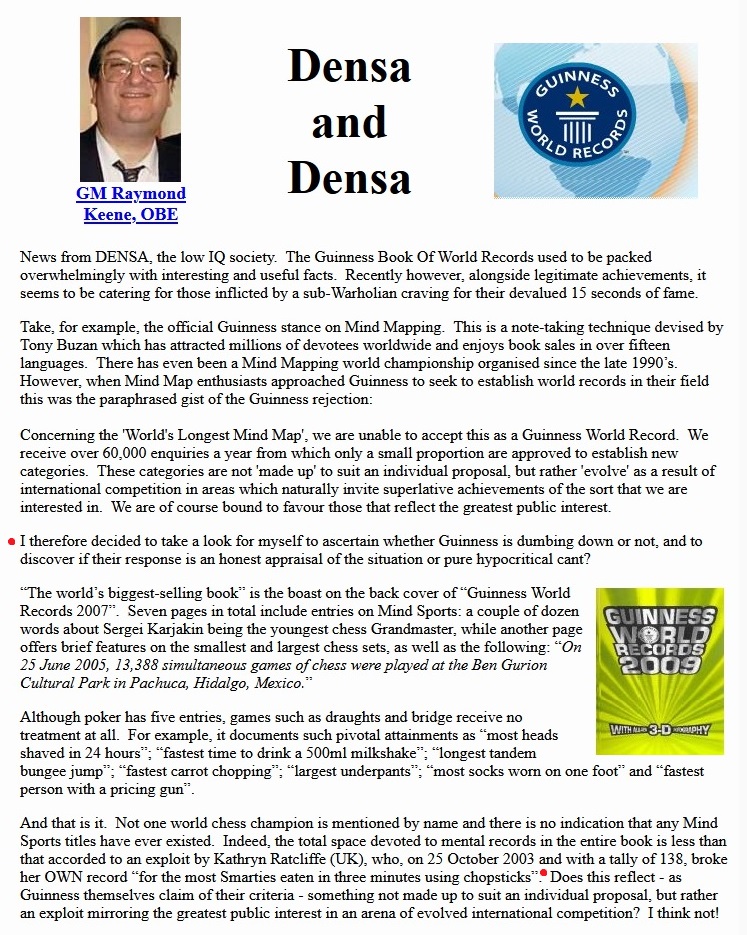
The image below highlights in red the only bits written by Mr Keene when he tried to pass off our writing as his own:
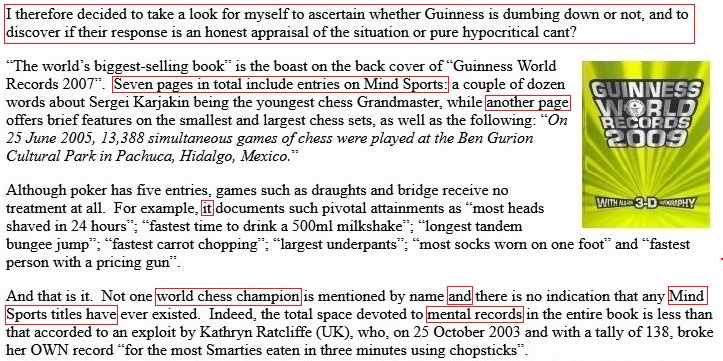
The matter has been investigated in detail at the website of the Streatham & Brixton Chess Club (reports dated 30 September, 8 October and 10 October 2008). It may be noted, in particular, that:
a) Mr Keene has made various attempts to explain his copying, and they have been proven untrue;
b) The website to which we referred in C.N. 5771 has now removed from Mr Keene’s article our paragraphs about chess;
c) Mr Keene’s article originally appeared in his weekly column in The Spectator (page 64 of the 7 June 2008 issue);
d) Over a third of ‘his’ article in The Spectator was, in fact, written by us.
(5795)
Below is Mr Keene’s column with our text blacked out:
Our writing as it appeared in The Spectator:
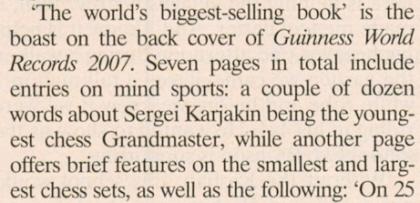
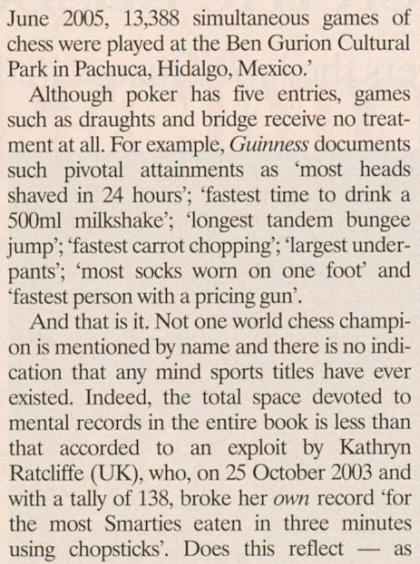
An apology was too much to expect, of course. There are no limits to what Raymond Keene will shrug off.
On 11 October 2008 we sent the following letter by registered post and e-mail to the then editor of The Spectator (London), Matthew d’Ancona:
‘Dear Mr d’Ancona,
May I advise you that over one third of the chess article by Mr Raymond Keene published on page 64 of The Spectator, 7 June 2008 was simply copied, word for word, from what I wrote some two years ago.
The following links to my Chess Notes webpage provide the facts:
http://www.chesshistory.com/winter/winter51.html#5795._More_copying_C.N._5771
http://www.chesshistory.com/winter/winter50.html#5771._More_copying
At no stage have I given permission for my writing to appear under Mr Keene’s name.
Thank you very much in advance for informing me of your proposal for settling this matter.
Yours sincerely,
Edward Winter.’
No reply of any kind was received.
As related in our feature article The Guinness World Records Slump, over a third of Raymond Keene’s column on page 64 of The Spectator, 7 June 2008 was written by us. His plagiarism of our work was reported by Private Eye later that year and was discussed in detail by Justin Horton on pages 7-9 of the Autumn 2009 issue of Kingpin (an article available online).
Of course, such public exposure was not a chastening experience for Mr Keene. Indeed, we add here that he subsequently plagiarized our Guinness material again, on page 139 of his book The Official Biography of Tony Buzan (Croydon, 2013). The full page can be viewed in our above-mentioned feature article. One example:
‘Indeed, the total space devoted to chess in the entire book is less than that accorded on page 113 to an exploit by Kathryn Ratcliffe (UK), who, on 25 October 2003 and with a tally of 138, broke her own record “for the most Smarties eaten in three minutes using chopsticks”.’
Our text in C.N. 3493, posted on 9 December 2004.
‘Indeed, the total space devoted to mental records in the entire book is less than that accorded to an exploit by Kathryn Ratcliffe (UK), who, on 25 October 2003 and with a tally of 138, broke her own record “for the most Smarties eaten in three minutes using chopsticks”.’
Raymond Keene in The Spectator, 7 June 2008, page 64.
‘Indeed, the total space devoted to Mental World Records in the entire book is less than that accorded to one exploit by Kathryn Ratcliffe (UK), who, on 25 October 2003, and with a tally of 138, broke her own record “for the most Smarties eaten in three minutes using chopsticks”.’
Raymond Keene in The Official Biography of Tony Buzan (Croydon, 2013), page 139.
(9178)
Further to the above-mentioned Kingpin article by Justin Horton, we add that Raymond Keene’s denial of plagiarism makes this a textbook case of crib and fib.

In a series of articles at the website of the Streatham & Brixton Chess Club, Justin Horton has reported on the conduct of Raymond Keene. The latest exposé of plagiarism concerns the game Alekhine v Rubinstein, Carlsbad, 1923, which Mr Keene published in The Spectator of 4 May 2013 with annotations lifted from volume one of Kasparov’s My Great Predecessors series.
(8099)
See too Mr Horton’s article dated 26 June 2013, concerning Réti v Capablanca, New York, 1924. Further instances have continued to be demonstrated at the Streatham & Brixton site in a series of articles about the duplicitous duplicator.
While the rest of us are reading a new chess book, Raymond Keene is casing the joint.
A Twitter thread begun on 20 June 2013 by Mig Greengard, Kasparov’s close associate:

From Raymond Keene’s chessgames.com page, on 12 January 2014:

An observation by Kasparov on Twitter, 9 March 2014:

Grandmaster A turns up at the board in an apparent drunken haze and falls asleep (or ‘promptly falls asleep’, as the accounts are more likely to say).
Grandmaster B refuses a pre-game handshake with his opponent because of personal problems between the two players (it is reported that they have ‘a history’).
Grandmaster C is suspected of wiring himself up to an electronic device in an attempt to cheat during a game (the affair is instantly and inevitably baptized any old thing plus the ‘gate’ suffix).
Such happenings in the chess world invariably ignite knee-jerk analysis (‘chat’), offering everyone merciful relief from having to discuss chess. Writers (including those individuals who incongruously combine pseudonymity with self-importance in forum discussions) chew over the rights and wrongs of the case, without knowing the facts or even whether there is a case. We are informed what they feel perhaps happened, what their best guess would be, what they would not be surprised by, what they think they once read somewhere, and what they deem a fitting punishment in view of what they ‘reckon’ occurred. If much of the discussion (dressed up, where possible, as ‘breaking news’) is expressed in prose dashed off without concern for spelling, grammar or anything else, that is a small price to pay for immediacy and the common goal of making the affair ‘go viral’. All the writers can then feel that they have been in on something worthwhile and have done their bit within the chess community.
Should it turn out that, for instance, Grandmaster A’s alcoholic intake was zero and that his drowsiness was caused by problems concerning (‘issues with’) medication, that will not be allowed to put a damper on the fun. Any such correction – not explicitly presented as a correction, of course – will merely open up fresh vistas for comment and speculation from a different angle; after all, drug-taking and drug-testing are notably fertile ground for those wishing to comment and pass judgement, unencumbered by the need to know anything. And so the whole spiel resumes. ‘Freedom of expression’ (i.e. scattergun imputations) can start anew, and a good time is had by all, except by those who care about truth and, more personally, those whose reputations are damaged, or even wrecked, in the maelstrom of misinformation and conjecture.
Now, exeunt Grandmasters A, B and C, and enter Grandmaster D. He is the subject not of gossip or scandal-mongering but of grave, incontrovertible disclosures about his conduct: it has now been demonstrated as a matter of public record that, quite apart from his slew of transgressions over the decades, he has presented other people’s writing as his own not just a few times, as was previously thought, but again and again.
C.N. 8099 briefly referred to Raymond Keene’s plagiarism, but since then the scale of it has become evident from the continuing series of articles by Justin Horton at the Streatham & Brixton website. Readers can examine the eye-popping details for themselves via a convenient ‘plagiarism index’ which is being kept updated.
Executive summary: in addition to shuttling his own writing, or what was imagined to be, from one Times or Spectator column to another (his columns being pale shadows of their former pale shadows), Raymond Keene has often used those outlets to pass off material, particularly from the Kasparov Predecessors books, as his own writing. It is not just occasional phrases, sentences or paragraphs that have been misappropriated, but material to fill entire columns. And, we now know, frequently.
Page 29 of the 28 June-11 July 2013 issue of Private Eye (a feature nearly 90 lines long – shown above in a small format for illustration only) discussed bluntly the behaviour of ‘this absurd comic-book thief’, but what can be said about the chess world’s reaction, or lack thereof, to the affair? To date, it has been a case of ‘lack thereof’. Such pusillanimity is nothing new, there being a longstanding belief among editors (including his employers) that the best place for unsavoury information about Raymond Keene is under the carpet. Now, though, given the sheer extent and seriousness of what he has done, why would any editors or columnists (and not only British ones) wish to continue concealing the facts from their readers? After all, if they were to persist in shielding Raymond Keene, how could they legitimately criticize anybody else for anything?
(8151)
A further article, ‘Chequered Mate’ [broken link], appeared on page 7 of the 6-19 September 2013 issue of Private Eye.
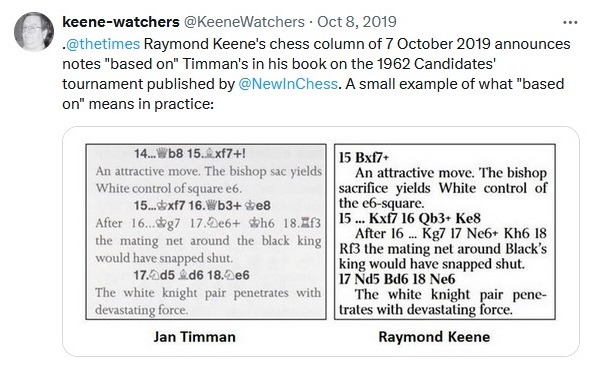
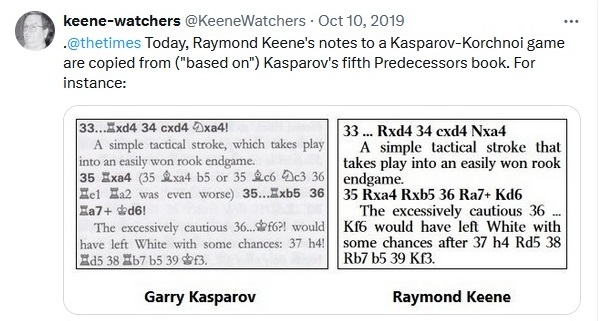
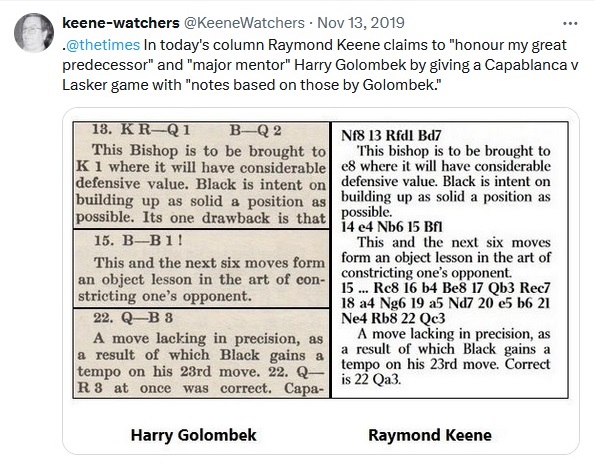
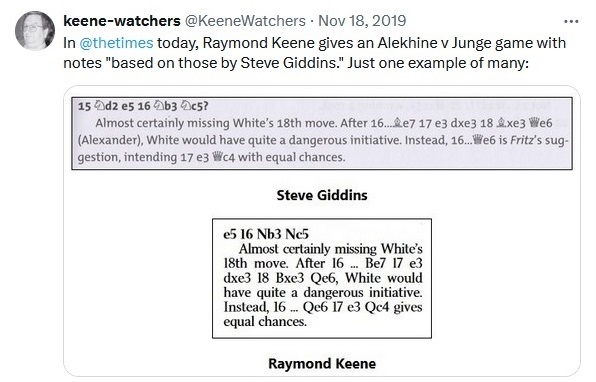
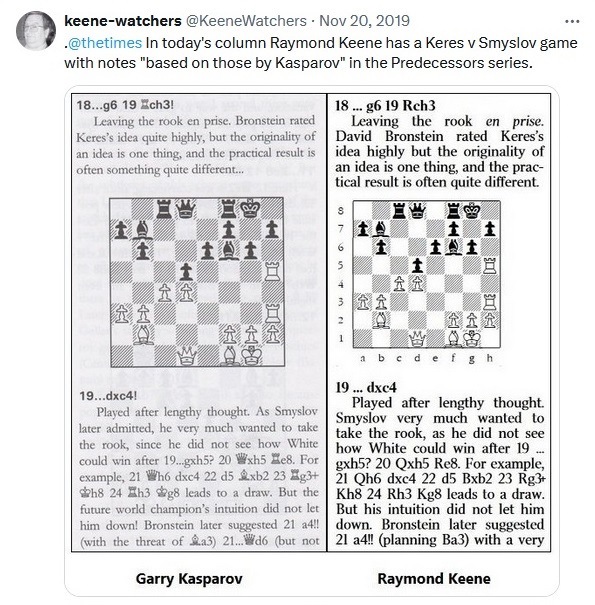
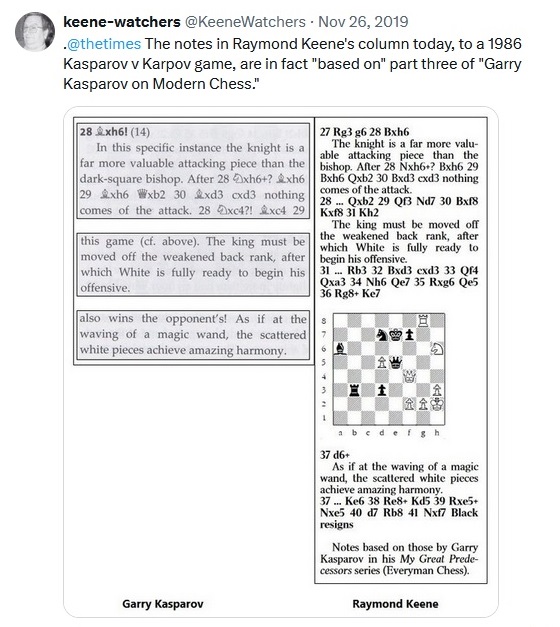
Sometimes Raymond Keene mentions the Predecessors series by name when helping himself to annotations. ‘Notes based on’ is Keenese for ‘Notes copied from’.
The ‘based on’ method is also seen in a brief article on Raymond Keene by Olimpiu G. Urcan.
Another piece by Mr Urcan is ‘Meal Ticket’, referred to in C.N. 11126.
A new website Keenipedia includes among its features a section entitled Plagiarism.
The two most recent issues of Private Eye ask how The Times can possibly continue to employ Raymond Keene, who is described as a ‘bubonic plagiarist’.
Plagiarism is one of the most shameful offences that a writer can commit, and the case against Mr Keene is incontestable. On the other hand, given all his further shortcomings (a whopping euphemism), why would any publication want him even if he had never stolen a single sentence?
(8776)
In the Streatham & Brixton Chess Blog of 5 September 2013 Justin Horton related his attempts to draw Raymond Keene’s conduct to the attention of The Times and The Spectator.
On 7 September 2013 James Plaskett added on that page his own experiences:
‘A year or two ago I sent copies of an edition of Kingpin to the editors of three publications for which Keene writes: The Times, The Sunday Times and The Spectator pointing out that the mag contained an article of a dozen pages accusing him of all kinds of stuff and that he was doing nothing in response. I stressed that I was NOT after a job but the unchallenged allegations being made against Keene weren’t helping the reputations of their publications.
I also said that there were many good young masters and Grandmasters who were as capable of being their correspondent and that this was not very nice for them when seeing this depicted as the way to success in the world of chess.
I received no replies.’
On 1 June 2024 we pointed out on the feedback form on the website of ‘TheArticle’ that Raymond Keene’s article on Rhoda A. Bowles ‘copies a huge amount of text from someone else’s article of five years ago. The copying even includes ‘each others houses’ instead of ‘each other’s houses’.’
Despite that ransacking by Mr Keene of a chess.com article and appropriation from other online sources, the BCM considered the Rhoda A. Bowles article worthy of nine pages and front-cover status in its July 2024 issue. The nine pages are shown below, with red diagonal lines added by us to mark those parts, all uncredited, that anyone could readily copy-paste from other people’s work available online. We have not marked the last two pages, which quote texts by Jacqueline Eales and Susan Polgar.
(12048)

Addition on 22 November 2024:
Already a third case of plagiarism of the same material, this time in book form.
From Raymond Keene’s chess column in The Spectator, 13 May 1989, page 51:
‘In 1847 he was elected MP for Richmond, Yorkshire, a seat he held until 1868, barring a break of two years. ... He played in no further tournaments, although it is said that he retained an interest in chess throughout his life.’
From page 381 of the Oxford Companion to Chess by D. Hooper and K. Whyld (Oxford, 1984):
‘In 1847 he was elected Member of Parliament for Richmond, Yorkshire, a seat he held until 1868 except for a break of two years ... Although he played in no more tournaments he retained an interest in the game throughout his life.’

Page 5 of Jaque, issue 345, January 1993
Raymond Keene is a man of many words, not always his own.
Quite by chance we have just discovered the following:
‘On Tuesday the chess official who asked Tony to send a cable to London if he became a Grand Master received a laconic telegram which said simply “A cable. Tony Miles.”
The steel behind this casual facade becomes evident in Miles’s dedicated effort at the chessboard. His play is aggressive, precise, and above all fearless of reputations ...’
‘A British chess federation official who had asked Miles to send a cable to London if he ever became a Grandmaster received a laconic telegram which simply read “A cable. Tony Miles”. The steel behind this casual facade becomes evident in Miles’ dedicated effort at the board – aggressive, precise, and above all fearless of reputations.’
‘A British Chess Federation official who had asked Miles to send a cable to London if he ever became a Grandmaster received a laconic telegram which simply read “A cable. Tony Miles”.
The steel behind this casual facade becomes evident in Miles’ dedicated effort at the board – aggressive, precise, and above all fearless of reputations.’
Page 6 of The English Chess Explosion stated, ‘we would like to thank Leonard Barden for permission to quote from his articles in The Guardian and The Financial Times’. The above, of course, is not a case of ‘quotation’.
(8267)
C.N. 8267 reproduced Barden’s full column in the Financial Times of 28 February 1976.
Apish ‘tributes’ to Bobby Fischer on page 21 of Chess Life, March 2008:
‘He was the pride and sorrow of chess.’ (Raymond Keene);
‘Chess was his native tongue.’ (Larry Evans).
(11059)
From the 1974 book The World of Chess by Anthony Saidy and Norman Lessing (page 115):
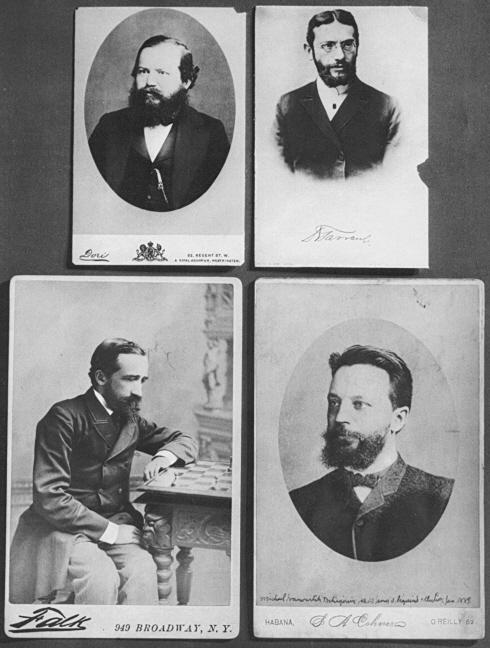
From the 1990 book Chess An Illustrated History by Raymond Keene (page 80):
Addition on 14 April 2024:
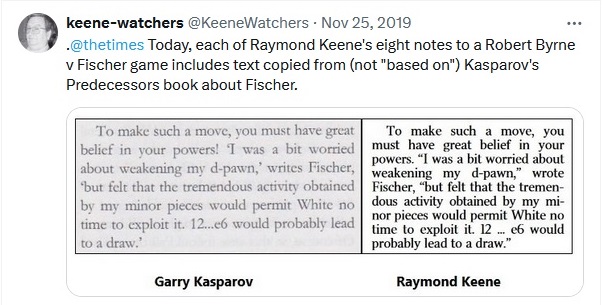
Some further examples of copying (Acknowledgement: keene-watchers):
From Oliver Beck (Seattle, WA, USA):
‘I have come across an article written by Raymond Keene entitled “Chips with a pinch of salt: Duchamp and Le Lionnais” which appeared online in The Article (thearticle.com), dated 7 December 2024. It contains material taken from C.N. 9465 with no mention of you or Chess Notes. However, Mr Keene did credit me with at least some of it, describing me as “the late Oliver Beck of Seattle”.’
(12102)
As is well known, Yasser Seirawan was born in Damascus, of a Syrian father and a British mother. However, on page 53 of his book Docklands Encounter (London, 1984) Raymond Keene claimed that Seirawan was ...
‘... born in England of mixed US and Syrian parentage’.
Page 278 of Warriors of the Mind (Brighton, 1989), a book co-bungled with Nathan Divinsky, re-affirmed that Seirawan was ...
‘... born in England of mixed US and Syrian parentage’.
When Warriors of the Mind was re-issued in 2002, the errors were, of course, left untouched.
Four years later, Messrs Keene and Divinsky, together with Jeff Sonas, produced a book entitled Who was the Strongest? Warriors of the Mind II. Page 270 stated that Seirawan was ...
‘... born in England of mixed US and Syrian parents’.
(6292)
One obvious reason why so many of Raymond Keene’s books contain so many gaffes is that he copies so much from so many of his previous books. He is not so much a writer as a repackager.
Raymond Keene’s latest chess column in The Spectator (22 June 2013, page 66), available on-line [broken link], reveals another handy method of avoiding exertion. The column features the game Ivanchuk v Anand, Linares, 1998, without mentioning that the annotations merely repeat, word for word, what Mr Keene was paid for writing in his column on page 60 of The Spectator, 21 March 1998.
For example:

The Spectator (2013)

The Spectator (1998)
(8100)
Addition on 28 June 2013: Pablo Byrne (London) points out a third occurrence in The Spectator of the same annotations to the Ivanchuk v Anand game, on page 58 of the 5 May 2012 issue.
C.N.s 2032 and 9843 (see Chess Anecdotes) discussed a groundless old yarn about Znosko-Borovsky and Capablanca. Some further citations:
Of Capablanca’s own games it has been written, with justice, that they breathe a serenity, a lucid crystal clarity, a type of model perfection. Indeed, that they are the product of supreme chessboard art.’
Raymond Keene, on page 40 of The Times (Review Section), 19 November 1988;
Of Capablanca’s own games it has been written, with justice, that they breathe a serenity, a lucid crystal clarity, a type of model perfection. Indeed, that they are the product of supreme chessboard art.’
Raymond Keene, on page 236 of Keene On Chess (New York, 1999);
Of Capablanca’s own games it has been written, with justice, that they breathe a serenity, a lucid crystal clarity, a type of model perfection. Indeed, that they are the product of supreme chessboard art.’
Raymond Keene, on page 237 of Complete Book of Beginning Chess (New York, 2003);
Of Capablanca’s own games it has been written, with justice, that they breathe a serenity, a lucid crystal clarity, a type of model perfection. Indeed, that they are the product of supreme chessboard art.’
Raymond Keene, on pages 40-41 of World Chess Championship Kramnik vs. Leko (Aylesbeare, 2004);
Of Capablanca’s own games it has been written, with justice, that they breathe a serenity, a lucid crystal clarity, a type of model perfection. Indeed, that they are the product of supreme chessboard art.’
Raymond Keene, on page 34 of Vishy’s Victory (2007);
Of Capablanca’s own games it has been written, with justice, that they breathe a serenity, a lucid crystal clarity, a type of model perfection. Indeed, that they are the product of supreme chessboard art.’
Raymond Keene, on page 21 of Battle of Bonn (2008);
Of Capablanca’s own games it has been written, with justice, that they breathe a serenity, a lucid crystal clarity, a type of model perfection. Indeed, that they are the product of supreme chessboard art.’
Raymond Keene, on page 58 of Carlsen-Anand Match for the World Chess Championship (Bronx, 2013).
As regards the second paragraph in each of those seven passages, the uncredited writer of the ‘lucid crystal clarity’ remark was Harry Golombek, on page ix of Capablanca’s Hundred Best Games of Chess.
(10316)
On page 84 of Chess An Illustrated History (Oxford, 1990) Raymond Keene gave another version of the quote about Capablanca:
‘Of his games, it has been declared that they breathe “a serenity, a crystal clarity, a perfection which is the result of the highest art”.’
In addition to its many factual errors, Carlsen v Caruana: FIDE World Chess Championship, London 2018 by Raymond Keene and Byron Jacobs (London, 2018) has much copying from other works by Mr Keene. A note at the end of Mr Urcan’s review mentioned in C.N. 11126 observes:
‘About 90% of the biographies of Lasker, Capablanca and Alekhine is a direct copy from Keene’s book on the 2000 world championship.’
Another example is the biographical section on Spassky, where even the misspelling ‘he gave full reign’ is repeated. From that section (pages 27-28) we highlight one sentence, concerning the 1972 world championship match:
In reverse chronological order:
Page 35 of The Brain Games World Chess Championship by Raymond Keene and Don Morris (London, 2000).
Page 178 of Samurai Chess by Michael Gelb and Raymond Keene (London, 1997).
Page 21 of part 5 of Raymond Keene’s Men of War publication for The Times during the 1993 Kasparov-Short match.
Page 72 of Chess for Absolute Beginners by Raymond Keene (London, 1993).
Page 10 of Fischer-Spassky II by Raymond Keene (London, 1992).
Page 96 of Chess An Illustrated History by Raymond Keene (London, 1990).
Page 223 of Warriors of the Mind by Raymond Keene and Nathan Divinsky (Brighton, 1989).
A sub-variation:
Page 107 of Carlsen-Anand Match for the World Chess Championship by Raymond Keene (New York, 2013).
Page 25 of Battle of Bonn by Raymond Keene and Eric Schiller (2008).
Page 50 of Vishy’s Victory by Raymond Keene (2007).
Page 58 of World Chess Championship Kramnik vs. Leko by Raymond Keene (Aylesbeare, 2004).
(11142)


Addition on 30 March 2024:
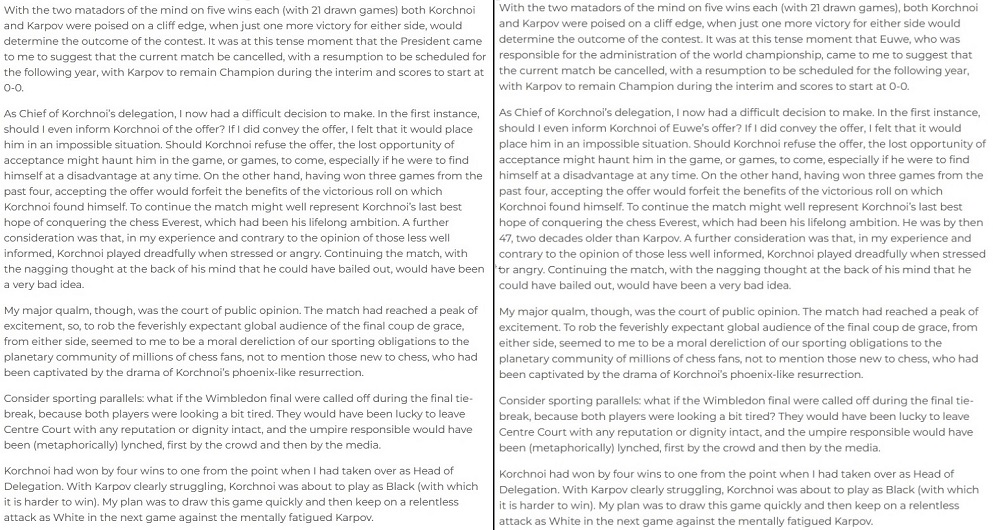
Left: from an article by Raymond Keene posted on 23 January 2021. Right: his contribution to the same website on 30 March 2024.
Addition on 13 April 2024:
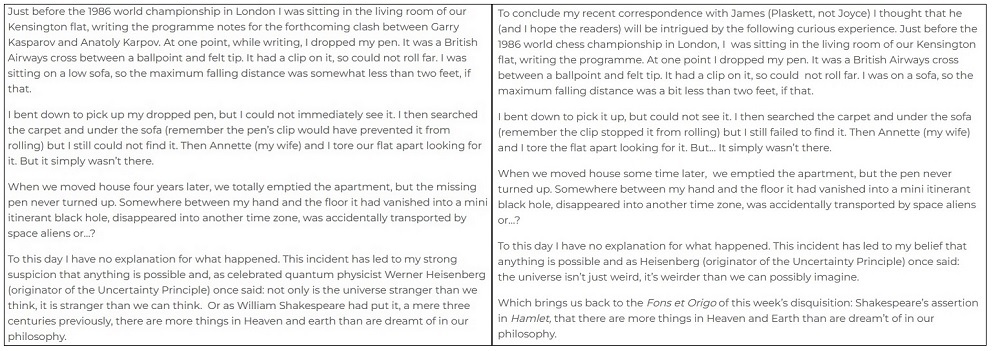
Left: posted by Raymond Keene on ‘TheArticle’, 17 February 2024. Right: posted by him on the same website on 13 April 2024.
Addition on 4 May 2024:
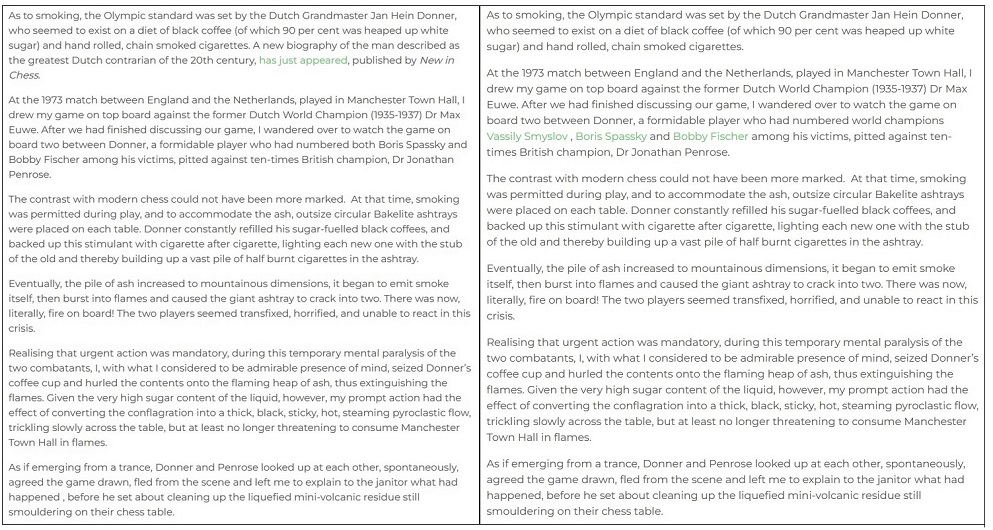
Left: from Raymond Keene’s ‘TheArticle’ column, 28 March 2020. Right: from his column at the same website on 4 May 2024.
There are, of course, various pre-2020 similarly-worded occurrences of the Donner story. Raymond Keene is unassailably the chess world’s most woeful regurgitator.
Addition on 9 June 2024:
In ‘TheArticle’, 9 June 2024 Raymond Keene rehashes his piece dated 15 May 2021.
Addition on 15 June 2024:
Much of Raymond Keene’s article of 15 June 2024 merely copies what he wrote on 21 January 2022.
Addition on 21 September 2024:
‘This week, in a Stakhanovite effort to engender outrage, in true Graham Linehan style, I shall enter the topic of gender wars. To misquote an ancient Indian adage about chess, this is a sea in which a gnat may sink and an elephant may drown.’
‘This week, in a Stakhanovite effort to engender outrage, faux or otherwise, I shall enter the topic of gender wars. To misquote an ancient Indian adage about chess, this is a sea in which a gnat may sink and an elephant may drown.’
As shown in our Chess Proverbs feature article (and as pointed out 18 years ago), the first known record of the ‘ancient Indian adage’ is in the 1930s.
The previous, longer paragraph in Raymond Keene’s articles is also a rehash, shedding further light on what, in his mind, is ‘a Stakhanovite effort’.
Often Raymond Keene’s writing does not even attain the level of typing.
Addition on 13 October 2024:
Quiz question: what percentage of the body of Raymond Keene’s contribution to ‘TheArticle’ on 13 October 2024 is more or less a chunk copied from his 29 May 2021 piece?
The answer is 57%.
In his Spectator column of 28 September 2019 Raymond Keene wrote:
‘After 42 years without missing a week, this is my last column for The Spectator.’
The assertion about not missing a week is untrue. For instance (as reported by Olimpiu G. Urcan at the English Chess Forum), in 1985 nine Spectator chess columns were by writers other than Raymond Keene. In a run of six columns in October-November 1986 four were written by other people.
In his Times column of 1 November 2019 Raymond Keene wrote:
‘Today I announce my retirement from writing The Times chess column. I shall be standing down at the end of November ...’
On his Twitter page on 31 July 2020 Raymond Keene wrote, misleadingly and ungrammatically:
‘I am 72. Last year, at the age of 71, both The Spectator and The Times fired me after respectively serving for 42 years and 34 years without missing a single column. And frequently topping the poll for most read chess column. So good luck youngsters!!’
Age was indeed the problem – the age of his material.
Summary regarding Raymond Keene’s chess columns:
Sunday Times: terminated in August 2017;
The Spectator: terminated in September 2019;
The Times: terminated in November 2019.
From page 9 of Private Eye, 18-31 October 2019:
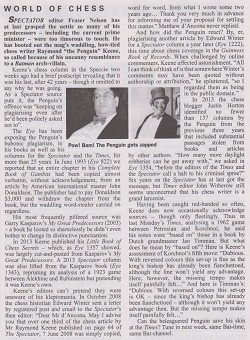
(Reduced format, for reference only)
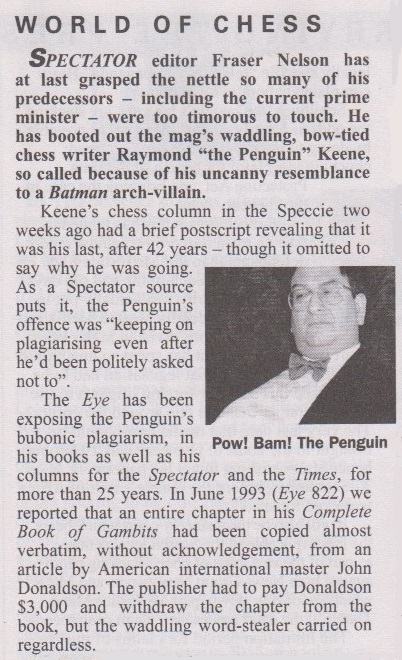
‘As a Spectator source puts it, the Penguin’s offence was “keeping on plagiarising even after he’d been politely asked not to”.’
The final paragraph of the column asked whether the ‘beleaguered’ Raymond Keene could survive at The Times. That question was answered, in the negative, by Private Eye on page 8 of its 15-28 November 2019 edition.
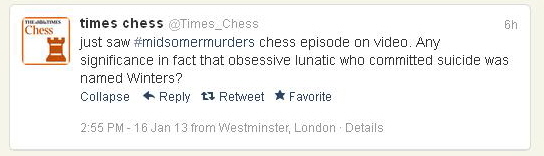
A Times tweet posted by Raymond Keene on 16 January 2013:
See also:
Articles on Raymond Keene
Cuttings
Raymond Keene’s Titles
Lisitsin’s Gambit
The Guinness World Records Slump
World Champion Combinations
Copying.
To the Chess Notes main page.
To the Archives for other feature articles.
Copyright: Edward Winter. All rights reserved.