
Edward Winter
R. Spielmann v J.R. Capablanca, New York, 1927. See C.N. 9515 below.
From page 195 of our 1989 monograph on Capablanca:

The endnote referred to, on page 319:

From page 84 of From Morphy to Fischer by Al Horowitz (London, 1973), in a discussion of Capablanca’s performance at New York, 1927:
‘… the situation reached the height of absurdity in his game with Nimzowitsch, where he had to send a message to his opponent (?) through the tournament director to make better moves or he would be unable, with the best will in the world, to avoid winning!’
Horowitz had written similarly on page 206 of Chess Review, July 1949:
‘The prearranged draw is really the blight upon the game. Even some of the greatest masters are guilty of this sin. On good authority comes the story of the Capablanca-Nimzowitsch, New York 1927, fiasco and its hilarious overtones. Capablanca, having first prize clinched, the story goes, agreed to draw with Nimzowitsch. In so doing, Capablanca would avert the effort and Nimzowitsch would insure half a point against the invincible Capablanca. Hence, both were satisfied. The game, however, did not follow conventional lines and Nimzowitsch mangled the defense. Capa was embarrassed! He requested the referee to intervene and advise Nimzowitsch to improve his play. Otherwise, Capablanca would be compelled to win!’
In the following issue (August 1949, page 225) Norbert Lederer commented:
‘In fairness to Capa, it should be noted that he had already secured first prize since he had a three and a half point lead with only three games to play; these were against Alekhine, Nimzowitsch and Vidmar. Capa announced that, in order not to appear favoring one of the three, who were all in the running for second or third prize, he would play for a draw against each of them, and he so informed me as tournament director. Needless to say, I did not relish this attitude, but there was little I could do about it.
During his game with Capablanca, Nimzowitsch indulged in some fancy play and found himself with a practically lost position. Capa then not only asked me to warn his opponent, but actually had to dictate the next four or five moves which Nimzowitsch played with great reluctance as he suspected a double-cross. However, he did follow instructions and a draw was reached four moves later.’
Capablanca referred to the matter in his tournament report in the New York Times, 27 March 1927, pages 1 and 4:
‘Our game with Vidmar needs only a few remarks. The peculiar position in which we found ourselves with regard to the other three leading competitors made us decide to exert ourselves to play for draws unless our opponents threatened to win, since any defeat at our hands would put any one of them out of the running for a prize, without any benefit to ourselves. Our opponent being satisfied to draw, the game could only have one result.
… The same remarks about our game with Vidmar in the previous round apply to our game with Nimzowitsch, except that here we had a chance to win, of which we did not avail ourselves.’
(2527)
Regarding the smoking threat yarn, see A Nimzowitsch Story.
C.N. 2514 quoted high praise of Frank Marshall’s endgame skill. A contrary view was voiced by E.G.R. Cordingley on page 109 of the Chess Students Quarterly, June 1947:
‘Marshall was never, contrary to the opinions expressed most often in his own country, among the world’s first three or four most accomplished living players, though he did gain one outstanding triumph and was both a very dangerous opponent to the best players and a potential winner in any tournament where there was a fair divergence in the abilities of the contending players. Again, he was definitely not a “master of the endgame”, as has been claimed; indeed, his technical skill was appreciably below that of the best during his years of practice, also well below his own marked talent for combinational play.’
On the other hand, Capablanca commented on page 8 of the New York Times, 13 February 1927:
‘In the endings, contrary to many people’s idea, Marshall is an A1 performer. To be truthful, he is no Dr Lasker or Rubinstein, when the latter is at his best, but only one or two of his competitors in the coming tournament [New York, 1927] will have the slightest advantage over him in this department of the game.’
(3072)
Christian Sánchez (Rosario, Argentina) provides an article by Hartwig Cassel (1850-1929) on page 2 of section 3 of the 21 August 1927 issue of La Prensa, although it was written in June (in New York). Cassel reported that in the opinion of the New York chessplayers the Capablanca v Alekhine match would not be of interest, as Capablanca would win easily. He stated that, on the basis of recent tournament results, Lasker and Bogoljubow had a greater right to challenge the Cuban, as Alekhine lacked the requisite stature for the match.
The article was unfortunate too not only in misspelling Cassel’s name on both occasions it was mentioned but also in claiming that in a game between Capablanca and Alekhine at New York, 1927 the following position had arisen ...

... and that Capablanca had played 1 Nd3, the game being drawn a few moves later. Instead, wrote Cassel, 1 Nc6 Bxc6 2 Rxc6 would have caused the loss of Black’s a-pawn, after which Capablanca might well have won the game.
In reality, the above position never occurred, as Alekhine pointed out on page 29 of the February 1928 American Chess Bulletin:

The New York Sun (mentioned by the Bulletin) had as its chess columnist Hartwig Cassel.
On page 97 of his book on New York, 1927 the explanation offered by Alekhine was that a telegraphic error had resulted in 20...Ne4 being given, instead of 20...Nd5, in South American and European chess magazines:

For an English version of the note, see page 308 of the Skinner/Verhoeven book on Alekhine.
Finally, page 117 of the July-August 1929 American Chess Bulletin had a photograph taken at Bradley Beach, 1929 which featured both Alekhine and Cassel. The latter died about a month afterwards.

The person between Herman and Lajos Steiner is not identified.
(5117)
Our feature article on Zugzwang remarks that the word ‘was not commonly found in English-language chess literature prior to the publication of My System [in 1929]’. Here we add that a rare, early explanation of Zugzwang occurred in an (uncharacteristically florid) article by Hermann Helms entitled ‘Applying the Straitjacket in Chess’ which was originally published in the Brooklyn Daily Eagle and was reproduced on pages 65-66 of the March 1927 American Chess Bulletin. It concerned Capablanca’s celebrated victory (with the Caro-Kann Defence) over Nimzowitsch at New York, 1927, and Helms commented:
‘It was an artistic gem of the chessboard. Nimzowitsch is an artist. No-one appreciates beauty or perfection more than he. His own artistry has often dumbfounded opponents less skillful. But against the champion – that’s something different again.
Once more, that straitjacket; that is, the chessic kind. ... His little army was precisely as large as Capablanca’s. But he was cramped and he ached for elbow room. As to space and mobility he was much restricted. No matter which way he looked there was restraint. The prospect was decidedly irksome.
Very expressive is the German term of “Zugzwang”. It covers the case exactly. Literally translated it means move-coercion. The player thus unfortunately placed may be said to be position-bound. Gradually all his available moves are exhausted; that is, the moves that count at all. Then he faces the inevitable.
... Some move must be made. With that very move he signs his own death warrant ...
So it was with Nimzowitsch. He was the fly in the net. Capablanca played the part of spider. The Dane was already enmeshed. He made a brave show of resistance. The more he struggled the more hopeless became his plight. The Cuban looked pleased. On an occasion like this he fairly beams. His countenance yesterday radiated delight.’
(5147)
From pages 222-223 of ‘Garry Kasparov on My Great Predecessors Part I with the participation of Dmitry Plisetsky’ (London, 2003):
‘To the super-tournament in New York (1927), arranged to “accommodate” Capablanca, Lasker was no longer invited.’
Zenón Franco Ocampos (Ponteareas, Spain) asks whether this is true. The answer is no, because Lasker was invited to New York, 1927.
We discussed the matter on pages 195-197 of our book on Capablanca, referring to the bitter public dispute which had arisen at New York, 1924 between Lasker and Norbert Lederer (the latter being a key figure on the organizing committees of New York, 1924 and New York, 1927).
Much additional information was presented in the article ‘New York 1927 Documentary Evidence Answers Lingering Questions’ by Hanon Russell on pages 88-104 of the first issue of the American Chess Journal (1992). A section of the article (pages 99-101) was headed ‘Why Didn’t Lasker Play?’, and it showed that although the New York, 1927 organizing committee did not believe that Lasker would participate, Lederer ...
‘... made an extraordinary effort to convince Lasker to play. He enlisted the help of influential people in the United States and Europe, but Lasker was not persuaded. Finally, as the plans which were formulated had to be finalized, Lederer made one last effort. On 10 December 1926 he wrote a five-page typewritten letter in German to Lasker (Russell Collection #584). Lederer, whose first language was German (he was born in Vienna), wanted to make absolutely certain that he would not be misunderstood. Lederer’s formal invitation to Lasker specified all the terms, financial and otherwise, being offered to Lasker as well as a strong plea for Lasker to relent and play in what was recognized even then as one of the world’s great chess tournaments.’
Lasker refused the invitation.
See also pages 74 and 640 of Emanuel Lasker: Denker Weltenbürger Schachweltmeister edited by R. Forster, S. Hansen and M. Negele (Berlin, 2009).
(6738)
Emanuel Lasker’s absence from New York, 1927 was due to a bitter dispute with the organizers of New York, 1924, and he issued a lengthy statement on the affair at the end of 1926. Much confusion and additional controversy arose because the text was published – in German, Dutch, Spanish and English – with many variants and discrepancies. Richard Forster (Winterthur, Switzerland) has sifted through all available versions of the statement in a special article presented here: Lasker Speaks Out (1926).
(11704)
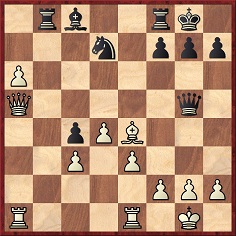
Position after 20 bxa6
‘The combination here is unique in the literature of chess games. Where else can one find a rook’s pawn on the sixth rank stronger than a queen?’
Source: page 24 of Solitaire Chess by I.A. Horowitz (New York, 1962). Horowitz had not included that curious remark when his article, ‘Spielmann Outspielmanned’, was published on page 9 of Chess Review, January 1955.
The full game-score, for ease of reference: 1 d4 d5 2 Nf3 e6 3 c4 Nd7 4 Nc3 Ngf6 5 Bg5 Bb4 6 cxd5 exd5 7 Qa4 Bxc3+ 8 bxc3 O-O 9 e3 c5 10 Bd3 c4 11 Bc2 Qe7 12 O-O a6 13 Rfe1 Qe6 14 Nd2 b5 15 Qa5 Ne4 16 Nxe4 dxe4 17 a4 Qd5 18 axb5 Qxg5 19 Bxe4 Rb8 20 bxa6 Rb5 21 Qc7 Nb6 22 a7 Bh3 23 Reb1 Rxb1+ 24 Rxb1 f5 25 Bf3 f4 26 exf4 Resigns.
As shown on pages 167-168 of our book on Capablanca, the Cuban annotated the game in an article on pages 1 and 2 of the New York Times, 13 March 1927. Among his comments: ‘We have been warmly congratulated by amateurs and experts alike for the manner in which we conducted the attack.’ He also provided notes on pages 245-248 of A Primer of Chess (London, 1935).
In the 1920s, other annotators included Maróczy (Kagans Neueste Schachnachrichten, April-June 1927, pages 304-305) and Alekhine in Das New Yorker Schachturnier 1927. (The English translation of the notes on pages 116-117 of the ‘21st Century Edition!’ (Milford, 2011) made no attempt to capture Alekhine’s prose style.) Réti gave the game in Masters of the Chess Board.
On page 143 of The Immortal Games of Capablanca (New York, 1942) Fred Reinfeld presented Capablanca v Spielmann as follows:
‘This might well be considered the classic Capablanca game. It shows his proverbial clean-cut and logical simplicity in its most attractive form.’
It was also the game that Harry Golombek picked for the section on Capablanca on pages 222-224 of The Game of Chess (various editions). The introduction stated:
‘Here is a game that seems perfectly natural once one has played through it; but no-one, save Capablanca, could have produced it.’
A detailed set of annotations, by John Nunn, was published on pages 149-152 of an anthology which he co-wrote with Graham Burgess and John Emms: The Mammoth Book of The World’s Greatest Chess Games (London, 1998). From the introduction:
‘Capablanca had the unusual ability to dispose of very strong opponents without any great effort. At first glance, there is little special about this game; the decisive combination, while attractive, is not really very deep. The simplicity is deceptive; a closer look shows that the combination resulted from very accurate play in the early middlegame.’
This photograph of Spielmann and Capablanca in the New York, 1927 tournament is in our monograph on the Cuban:
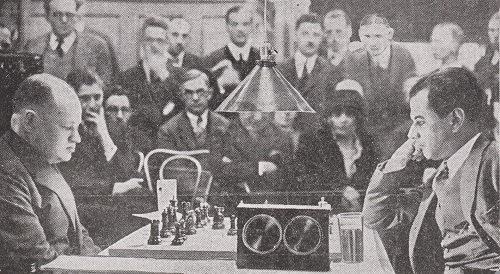
(9515)
Before the New York tournament began, Capablanca wrote about Spielmann in his New York Times column of 16 February 1927, page 1. The text appears below from pages 154-155 of our 1989 monograph on Capablanca:


From Chess Punctuation:
An example of punctuation which is accidentally wrong in a game-score occurs on page 104 of Scacchi (‘Manuale di base’) by Paola Cavallanti (Florence and Milan, 2002): in Capablanca v Spielmann, New York, 1927, 18 axb5 is given two question marks.
From page 60 of the March 1927 American Chess Bulletin:
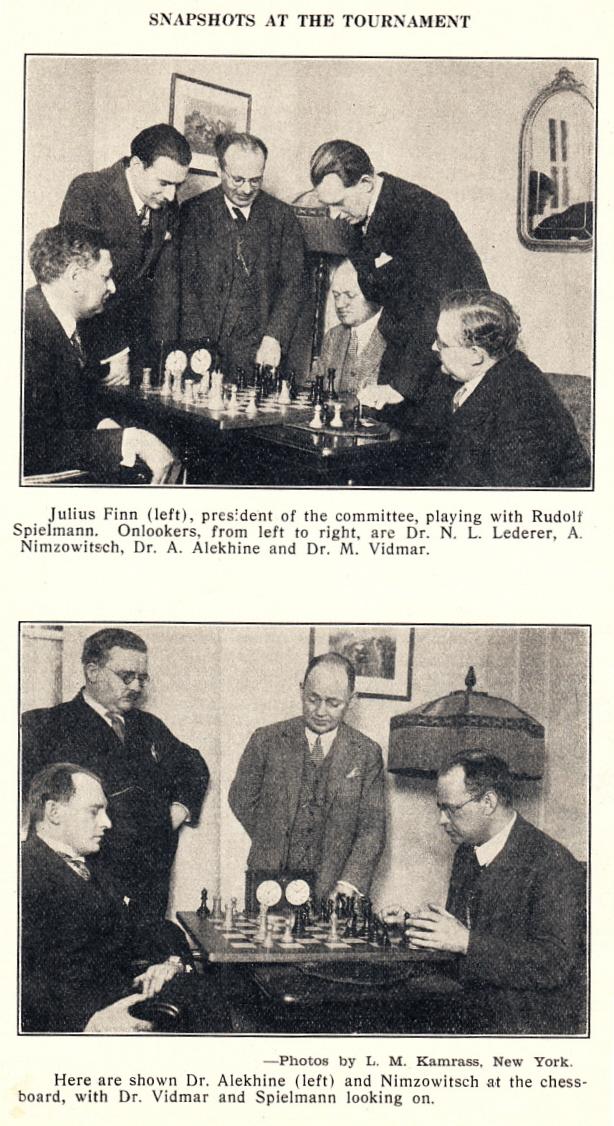
Olimpiu G. Urcan (Singapore), who gave the first photograph on page 226 of his book Julius Finn (Jefferson, 2010), informs us that he has now acquired a much better copy:
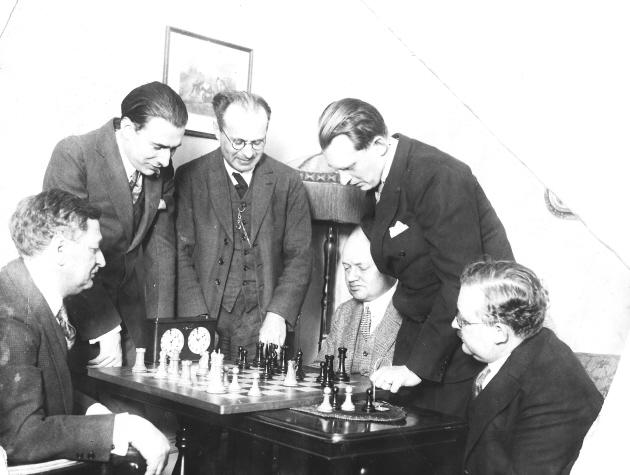
Our correspondent identifies the position as arising in analysis of the third-round game at New York, 1927 between Vidmar and Spielmann:
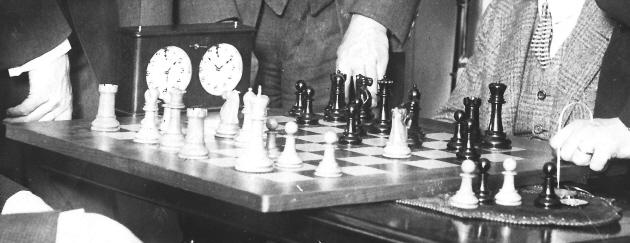
(7602)
A much poorer version, with an even poorer caption, has appeared on page 45 of Alexander Aljechin Biografie des 4. Schachweltmeisters by W. Daniel (Eltmann, 2012):

(7957)
The photograph below comes from page 56 of the March 1927 American Chess Bulletin:

There could hardly be a more difficult identification exercise, even with the aid of the report on pages 57-58:


(8441)
In an article presenting his new edition of Nimzowitsch’s My System Fred Reinfeld wrote on page 208 of the July 1949 Chess Review:
Can information be found about Reinfeld’s game against Cohen?
Reinfeld also mentioned his visit to the New York, 1927 tournament on page 161 of The Great Chess Masters and Their Games (New York, 1952), in the chapter on Capablanca:
‘The other masters were so clearly outclassed that comparison was piteous. I attended the tournament one day to catch a glimpse of the grandmasters. Capablanca looked sleek, poised, quite sure of himself. The others were fearfully nervous – Sorcerer’s Apprentices, all of them, in the presence of the master magician. In any other man, Capablanca’s air of assurance would have made a distasteful impression – but not in his case: he looked so distinguished, so authentically a great man, that the predominant reaction was one of awe.’
(8805)
On page 1 of the New York Times (Sports Section), 16 February 1927 Capablanca wrote of Nimzowitsch:
‘We believe that his strength is his weakness; he plays such bizarre openings and such complicated games that very often he is just as much puzzled as his opponent, if not more so, as to the best course to follow.’
See the chapter on New York, 1927 in our 1989 monograph on Capablanca.
John Hilbert (Amherst, NY, USA) reverts to C.N. 2169 (see page 330 of Kings, Commoners and Knaves), which sought corroboration of a claim by William M. Russell (American Chess Bulletin, April 1927, page 82) that Capablanca learned from A.W. Fox ‘his art of stalling and waiting for his opponent to blunder’.
Our correspondent notes that page 4 of the Washington Sunday Star, part five, 12 December 1915 quoted a compliment by Capablanca about Fox:

Capablanca’s quoted words: ‘Fox ... was one of the most promising young players in the world at the time he gave up chess to engage in newspaper work, and I still think he is the best odds giver I have ever seen.’
Dr Hilbert adds that in a 26-board simultaneous display in Washington on 20 November 1915 it was only Fox’s draw that denied Capablanca a clean score. Source: part five of the Sunday Star, 28 November 1915, page 4, which gave the (familiar) game-score.
Below is the conclusion of William M. Russell’s above-mentioned article on New York, 1927:

See too The Fox Enigma.
(10606)
From Copyright on Chess Games:
One of the conditions of play at New York, 1927 was the following:
‘The players undertake not to write any annotation or publish any of the games played in book form for a period of one year after publication of the Official Tournament Book.’
Here the trouble was that the ‘Official Tournament Book’, which was supposed to be by Capablanca, was never published. (American Chess Bulletin, February 1927, pages 21 and 23.)
In an article on pages 108-112 of issue one of the American Chess Journal, 1992 (see Alekhine Renaissance) we commented:
He produced a tournament book (of New York, 1927) which was shamefully biased against Capablanca, yet he managed to remain reasonably objective in another one (Nottingham, 1936) written when relations between the two masters were infinitely worse.
To the Archives for other feature articles.
Copyright Edward Winter. All rights reserved.
