
Edward Winter
This feature article brings together material that was previously in Chess and Women and Nigel Short.

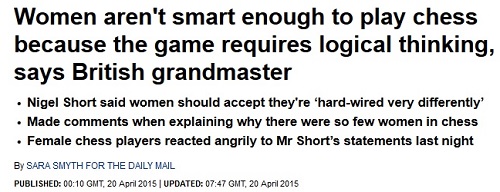
Newspapers are forever reporting alleged anger, fury, etc. vented ‘last night’. (Profound discontent generally seems nocturnal.) The original report about Nigel Short, in the Daily Telegraph of 20 April 2015 [by Leon Watson], illustrates how news stories may nowadays be confected from Twitter, and one tweet grabbed is a claim that Short’s comments were ‘incredibly damaging’. (‘Incredibly’ generally means ‘very’.) Last night’s ire is a curiously delayed reaction to an article by Short, ‘Vive la Différence’, on pages 50-51 of the 2/2015 New in Chess – an issue which was published a month ago but evidently remained unavailable last night, and even today, given that much of the coverage bears little relation to what Short wrote in the Dutch magazine.
It is incredibly easy to express simplistic views on the topic of chess and women in ignorance of the key factors, whether biological, cultural, psychological, sociological, etc., which may or may not explain any differences between male and female chessplayers, whether now or in the past. We have made that last sentence as woolly as possible to underscore the futility of such general, synthetic ‘debates’, which concern, in full or in part, questions of opinion and taste.
If Nigel Short’s New in Chess article contained factual mistakes, misquotations, faulty statistics, bad writing or plagiarism, there would be every reason to complain, but we have seen no attempt to rebut, even, this important paragraph of his on page 51:
‘Given Susan Polgar’s undoubted genuine achievements – such as being the first woman to earn the Grandmaster title conventionally by making three norms – it is tragic that her brand is tarnished by extravagant and literally incredible claims like her supposed world record in 2005 of playing 1,131 games consecutively (winning 1,112!) in just 990 minutes. This works out at just 52.5 seconds per game – although it would be somewhat less when one takes into account bathroom breaks. Given that she was walking around the whole time, which causes a second or seconds to be lost on [e]very move, for this record not to be fictitious would require an extraordinary high number of Scholar’s Mates. It is hard to understand why an emotionally stable individual would even imagine anyone else might believe this record to be genuine.’
(9244)
Nigel Short’s article was so bad that few, if any, top-level masters have expressed agreement with it. Nigel Short’s article was so good that few, if any, top-level masters have expressed disagreement with it.
There are other possibilities too, of course, and of all the lessons to be learned from the shambolic, sprawling rumpus over ‘Vive la Différence’ (an article still being discussed by individuals who have not read it) a neglected one is mentioned here, in the context of any current issues (as opposed to history and lore): the lack of a proper online chess forum where topical controversies can be discussed in depth; where comprehensive and comprehensible coverage is founded on facts and informed opinions; where contributions bear the writer’s real name; where hearsay is absent; where wit is welcome but glib illiterates are not; where Internet links are supplied only if they lead to something worthwhile; where irrelevancy and repetition are avoided; where strong criticism of people and of ideas is expressed solely if based on substantiated information; where all relevant sources are cited; where points are not deemed true, or even noteworthy, merely because they come from the mainstream media; where press articles by non-chess-specialists are treated not with automatic gratitude but with particular caution; where misquotation is excoriated; where the debate, however lively, is moderated with rigorous even-handedness; where good linguistic standards are ensured; where contributors and readers are treated with the respect that they deserve; where anyone, including top-level masters, would be proud to have a contribution posted.
Wanted: one topical chess forum where 100% of the contributions are worth reading, and not 100 forums where 1% are.
(9254)
On pages 36-37 of the 4/2015 New in Chess Nigel Short has written a follow-up article, ‘A Beautiful Minefield’, discussing reaction to ‘Vive la Différence’ (published on pages 50-51 of the 2/2015 issue). A brief extract:
‘On 20 April an article appeared in The Daily Telegraph entitled “Nigel Short: Girls Just Don’t Have the Brains to Play Chess”. Never mind the fact I didn’t say that, it was a catchy headline to set me up as a misogynist pantomime villain. In extraordinary rapid succession came a whole series of similar articles, in The Guardian, The Times, The Independent, many with totally fabricated quotes and grotesque distortions – such as the Daily Mail’s “Women aren’t smart enough to play chess because the game requires logical thinking, says British Grandmaster”, despite me having said nothing at all about logic.’
Indeed so, notwithstanding Raymond Keene’s assertions in an item for the Spectator placed online on 22 April 2015 (i.e. over a month after the 2/2015 issue of New in Chess appeared):
‘According to Short’s comments, the female brain fails in the logic department, hence girls will never be able to match boys over the chessboard ...
Even if Nigel has a point about logic, at least one of the greats of chess history is not on his side. As the brilliant tactician and incandescently creative world champion Alexander Alekhine once said, “chess is not only knowledge and logic!”.’
(What Alekhine ‘once said’ can be found in the final note to his victory over Reshevsky, Kemeri, 1937, in his second volume of Best Games.)
Many so-called journalists, from Raymond Keene upwards, have written about Nigel Short’s ‘Vive la Différence’ article without bothering to read it, but it cannot be assumed that they, or the hordes of unpaid opinionizers online, would have had anything worth writing even if they had read it. C.N. 9051 observed that ‘technology increasingly encourages people, including the uninformed and illiterate, to share their opinions about tout ce qui bouge’. The complex issues concerning chess and women, and Nigel Short’s views thereon, merit rigorous scrutiny and discussion. That has yet to start.
The tornado of the past two months has contributed virtually nothing, beyond providing a text-book example, notable well beyond the chess world, of how the media often operate nowadays. At their worst, they wake up late, scavenge, copy, misinterpret, invent, pontificate and then move on to wreak havoc elsewhere. The process is aggravated by a recent development: convergence of the viciously shallow press and online outlets such as Twitter, so that kneejerk reactions abound and maelstroms are inevitable.
In such circumstances, no mature discussion of the relative weakness, or otherwise, of female chessplayers is possible. What has been on abundant offer, however, is incontrovertible proof of the irremediable weakness of commentators, irrespective of their sex.
(9344)
Has any article in chess history been so misrepresented as Nigel Short’s on female players in New in Chess?
Having previously asked readers to imagine themselves as the editor of a chess quotations book (C.N. 11994) and of a single-volume chess encyclopaedia (C.N. 12035), we now invite them to assume the role of a mainstream journalist commissioned to produce a chess article on recent allegations of online cheating. Where to look for the essentials? Where to find output in which opinions, biased or not, do not leap-frog over facts?
The journalist may dive in at some random point proposed by Google, only to find barely comprehensible arguments deployed with links to barely comprehensible X/Twitter posts or YouTube videos, as various parties and partisans compete with declarations, interrogations, accusations and insinuations. But where are a placid, objectively formulated overview and chronology of how any given point was reached? In brief, where is the journalism?
This is not new. Nearly a decade ago, Nigel Short wrote in New in Chess about the differences between male and female chessplayers, and an outcry ensued, unhurriedly. If a journalist today seeks a reminder of the case, where to go? Should Google prove unhelpful, it may seem sensible to turn to a ‘standard’ source such as the Wikipedia entry on Short, but that fails too. It has 70 words on the affair and three endnotes, all three being links to ‘outcry’ articles by non-specialist writers in three UK newspapers, the Independent, the Guardian and the Daily Telegraph; all three articles, as it happens, were dated 20 April 2015. The New in Chess piece had been published about a month previously.
Wikipedia does not relate what Short had written in New in Chess, even though the full text was reproduced by ChessBase not long after the tumult began, and is still there. Nor does Wikipedia display awareness of Short’s follow-up article in New in Chess, which was, in part, a reply to the assertions in the three UK newspapers. The media had gorged themselves and, in terms of actual arguments, the second New in Chess article was, so to speak, even more ignored than the first one. Vive l’indifférence.
That was the shallow treatment of a controversy in 2015, and one looks in vain, even today, for a plain, factual account of it. How will the media of 2024 be judged in future years for their handling of the present cheating cacophony? Who will emerge with honour for showing care over facts and respect for fair play? Who will work hard to clarify the issues for the public’s benefit? And when will the process start?
(12060)
The full text of the follow-up article (‘A Beautiful Minefield’, from pages 36-37 of the 4/2015 New in Chess) was placed online by Nigel Short at the English Chess Forum on 18 December 2020.
To the Archives
for other feature articles.
Copyright Edward Winter. All rights reserved.