Edward Winter
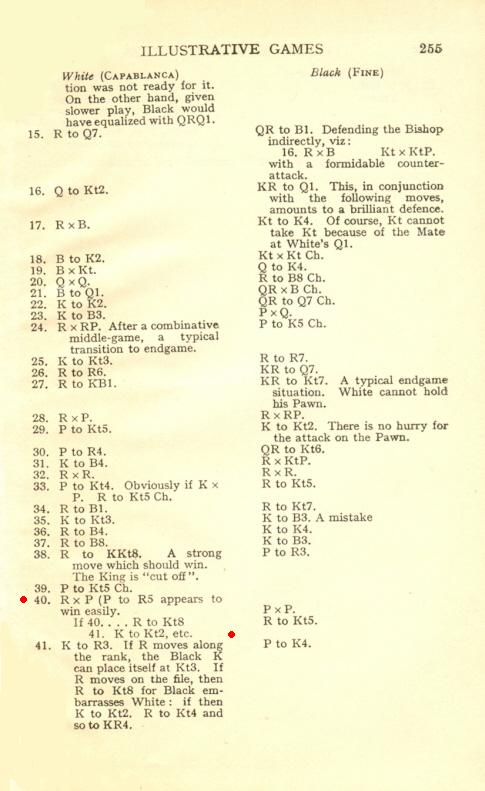
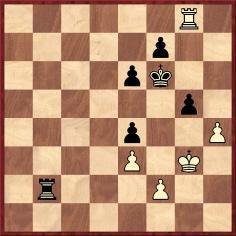
Position after ...hxg5
On page 108 of The Batsford Chess Puzzle Book (London, 2002) Leonard Barden erred in his account of this position from Capablanca v Fine, AVRO, 1938. After noting that Capablanca played 1 Rxg5, with a draw agreed upon shortly afterwards, Barden writes:
‘Neither of the players and none of the expert commentators noticed anything amiss at the time, but half a century later an unknown amateur pointed out that Capablanca, regarded as one of the greatest world champions, had overlooked a simple winning plan.’
Page 170 gives the solution: ‘1 h5 Rb1 2 Kg2! g4 3 h6 Rb5 4 h7 and White’s queening pawn will cost Black his rook.’
It was certainly some time after the AVRO tournament that this winning line was discovered, but not more than a dozen years or so. All that happened about ‘half a century later’ was that David Arganian won a ‘Best Question’ book prize in Larry Evans’ Chess Life column (January 1987, page 84) for mentioning h5. Evans’ response included the following:
‘I suspect that Grandmaster Fine is here learning about this possibility for the first time. Even if this resource for White has been pointed out before, your amazing discovery deserves a prize for overturning the conventional wisdom about a very famous game.’
However, on page 50 of the August 1987 Chess Life, Richard Lighton informed Evans: ‘this move has been “discovered” before – and at least a quarter of a century ago.’
Indeed it had. Back in 1984 (C.N. 593) we reported that 40 h5 had been commented upon by Wolfgang Heidenfeld on page 8 of his 1982 book Draw! The missed win, wrote Heidenfeld, ‘was pointed out a good 20 years later by Paul Schlensker in Schach-Echo’.
Thanks to a lead from another correspondent, Paul Timson (Whalley, England), we were subsequently able to show (in C.N. 1475) that 40 h5 had been mentioned as early as 1951, by Gerald Abrahams. He published the game on pages 254-256 of his book Teach Yourself Chess, and in the original edition (1948) he wrote:
‘40 RxP. Leaving Black with a “cut-off” King.’
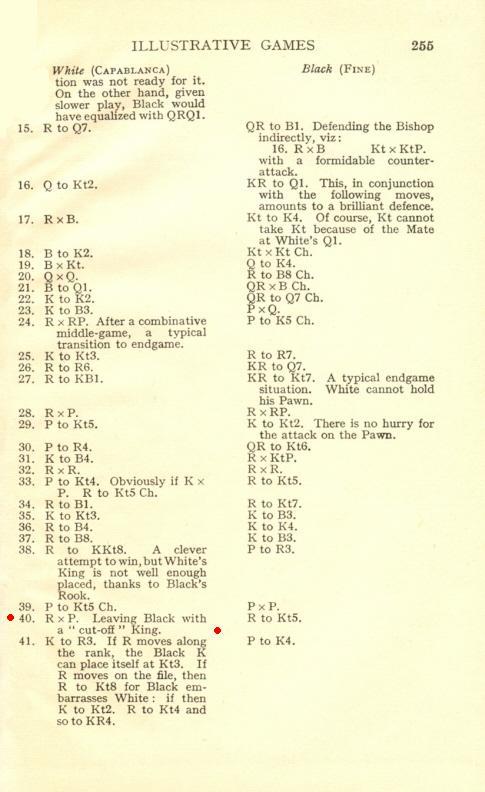
In the Revised Edition of 1951 this was amended to:
‘40 RxP. P to R5 appears to win easily. If 40…R to Kt8 41 K to Kt2, etc.’
Also in C.N. 1475 the librarian Rob Verhoeven (The Hague, the Netherlands) informed us that a search at the Royal Library in The Hague had failed to locate where in Schach-Echo Paul Schlensker had indicated the winning move. That question remains open today. However, unless Heidenfeld’s words ‘a good 20 years later’ regarding Schach-Echo were a mistake, Abrahams gave 40 h5 much earlier than did Schlensker.
(2907)

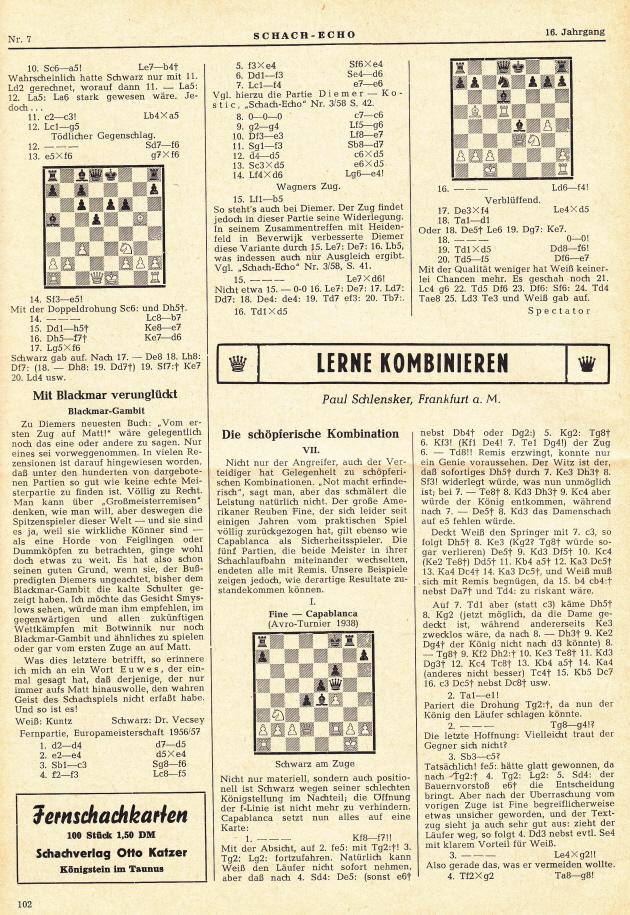
A loose end concerning this position in the Capablanca v Fine game relates to Wolfgang Heidenfeld’s remark that 40 h5 was first pointed out by Paul Schlensker in Schach-Echo. No such reference has been found, but now Alan McGowan (Waterloo, Canada) notes that Schlensker discussed both AVRO games between Capablanca and Fine on pages 102-103 of the 5 April 1958 Schach-Echo, although without any treatment of the rook ending:
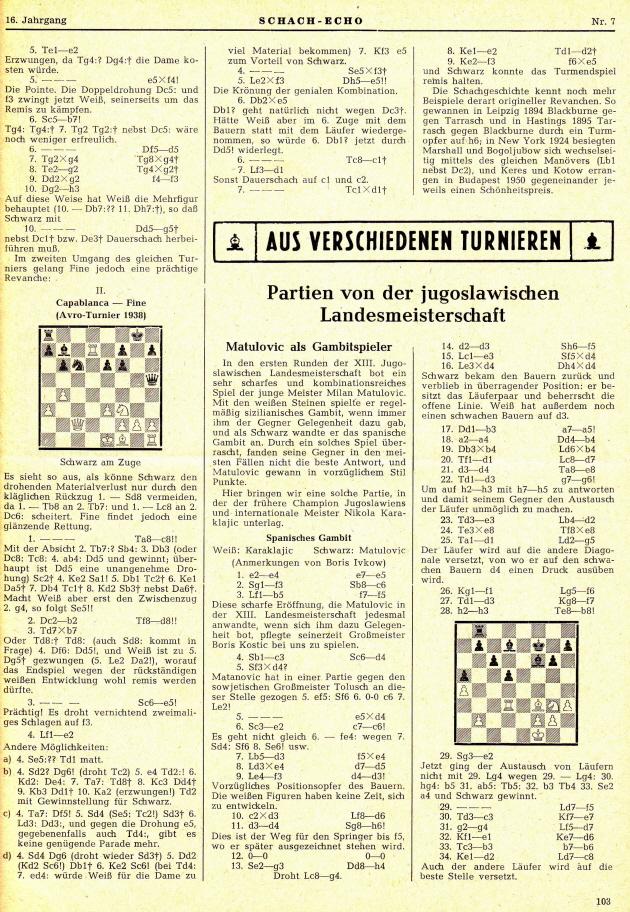
(8648)
Alan McGowan ties up a loose end by providing the conclusion of a column by Paul Schlensker on pages 114-115 of Schach-Echo, 20 April 1958:
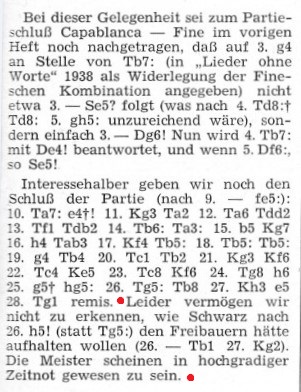
Thus Wolfgang Heidenfeld was correct to state on page 8 of Draw! (London, 1982) that Schlensker mentioned in Schach-Echo the possibility of 40 h5 about 20 years after the AVRO tournament, although Heidenfeld did not realize that by that time the move had already been pointed out elsewhere (in the 1951 edition of Teach Yourself Chess by Gerald Abrahams).
A further question now concerns the basis for Schlensker’s reference to time-pressure towards the end of the game.
(9352)
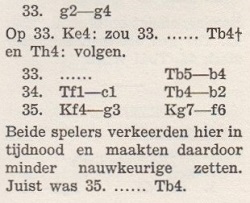
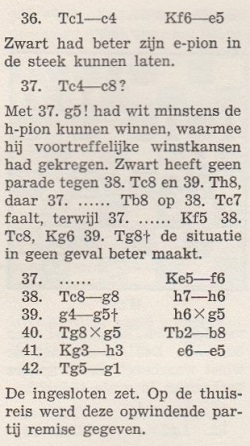
Roger Scowen (Hampton, England) notes that time-pressure was mentioned in the note to Black’s 35th move in Analysen van A.V.R.O.’s wereld-schaak-tournooi by Max Euwe (Amsterdam, 1938). Below is the final part of the game, from pages 102-103:
To the Chess Notes main page.
To the Archives for other feature articles.
Copyright: Edward Winter. All rights reserved.