Edward Winter
René Olthof (Rosmalen, the Netherlands) approvingly draws our attention to the views of Nigel Short in the 2/1986 New in Chess:
‘I always liked Nimzowitsch – until recently. I got this book about Carlsbad 1929, played through all his games and they were really bad! I thought: If this is what he played like, on average, then he wasn’t a very good player. You can take any player in the world and show their best games and make them look brilliant. Nimzowitsch is not as original as people thought he was. Many of his ideas were extensions of earlier ideas of Steinitz. Actually, I’m more impressed with modern players. I’m still stunned by Fischer and more so recently. Look at his results, my goodness! He has been winning tournaments with a hundred per cent score. How is it possible? And when you play through his games they all look so easy! In 1972 he didn’t behave very well, but I liked him.’
In his New in Chess interview Short also has some strong criticisms of chess coverage in English newspapers. Good for him.
(1199)
The 2/1987 issue of New in Chess has an interview by Dirk Jan ten Geuzendam with Ulf Andersson, whose opinions make a contrast with those of Nigel Short quoted in C.N. 1199:
‘Interviewer: Do you admire certain champions of the past, or do you have one special hero?
Andersson: No-one special, no, I somehow like all the world champions. All of them. I would not like to mention anyone specific.
Interviewer: So you are not a special Capablanca fan?
Andersson: No, not like that. I just like to see the old masters play very much. I enjoy this very much, because I believe that the old masters, the champions so to say, had fantastic qualities. My opinion is that the world champion, any world champion, is not stronger than the preceding other world champions. The later world champions are not stronger than Alekhine or Capablanca.
Interviewer: But still the game is developing all the time.
Andersson: No, I don’t think so. The champion of each period is of the same strength. That is just my opinion. Today there are many more players behind the world champion, there is more competition, but that does not change the level of the world champion. There are more players, but that does not mean the level of chess is going up. I believe in the human mind, and it was not inferior in those days.
Interviewer: But there is much more theory today.
Andersson: It does not have to be better because there is a lot. Theory is just theory. I believe it was Alekhine who said “What I play is theory”.
Interviewer: Still one might argue that in the field of opening theory there is a constant process of improving on games that have been played before.
Andersson: Yes, I don’t know. The old masters would not do this, they would play the right move immediately. You know what I mean, they would not make this mistake and find the better move later on. They would make the right move immediately.
Interviewer: But their games weren’t perfect.
Andersson: These were very good games. Of course, they weren’t all perfect, but also today not all games are perfect.
Interviewer: Yet we have this feeling of superiority in the theoretical field and sometimes laugh at the openings of the players of the past.
Andersson: I don’t know. It’s just a matter of taste, which is different today. Maybe the old masters would laugh at the players of today, who knows?’
(1390)
Kasparov’s views on masters of the past are given on page 275 of Mortal Games by Fred Waitzkin (New York, 1993). A suggestion by Fischer that Capablanca was one of the best of all time is described as ‘nonsense’ by Kasparov, who adds:
‘Bobby says that he is not sure he could have beaten Capablanca. Ridiculous. He would have won easily. To compare players from different eras makes no sense. My games against Karpov would not be understood by the great players of the nineteenth century. If you took someone like Ljubojević, who will finish near the bottom in Linares, and put him back into the twenties, Capablanca’s time, he would have been world champion without a question. The only way to judge the old players is relative to the other players of their period. Fischer was far ahead of the other players of his day. By this measure, I consider him the greatest world champion.’
In The Times of 5 October 1993 (page 11) Kasparov said, ‘If you compare our games [in the Kasparov v Short match] with previous title matches, you will find mistakes in all of them’. This prompts us to suggest one method of comparing players of different eras: their frequency of error in top-level matches. After Capablanca took the world title from Lasker in Havana in 1921 without losing a game, he asserted (BCM, October 1922, page 376): ‘The one outstanding feature of the match and the one that most critics overlook is that not once did he [Lasker] have a won game.’ Even today annotators accept that the Cuban’s play in that match was virtually faultless, so why would Ljubojević, or even Kasparov, have been assured of success in the 1920s? Readers’ views are welcomed.
(2006)
From Peter Verboven (Gwatt, Switzerland):
‘C.N. 2006 proposes comparing masters of different epochs by their frequency of error in top-level matches. Because of the rules, all chess games end after a finite number of moves. Every position is thus either a draw, or a win for White or Black. This also applies to the initial position, though nobody knows for sure which of the three it is. Let us define an error as a move that turns a win into a draw, or a draw into a loss; we will define a blunder as a move that turns a win into a loss. If it were possible to point out all errors and blunders in a single game, we could know, by working backwards, whether the initial position is a forced win. Since errors cannot currently be counted, they cannot constitute a measure of comparison. The strength of a player depends as much on his ability to induce error as on his skill in avoiding error.’
(2057)
In discussions of that hoary question ‘Who is the greatest player of all time?’ assumptions tend to be made about the historical progression of playing strength which are by no means favourable to the old-timers. The view that chess is forever moving forward forces the conclusion that Morphy would have plenty to learn from the moderns, and one thus reads condescending speculation about how the American would fare today if he was generously granted six months or a year to ‘absorb all the new chess knowledge’ that has come into being since his time. His inferiority is further demonstrated by those deceptive ‘historical ratings’ and other mathematical sideshows. They have much to answer for, since it is only in the small print that we learn that if an Elo rating of, say, 2500 is a) earned by a modern player and b) dumped on a dead master that does not mean that the two are of comparable strength. The late Professor Arpad Elo confirmed this in a letter to us dated 18 November 1988.
With recourse to reason and logic, can a case be constructed for actually believing that some of the oldsters would be capable of unhorsing today’s leading exponents without any additional schooling? Objectivity is certainly needed here too, for the glamour attached to such names as Anderssen and Spielmann may misdirect a commentator who is by temperament a laudator temporis acti. In many respects the overall level of chess play, in terms of quantity and quality, has progressed immeasurably in recent decades, but it is noticeable that however large the mass of ordinary club players and ordinary masters the number of outstanding exponents at any one time remains relatively small. It is with that élite that we are concerned here. It can be argued that almost every chess title, including that of world champion, has been cheapened in recent years. ‘Grandmasters’ are so plentiful that it is quaint to recall how, even in 1953, their proliferation was being criticized. In that year’s May issue of Chess Review (page 129) a correspondent, W.N. Wilson, complained about the ‘loose use of the term’, and the magazine agreed that ‘there is something in Mr Wilson’s contention that there ought to be a distinctive title for those who tower head and shoulders above all others in their generation. With a couple of dozen grandmasters around now, we ought to have a grade designated between the bulk of these and the world champion’.
Chess literature too has developed. Analysis and annotations are often more thorough than in former times, even if the accompanying prose would have some of the old stylists quavering in disbelief. In writing a book about Morphy, P.W. Sergeant could give queen odds to Chris Ward. Even so, it may charily be suggested that only one post-War world champion, Tal, has been a truly brilliant writer, whereas two earlier champions deserve that accolade, Steinitz and Alekhine.
Nor can the superiority of the old-timers necessarily be deduced from the fact that in some areas, such as blindfold chess, they were more skilled. Although it can be retorted that the ability to play sans voir is no measure of world-beating chess skill, it remains inconveniently true that a forgotten nineteenth-century player such as Alexander Fritz (1857-1932) could play 12 blindfold games simultaneously, a feat undoubtedly beyond nearly every master in the world today. A report of Fritz’s exploits appeared on page 172 of the June 1880 Deutsche Schachzeitung and, as an interlude, we may examine one of his games, also forgotten, from a four-board blindfold exhibition. The opposition is not strong, but if the game had been played, even with sight of the board, by a prominent master of today it would be a likely candidate for the anthologies.
Alexander Fritz (blindfold) – Adolf Hensel1 e4 c5 2 d4 d6 3 Nf3 Nf6 4 Nc3 cxd4 5 Nxd4 e5 6 Bb5+ Bd7 7 Nf5 Nc6 8 Nxd6+ Bxd6 9 Qxd6 a6 10 Bg5 h6
11 Nd5 Rc8 12 Bxf6 Qa5+ 13 c3 Qxb5 14 O-O-O Be6 15 Nc7+ Rxc7 16 Qd8+ Nxd8 17 Rxd8 mate.
Source: Deutsche Schachzeitung, October-November 1879, pages 336-337.
A key issue in comparing old masters with new is the extent of advances in chess knowledge and the implications thereof. That more or less continuous progress was made throughout the nineteenth century and into the first three decades of the twentieth century it would seem churlish to dispute. Both Anderssen and Morphy had great positional skill in addition to their better-known tactical expertise, but knowledge of the openings, middle-game and endgame developed enormously between 1880 and 1930, as did the understanding of attacking and defensive technique and, even the importance of chess psychology. But by the end of the 1920s, the dust was settling on the Hypermodern Revolution, leaving a balance between the ‘Classical’ and ‘Hypermodern’ schools that has continued, with considerable stability, to this day.
There has, to be sure, been an explosion of interest in – not to say obsession with – the openings, but of itself the level of activity means little. If Anand were to sit down today against Schlechter would he necessarily be at an advantage? Supposing that he opened 1 d4 and that after 1…Nf6 2 c4 Schlechter essayed 2…e5. The Budapest Defence is an opening on which Schlechter, not Anand, has written a monograph. We are often reminded, but still oftener forget, that opening theory is not an inexorable march forward. Lines, variations, sub-variations and entire openings come into and go out of fashion, by chance and whim. It is often claimed that the Danish Gambit (1 e4 e5 2 d4 exd4 3 c3 was dealt a near-lethal blow by 3…dxc3 4 Bc4 cxb2 5 Bxb2 d5 6 Bxd5 Nf6 7 Bxf7+ Kxf7 8 Qxd8 Bb4+. In reality, few openings are ever truly refuted and, even when they are, ignorance about the circumstances persists. Countless books ascribe the above Danish Gambit ‘refutation’ to Schlechter, whose magazine, Deutsche Schachzeitung, gave the line on page 80 of its March 1914 issue. Annotating Marshall v Důras, third match game, 1913, which featured ‘5…Nf6?’, Andrew Soltis wrote on page 216 of Frank Marshall United States Chess Champion (Jefferson, 1994): ‘Schlechter had not yet introduced the defense (5…d5! 6 Bxd5 Nf6) that would permanently retire the Danish Gambit’. In reality, Marshall himself, annotating that same game, had already written that 5…d5 6 Bxd5 Nf6 7 Bxf7+ Kxf7 8 Qxd8 Bb4+ 9 Qd2 Bxd2+ 10 Nxd2 Re8 ‘would make things rather interesting’ (see page 247 of the November 1913 American Chess Bulletin). Moreover, the move 5…d5 (answered by 6 exd5) had also been seen in E. Macdonald v R. Lean, Brighton, 29 January 1906 (see BCM, March 1906, page 128). Ignorance reigns, and one may wonder whether even Ponziani’s Opening may not make a comeback. ‘Chess knowledge’ includes reams of analysis of 1 e4 e5 2 Nf3 Nc6 3 c3, but who today is familiar with any of it?
Regarding the middlegame, it may also be asked what precisely has been learned for certain since around 1930. How many people today attack better than Alekhine (or even Anderssen) and defend better than Capablanca (or even Steinitz)? Are there fewer blunders today? As regards subtle strategy, are masters any closer to perfecting the proper technique for playing against hanging pawns or for switching an attack from one side of the board to the other?
With respect to endgame theory, the most scientific phase of the game, substantial advances have been made, not least because of computer technology. But if far more is known does that necessarily mean that today’s masters are the superior endgame technicians? As we saw with openings, there is a vast difference between chess knowledge and what individual chessmasters, even the best, know. Chess knowledge is the corporate body of all discoveries, but no individual human brain has assimilated it all. Endgame theorists such as Averbakh and Rey Ardid have published multi-volume series on the various endings, but not even they would have committed to memory the entire content of their books, to the extent that it would unfailingly be at their fingertips in an over-the-board encounter. That can be done only by computers.
It is self-evident that all chessplayers start from scratch in their acquisition of whatever chess knowledge they eventually take on board. What counts is the level of talent and of application. The heritage is not automatically self-promoting. These nebulous imponderables come into sharper focus if we consider the domain of endgame composition. Asked who were the greatest ever endgame composers, most people would be likely to say Rinck, Troitzky and Kasparyan, all figures from the past. No inexorable progression there.
Do even today’s masters believe in their own superiority? Interviews indicate a mixture of views, but very few masters venture to claim that the ten strongest players of all time are all alive today. Personal ‘top ten’ lists almost invariably include a profuse sprinkling of old names, such as Capablanca. One can understand why he appears on almost everybody’s list: innumerable games were played by him in perfect style as far as anyone has been able to judge either then or now. Events such as his 1921 world championship match against Lasker and the New York, 1927 tournament were won by him without a single defeat. Indeed, in those two events, in which he played a total of 34 games against Lasker, Alekhine, Nimzowitsch, Vidmar, Spielmann and Marshall, it is difficult to find any game in which he even had a truly inferior position.
The above article originally appeared at the Chess Café in October 1997.
See too C.N. 2276.
C.N. 761 quoted a remark by Sir George Thomas on page 242 of the September 1951 BCM:
‘... It is my firm conviction that either Lasker or Capablanca at his best, and with no more modern equipment than he possessed at that time, could have given the odds of the latest technique to any player of today.’
(7128)
On pages 201-202 of the April 1974 CHESS Irving Chernev contributed an article, ‘Who were the greatest?’, which concluded:
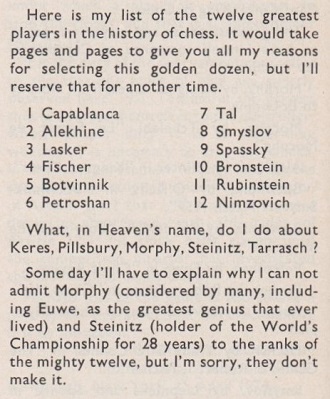
Chernev adhered to the same list in his book The Golden Dozen (Oxford, 1976) but did not explain the omissions. His CHESS article was prompted by a poll conducted a few years earlier by William D. Rubinstein, whose report, ‘Who are, or were, the Greatest?’, was published on pages 75-76 of CHESS, 5 November 1970. Chernev was one of many prominent contributors, and in the 1980s Rubinstein sent us copies of all the correspondence. He has now given us permission to reproduce some of the material here.
In a letter to Rubinstein dated 28 April 1970 Chernev mentioned that his opinions were subject to change but that his current listing was:
‘1 Capablanca; 2 Alekhine; 3 Lasker; 4 Botvinnik; 5 Petrosian; 6 Tal; 7 Fischer; 8 Spassky; 9 Smyslov; 10 Keres; 11 Bronstein; 12 Rubinstein. Pinch hitters: Pillsbury, Tarrasch, Nimzowitsch.’
A late contributor to the poll was Larsen, who replied on 17 November 1970 from Palma de Mallorca. The full letter is reproduced below verbatim:
‘Dear Mr Rubinstein,
If “best” means: “of greatest practical playing strength” my answer is, that the twelve “best” are probably all alive to-day. I know that in an interview, which as far as I remember was also published in Chess Life, I mentioned Alekhine among the ten best, but at second thought I would put Alekhine lower than number 12 on the list. His most brilliant successes were against much weaker opposition than in a good grandmaster tournament to-day.
Of course, when I mention Botvinnik, Keres, Smyslov, Tal and Bronstein, my thoughts go back ten years or more. Then add Petrosyan, Korchnoj and Spassky, these eight russians belong to the list of twelve, in my opinion. So do Fischer and I. The last two I would have to find between Gligoric, Reshevsky, Fine, Najdorf, Portisch and Hort, probably the first two.
To enumerate the ten or twelve is a little difficult, I am not a neutral observer. I would rank Botvinnik higher than Keres, that is about the only thing I can say.
With best regards.
Bent Larsen.’
In an article ‘I Was There’ by Dimitrije Bjelica on pages 49-50 of the February 1968 Chess Life the following exchanges with Larsen were reported:
‘Q: “Who are the best players in chess history?”
A: “The best was Philidor, because he was ahead of the others. Then Morphy, Steinitz, Lasker, Nimzowitsch, Alekhine, Botvinnik ... these are the best.”
Q: “But you have forgotten Capablanca?”
A: “No, I did not forget him. I think he did not give to chess what he could.”
Q: “Who are the most genial [sic] players of all time?”
A: “Philidor, Steinitz, Nimzowitsch.”
Q: “Do you think that Bobby will be world champion?”
A: “He won’t be, because he is too afraid to lose a game.”’
The concluding exchange in ‘Larsen Interviewed’ by Dimitrije Bjelica on pages 283-284 of the May 1970 Chess Life & Review:
‘“And who are the best players in history?”
“Philidor, Steinitz, Lasker, Alekhine, Botvinnik, Tal, Fischer, Petrosian, Spassky and Larsen.”’
See too Larsen’s remarks (e.g. ‘If I were put back in the early 1920s, it would be easy, very easy to be world champion’) in his January 1973 discussion with C.H.O’D. Alexander, as quoted in Bent Larsen (1935-2010).
Larsen’s view of his own position among the greatest players was referred to by David Hooper in a letter dated 28 March 1971 which was published under the title ‘Are the moderns so wonderful?’ on pages 250-251 of CHESS, 13 April 1971. Below is an abridged version (without the diagrams and moves of the games cited, which are all familiar):
‘Does the standard of play improve all the time? The following positions may interest your readers:
In 1916 Janowsky won a brilliancy prize against Chajes. ... An identical position arose 15 years later when Mikėnas playing against Kashdan took a perpetual check.
In 1906 Chigorin (aged 56, and past his best) played 27 R-B7 [against Rubinstein] and his opponent resigned. Forty years later ... Smyslov (soon to be champion) took a perpetual check [against Lundin].
In 1886 Zukertort defeated Steinitz (world champion) with a crushing attack ... Thirty-eight years later Alekhine (soon to be challenger) drew against Capablanca (champion). [Hooper was referring to the fifth match-game in the 1886 world championship match, which began 1 d4 d5 2 c4 c6 3 Nc3 Nf6 4 e3 Bf5 5 cxd5 cxd5 6 Qb3 Bc8 7 Nf3 Nc6 8 Ne5, and Alekhine v Capablanca, New York, 1924, which opened 1 d4 d5 2 c4 c6 3 Nc3 Nf6 4 e3 Bf5 5 cxd5 cxd5 6 Qb3 Bc8 7 Nf3 e6 8 Bd3.]
[Taimanov v Larsen]. Black lost after 63...K-K4? instead of 63...R-KR1ch= (Palma de Mallorca, 1970).
It happens I have the scores of about 900 games played by Capablanca. I cannot find one in which he lost a drawn rook and pawn endgame. For a brief moment I thought: was it possible that he played the endgame better than Larsen? But no! Capablanca, of course, only played against Lasker, Rubinstein, Alekhine and other second-raters.’
To pursue the topic of the greatest players past and present, information is sought, in particular, on other occasions when Larsen gave his views.
Further to Larsen’s controversial inclusion of himself on the ‘best’ list, we note Max Euwe’s reply to William D. Rubinstein:
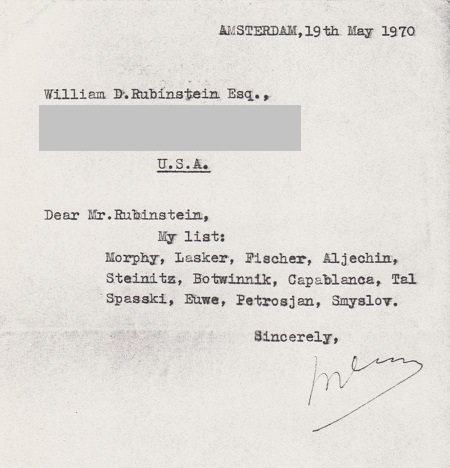
(9275)
A passage by C.H.O’D. Alexander on pages 21-22 of Chess Treasury of the Air by Terence Tiller (Harmondsworth, 1966):
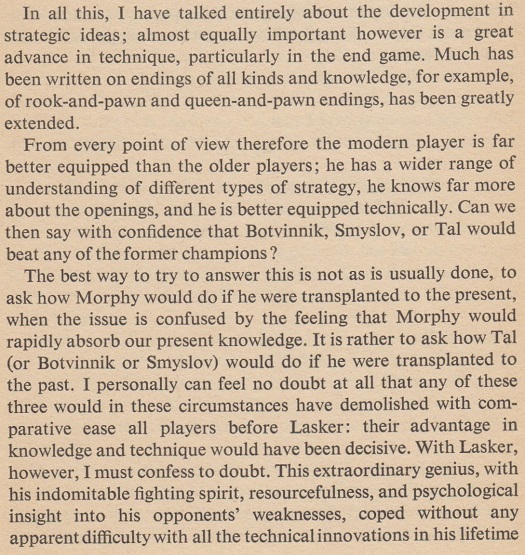
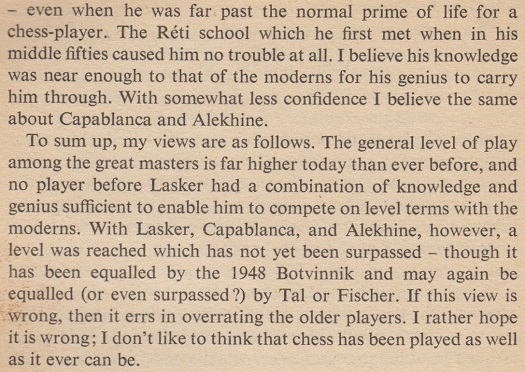
Another addition comes from a report by Miro Radojčić on his conversation with M. Najdorf at the 1968 Olympiad in Lugano. Najdorf asserted:
‘Whether the great ones of the past played better or not is hardly the real question. Nobody could answer that. But what one could say and what is certainly true is that grandmasters from past generations played much more interesting chess than those of today. Theirs were creative minds in complete contrast with the majority of contemporary stars who are rather hard workers and imitators more than anything else.’
Source: Chess Life, January 1969, page 9.
(11258)
To the Chess Notes main page.
To the Archives for other feature articles.
Copyright: Edward Winter. All rights reserved.