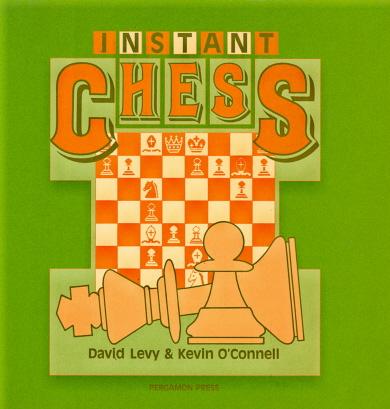
The penultimate page of Instant Chess by David Levy and
Kevin O’Connell (Oxford, 1984) contains the following observation:
‘Many books, to be blunt, are mediocre or downright bad.’
Nobody who has struggled through the preceding 74 pages will be
in any mood to argue.
Pity the poor beginner who tries to pick up the game from this
truly awful work. Vital matters are never mentioned at all: that
White moves first, that the players move alternately, what the
pieces look like ‘in the flesh’, what perpetual check is, what is
scored for a draw, etc. The following list of other complaints is
far from exhaustive.
Page 4: ‘The king may move one square at a time in any
direction – forwards, backwards or sideways.’ What about
diagonally?
Pages 5-9: Some pieces are said to capture exactly as they
move, others ‘almost exactly’. What is the difference? In any
event, is a capture not a move?
Page 7: ‘... the bishop may advance ...’ – as if retreat is
prohibited.
Page 8: In the diagram the possibility Nxg5 is ignored. It is,
moreover, specified that the queen, bishop and rook cannot take
the enemy king, but there is no such comment regarding the
knight.
Page 9: ‘Like all the other chess pieces (except the knights
and kings) the rook can move as far as you wish until it meets
an obstruction.’ All the others? Just bishops and queens.
Page 9: A further use of ‘advance’ in the sense of ‘move’.
Page 12: ‘However, when a pawn is still on its initial square
it enjoys an excellent supply line from the powerful forces
behind it. Under these circumstances it can utilise these good
communications and supplies to rush two squares forwards.’ To
make this link between the pawns’ double advance and the
back-rank forces is an irrelevance which is just asking for
trouble. And so the co-authors have to extricate themselves:
‘This right applies throughout the game, even if the pieces that
were behind a pawn have since moved out into battle.’
Unnecessary complications.
Page 12: ‘Note that a two-square advance cannot be made if the
square immediately in front of the pawn is occupied.’ Why no
mention of the square in front of that?
Page 13: Conditions under which castling is temporarily
illegal; point three is already fully covered by point two.
Page 14: ‘When a pawn reaches the opposite end of the board it
can, indeed must, be promoted to the rank of a piece.’ Fine, but
since the writers have just referred to a pawn which ‘reaches
the far rank’, the quoted sentence is ambiguous and bound to
confuse.
Page 15: More confusion, this time over the difference between
‘man’ and ‘piece’.
Page 16: ‘It is also possible for a piece to attack an empty
square.’ Only very rarely will it not.
Page 23: In notation white pawns are twice promoted to black
queens.
Page 32: ‘It may seem impossible for a king to carry out a
successful fork because it is such an important and valuable
piece.’ Where is the logic in that?
Page 35: Skewers are limited to ‘Queen Skewers’.
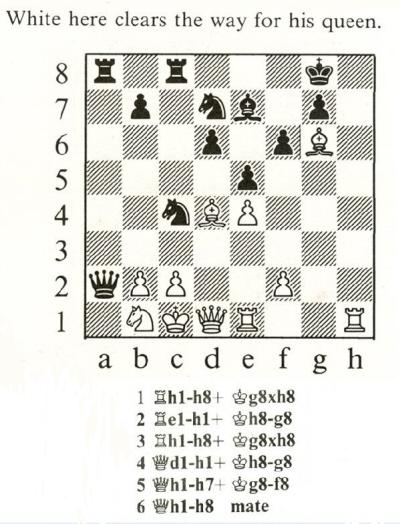
Page 44: The authors overlook the alternative 1 Qxf8+ and mate
next move (diagram position). Also, after 1...Kh8 2 Rxf8 is a
third mating move. Why mention only two out of three?
Page 45: An exclamation mark is awarded to a move without
explaining what this means.
Page 45: In the first sequence of moves there is no mention of
3...Nf5 / 5 h3 mate, etc.
Page 45: No explanation as to why Morphy should have played
the given game without his QR. Nowhere is the reader told
anything about odds games.
Page 46: Second diagram; no note that White can delay the mate
with bishop and queen moves.
Pages 46-47: They overlook the faster mate beginning with 2
Qh5+.
Page 47: (Tartakower game). The unfortunate co-writers wrongly
have Black manoeuvring to play 3...Qc5+, when he could have
obtained the self-same position at once by 1...Qc5+. [C.N. 1357
noted that the same mess (down to virtually identical notes) had
appeared on page 127 of Chernev and Reinfeld’s The Fireside
Book of Chess.]
Page 48: Another snap mate is missed, in the note (8...Qf2+,
rather than 8...Qe3+).
Page 54: ‘Whereas a knight normally has only three possible
development squares (for example, a3, c3 and d2 ) ...’ This
implies that there are cases when a knight may have more from
its starting position.
Page 55: (first sentence) Squares for developing bishops are
listed as though Black did not exist.
Page 58: (first sentence under ‘Rooks’). Again, only White is
thought about.
Page 61: Chigorin’s opponent was Cohn, not Cohen.
Page 63: ‘An isolated pawn is a weakness.’ Far too dogmatic.
Page 64: The white queen on h1 should be a king.
Page 65: The term ‘second player’ is used without explanation.
(Remember, we have never been told that White moves first.)
Page 66: ‘Passed pawn’ is used before it has been defined.
Page 67: ‘Seventh rank’ needs rather more careful use in a
beginners’ book using the algebraic.
Page 68: Pawns cannot be decimated.
Page 69: A feature ‘The Golden Rules of Good Chess’ begins
with ‘The mistakes are all there, waiting to be made.’ A great
help... And was it really Morphy who said ‘Help your pieces so
that they can help you’? Algebraic notation destroys the alleged
Anderssen quote, given as follows: ‘Once get a knight firmly
posted at e6 (White) or e3 (as Black) and you can go to sleep.
Your game will then play itself.’ Normally ‘K5’ is the square in
question.
Page 73: Blitz: ‘Both players’ clocks are set at 5 minutes to
the hour and the first player whose flag falls loses.’ So it is
not possible to lose by being checkmated is the implication.
Page 75: ‘We will recommend some suitable books.’ The ‘some’
turns out to be two.
Page 76: The book concludes with an unacceptably dismissive
attitude to chess problems: ‘The position will usually be an
artificial one, in which the winning side has an enormous
material advantage, and so if you had that position in one of
your games you would not worry about finding a mate in two
moves, you would just win! Problems of this type are of no real
value to the aspiring player, and will not help you to improve
your game.’ Note the insistent tautology of that final sentence.
Observe also how the reference to not worrying about finding the
fastest mate contradicts one of those precious ‘Golden Rules’
quoted just a few pages previously: ‘If you have a good move,
look if there not be a better one – Rowbotham.’
It is scarcely credible that two prominent chess writers could
dare place before the public such a pathetic book. How did they
manage to take Pergamon Press in?
(926)
Our criticisms of Instant Chess (C.N. 926) have met with
a certain amount of resistance from Pergamon Press, and we have
suggested that if doubt exists they should be submitted to a
third-party expert of the company’s own choice. There has not been
any reaction to that, just as none of the specific criticisms we
made has been contradicted by Pergamon or anyone else. The Press’s
main reason for querying our misgivings is that other writers have
not given Instant Chess poor reviews.
(1034)
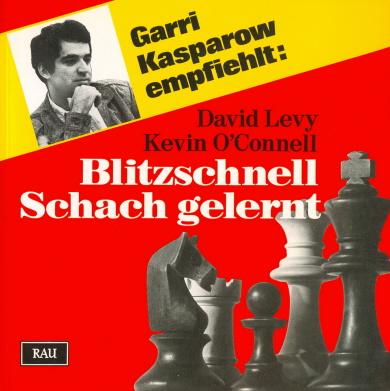
C.N. 1559 described Instant Chess as ‘one of the least
impressive beginners’ books ever published’ and noted that a
German edition had just been published by Walter Rau Verlag under
the title Blitzschnell Schach gelernt – and with a
flamboyant strip on the front cover proclaiming ‘Recommended by
Garry Kasparov’.