Edward Winter
(2003, with updates)
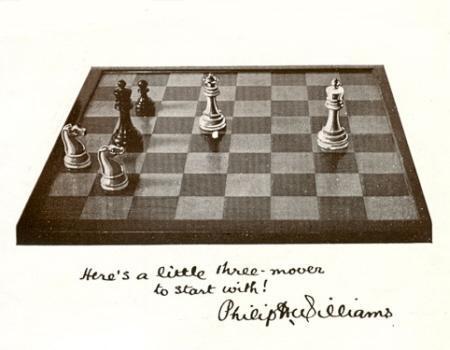
The above illustration of a problem by Philip Hamilton Williams is from his highly entertaining book Chess Chatter & Chaff (Stroud, 1909). In his 1903 work The Modern Chess Problem (page 182) the white king was on h4. The composition (dedicated to B.G. Laws) had been published on page 271 of the June 1901 BCM, but with the white king on f4 (which, rather curiously, allows other mates).
Our article on Esperanto quoted a number of passages from Williams’ writings, and we wonder whether any figure in chess history has received such eulogistic obituaries as those accorded to him in 1922, following his death at the age of 48. The praise of his brilliance and personal qualities went far beyond the customary panegyrics, and the word ‘genius’ was used frequently. This contrasts starkly with the meagre recognition given to him nowadays, although that may change with the reprinting by Moravian Chess of the Chess Amateur, where he wrote a discursive problem column unlike any other before or since.
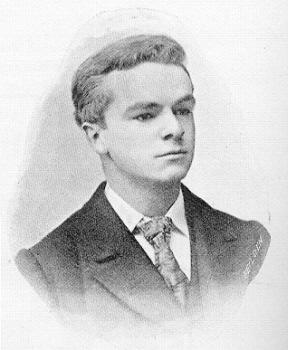
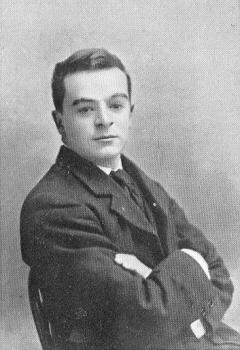
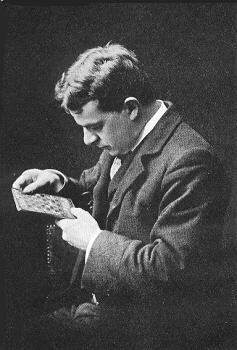
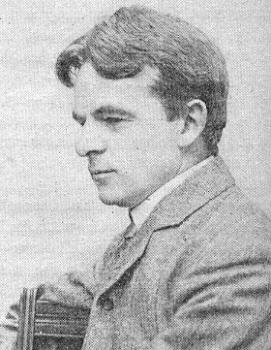
Philip Hamilton Williams: The Chess Bouquet, page 68; The Modern Chess Problem (first and third editions); American Chess Bulletin, March 1910, page 60
The BCM (October 1922 issue, pages 375-376) reported that on the morning of Thursday 14 September 1922 Williams was found dead in bed:
‘Only on Monday last he delivered a lecture on “Chess Psychology” at the newly-formed Royal Mint Chess Club, and those who listened to his entertaining remarks on that occasion will feel honoured to be the last to have heard one of the most entertaining and genial chess enthusiasts they are ever likely to meet.
… As one who had known him almost from boyhood I may say that I have never met anyone who was so invariably genial and humorous, and his humour never had anything rancorous in it. I should imagine that he was absolutely without an enemy. His genius showed itself in many ways. Professionally he was a Chartered Accountant. Like his mother, he was very fond of chess and quite early in his career became a well-known problemist. To his genius in this department our problem editor will no doubt refer.
As a chessplayer, he had not the patience to enjoy match game play, but preferred Kriegspiel, at which he was always the life and soul of the table. To hear his remarks as umpire was always a matter of hilarity, and his good-natured banter never had any sting in it. He was a first-class musician and had composed several cantatas, he was also an excellent accompanist and improvisor, and in addition to this was a first-class amateur photographer, being one of the first to take up colour photography.’
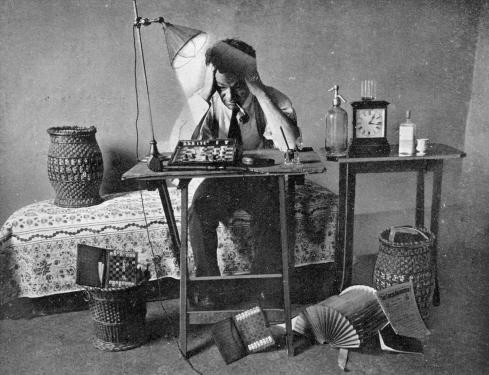
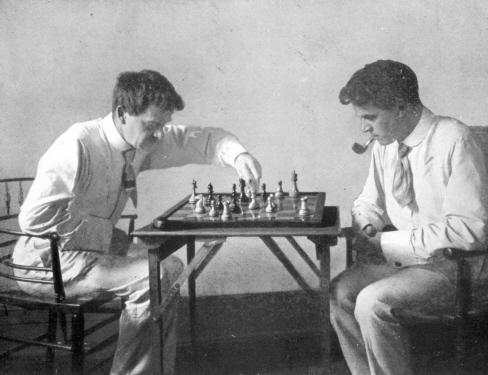
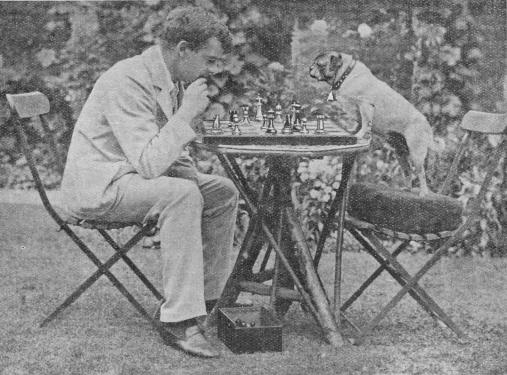
Philip Hamilton Williams: two photographs from Chess Chatter & Chaff and one from page 119 of the Chess Amateur, January 1909
The notice of his death on page 1 of the October 1922 Chess Amateur included the following:
‘He was, as Mr Brian Harley writes, “a genius, and unlike most of that ilk, a thoroughly kind, simple-hearted man”. This describes Mr Williams. We, who knew him during a long sequence of years, who realized the breadth of his versatile genius, the kindliness of his heart, the generosity of his motives, have suffered a grievous loss.’
Pages 10-12 of the same issue had an outstanding tribute to him by Harley. Two brief excerpts follow:
‘Williams’ position in the world of chess problems is a very assured one. In his enormous gallery of over 1,200 published positions, begun at the age of 15, are many masterpieces – usually on a small scale. He rarely attempted big canvases. It was not his métier. Elegance and piquancy are what we expect in a P.H.W. composition. He is par excellence the composer of ideas, often beautiful, often humorous, sometimes both …
We have lost a unique personality – a genius, without egoism, but with the kindest heart in the world.’
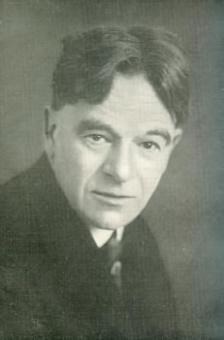
Philip Hamilton Williams: BCM, October 1922
Readers will, we hope, look out for P.H. Williams’ problems and writings. (Various editions of The Modern Chess Problem are not difficult to find.) He was indeed an exceptional figure (already described on page 60 of the March 1910 American Chess Bulletin as ‘England’s chess genius’), and below we give a problem dating from 1904:
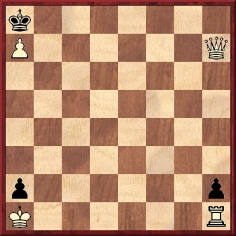
Mate in three
This was one of 42 compositions by Williams which appeared in 777 “Chess Miniatures in Three” by E. Wallis (Scarborough, 1908), a book to which Williams contributed the Preface. On page 245 of Miniature Chess Problems from Many Countries (London, 1981/1982) Colin Russ called it ‘a truly extraordinary miniature’.
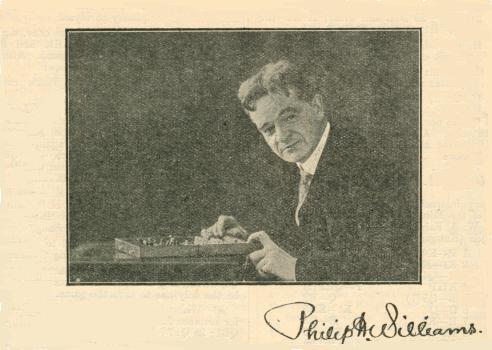
Philip Hamilton Williams: Chess Amateur, October 1922, page 10.
From page 28 of the January 1923 BCM:
‘P.H.W. Reliquiæ Quædam. We have received from Mrs P.H. Williams a collection of about 18 sonnets, etc., written by her late husband, as a Memorial. A few have relation to chess, and it is nice to possess an uncommon memento of a versatile friend.’
P.H.W. Reliquiae Quaedam was also mentioned on page 101 of the January 1923 Chess Amateur, together with a brief poem by Williams (first line: ‘The sweet and mystic shadows of the night’). His widow was named as Mrs Katharine M. Williams.
The game below, from a Hastings v Tunbridge Wells match, was given in C.N. 117, our source being page 476 of the Times Literary Supplement of 4 September 1919:
Philip Hamilton Williams – William Dundas Wight1 e4 e5 2 Nf3 Nc6 3 d4 exd4 4 Nxd4 g6 5 f4 d6 6 Bc4 Bg7 7 Nf3 Be6 8 Qd3 Qd7 9 O-O Bxc4 10 Qxc4 O-O-O 11 Nc3 f6 12 Be3 a6 13 a4 Nh6 14 Nd5 Rde8 15 Bb6 Qe6 16 Bxc7 Qxe4 17 Nd2 Qd4+ 18 Qxd4 Nxd4 19 Nc4 Kd7 20 Bxd6 Nhf5 21 Rfd1 Ne2+ 22 Kh1 Nxd6 23 Ndb6+ Kc7 24 Rxd6 Bf8 25 Rd7+ Kc6 26 c3 Bc5
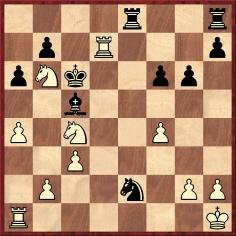
27 Na5+ Kxb6 28 Rxb7+ Kxa5 29 b4+ and mates next move. ‘A brilliant ending’, the Times Literary Supplement commented.
On page 336 of the September 1919 Chess Amateur Williams wrote about the game in a report on his visit to the Hastings Congress:
‘I overheard part of an interview with J.R. Capablanca, who was asked his opinion of problems. As a player, of course, he takes little interest in them, though a remarkably rapid solver. He says that they do not tend to improve one’s power as a player. Now, nobody interviews me, but were I asked my opinion of games, I should say that they do not improve one’s power as a problem composer. Am I not entitled to this view? Capablanca is an awfully nice fellow, and he has a way, I believe, of looking on his game, when Black, thus:
1 P-K4 (a)
(a) This loses.This is a useful attitude as it generally does lose. Yet I am told that it is the best move on the board. He himself plays it, when White, and when he does so, his visualization is thus:
1 P-K4 (a)
(a) This wins.Chess is a wonderful game, isn’t it?
I took a board against Blackburne, losing quite comfortably. I also played in a 33-board match, succeeding in taking away the nasty taste; for I managed to bring off a nice mate – quite after the problemist’s heart. I am bold enough to submit it to the Games Editor, and hope that he will be merciful with the weak play on both sides leading up to a rather saucy finish. The little shower of sparks comes at the end. There are no idle white pieces – thus conforming to the laws of problem construction.
But a strong player will discount the neatness of the mate on account of the weak play which preceded it; a problem composer does not bother about this question, so long as the position as diagrammed is a possible one; that is his postulate. Negatively, a problem which can be reached by reasonably good play ab initio is probably an inferior one.’
The Williams v Wight game was published, without notes, on page 38 of the November 1919 Chess Amateur.
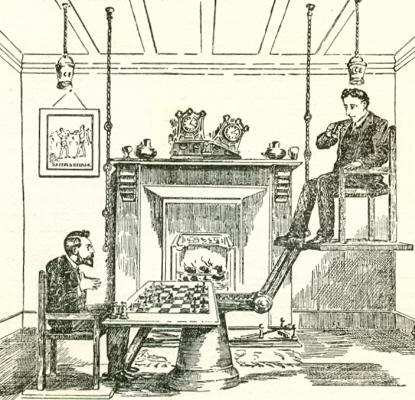
This drawing comes from the book Chess Chatter & Chaff by Philip H. Williams (published by the Chess Amateur, Stroud in 1909). On pages 71-73 he delivered a deadpan presentation of his invention, ‘The Chess See-Saw’:
‘Chess clocks are pivoted. Why not pivot the players also? The inventor submits plans embodying the principle. He is much indebted to Mr F. Orrett, of Manchester, whose capital drawing realizes the idea with great accuracy and spirit. The following technical data will show the method, though the drawing is so clear that readers, by glancing at it, will see-saw for themselves.
The table is supported by a stout iron column bolted into concrete flooring. The combatants are placed at each end of the see-saw, and the board is made to oscillate between them automatically with the movement of the balanced platforms. A player, having made his move, pulls his rope, goes up to the higher position and starts his opponent’s clock. Simultaneously the other platform comes down, and the board glides across in readiness for the descending player to consider his move. The advantages are manifest:
1. The player engaged on his move is not hindered by the smoking, fidgeting, coughing, chuckling, snoring or whistling of his opponent.
2. He cannot interfere with his clock until he has made his move and pulled his rope.
3. Whilst his opponent is “in play” he may rest at his ease in a changed atmosphere and, well out of the way, can recoup his flagging energies without interfering with his adversary.
From his elevated position he can consider the situation with singular clearness. He will be able to watch the top of his opponent’s head; any unusual bulging in the latter will of course indicate the formation of some profound plot, of which he will be thus duly warned.’
(2730)
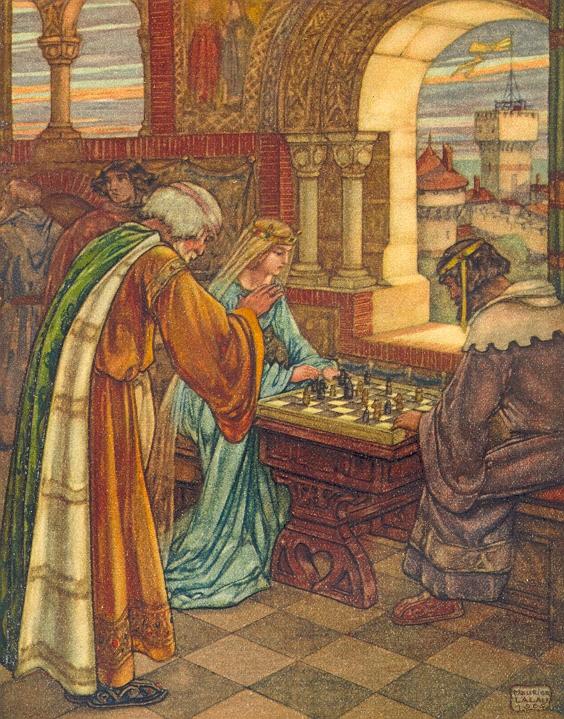
On page 114 of the January 1914 Chess Amateur P.H. Williams wrote about ...
‘... a magnificent book called The Romance of Tristram and Iseult, with superb illustrations in colour by Maurice Lalau. Facing page 174 is a beautiful picture called “King Mark and Iseult the Fair were seated at chess”.’
Williams pointed out that the board was 7x7, with a white square in each corner. Since we have the book in our collection, the picture is reproduced here:
(2943)
Philip Hamilton Williams – Hammant
Occasion?
Centre Game
1 e4 e5 2 d4 Nc6 3 d5 Nce7 4 c4 d6 5 Be3 h6 6 Nf3 Nf6 7 c5 Ng6 8 Qa4+ Bd7 9 c6 bxc6 10 dxc6 Be6 11 Ba6 Ng4 12 Bb7 Nxe3 13 Bxa8 Nxg2+ 14 Kf1 Bh3 15 Bb7 N6f4 16 Nbd2
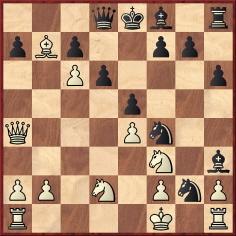
16...Ne3+ 17 Ke1 Neg2+ 18 Kd1 Nd3 19 Qxa7 Be7 20 Kc2 Ngf4 21 Rhg1 O-O 22 Rg3 Be6 23 Ne1 Nxe1+ 24 Rxe1 Bh4 25 Ra3 Nh3 26 Rf1 d5 27 Rd3 d4 28 f3 Bc4 29 Nxc4 Nf4 30 Nxe5 Nxd3 31 Kxd3 Qe7
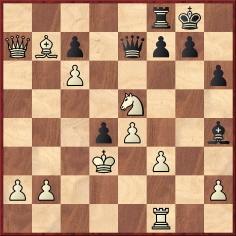
32 Qxd4 Rd8 33 Nd7 Bf6 34 Qf2 Qb4 35 Rb1 Qb5+ 36 Kc2 Qc4+ 37 Kd1 Qd3+ 38 Kc1 Qc4+ 39 Qc2 Bg5+ ‘and wins’.
The game, which contains a number of oversights, was annotated by W.P. Turnbull on pages 74-75 of the Chess Amateur, December 1908. In his problem column in the same issue Williams wrote, on page 89:
‘The “P.E.” [Problem Editor] as a Match Player
Yes, I really did play in a match a short time ago, and I have made so bold as to submit the game to the Games Editor. It is to be found on page 74 of this issue. It will be seen from it that my opponent didn’t care a penny stamp for P.H.W., nor did P.H.W. care one for him – no, not even one with the gum licked off. The result was that we went for each other like a brace of rival Socialist orators in the Park. I was smashed. But the funny thing about it was that I was quite happy until the very last moment, and was just thinking of borrowing the cigarette (with match complete) which I deserved, when I covered a certain check with a pawn, and my jaw fell as it was removed (the pawn, that is) followed by a saucy mate. My man said he was ready for a perpetual even at the penultimate move. All the same, I had great fun; when those two black knights came pottering around, was I frightened? Not a bit of it. I merely dodged round and sailed out on the other side, with the exchange to the good. Oh, it was all so nice. But I was smashed. Do you know why I overlooked the mate? No? Neither do I, but I broached the kegs of rum before the ship went down. The opening was the Jackass gambit with Terra del Fuego variations in F-sharp minor. (See my treatise on the openings, page 2668.)’
(8789)
From John Keeble’s review of Chess Chatter & Chaff by P.H. Williams (Stroud, 1909) on page 48 of the November 1909 Chess Amateur:
‘Mr P.H. Williams has a style that is quite his own. He has been called the “Mark Twain” of the chess world – a compliment well deserved. He has a keen sense of humour, which, by the way, is generally directed against himself, for he introduces himself into most of his writings. If, for instance, we find that anyone in a tale gets a black eye, it is sure to be the author, and so on. Another marked feature of Mr Williams’ literary work is that he is equally at home either with prose or poetry, a thing that can scarcely be said of any other chess writer of the present day.’
Mention was also made of Williams’ skill as a parodist, and below we give, from pages 74-77 of Chess Chatter & Chaff, his mockery of the books of Franklin Knowles Young:
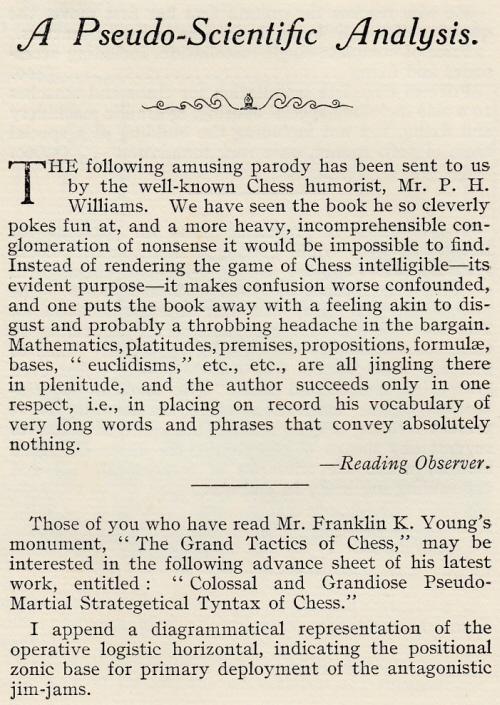
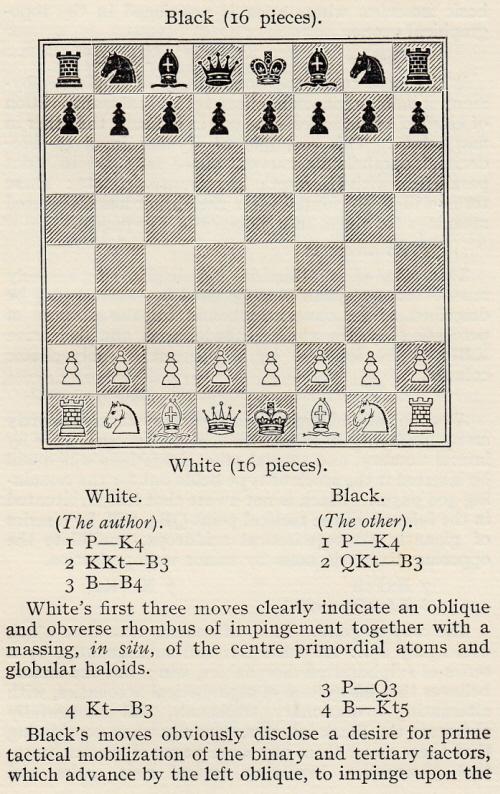
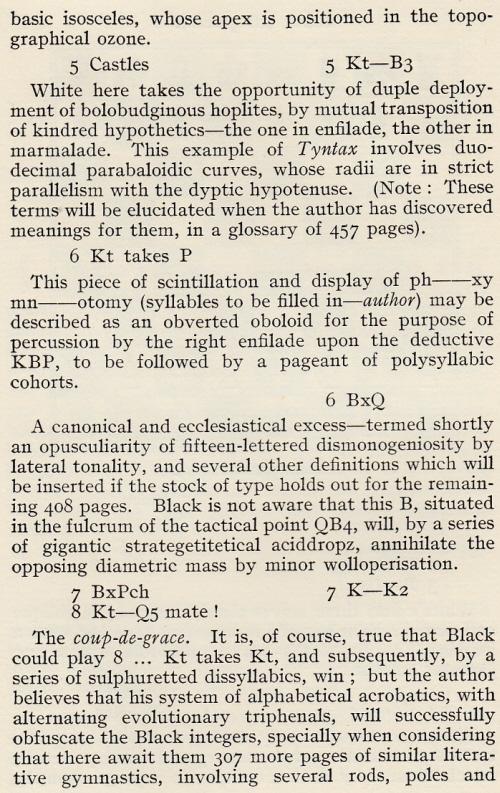
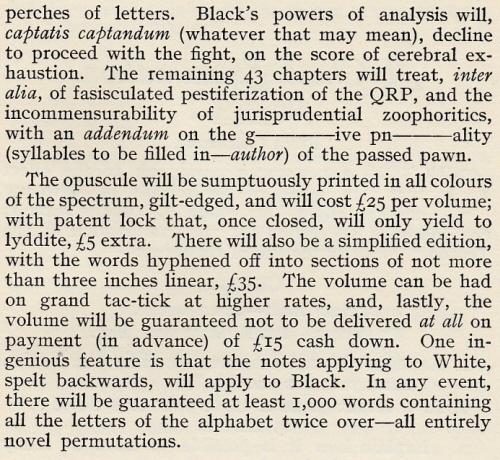
(8790)
‘I know well enough that no amount of argument will make the hardened game enthusiast see anything in problems to interest him. Still it is unfair to sneer at problems simply because you fail to see anything in them. Others do. I have a pet dislike myself – I can’t bear celery, and the fact that ten different people tell me that celery is very nice naturally avails me nothing. But I do not call these ten men names for liking celery.’
Source: Chess Chatter & Chaff by P.H. Williams (Stroud, 1909), page 56.
(8797)
See too C.N.s 9930, 9931 and 9935 for puzzles set by Williams in his Chess Amateur column in 1909.
Williams’ poem Vae Victis! (‘with due apologies to the poet for changes made in the last two stanzas which originally had been intended for readers of the British Chess Magazine only’) was published on page 108 of Chess Review, April 1950 and on pages 227-228 of The Adventure of Chess by Edward Lasker (New York, 1950).
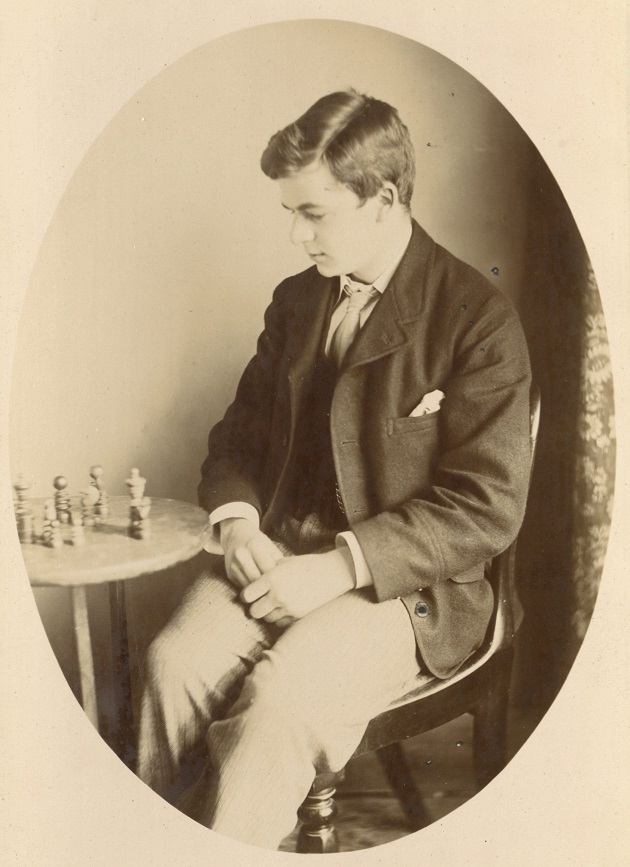
From The Chess Album, August 1894 we show, courtesy of the Cleveland Public Library, this photograph of Philip H. Williams:
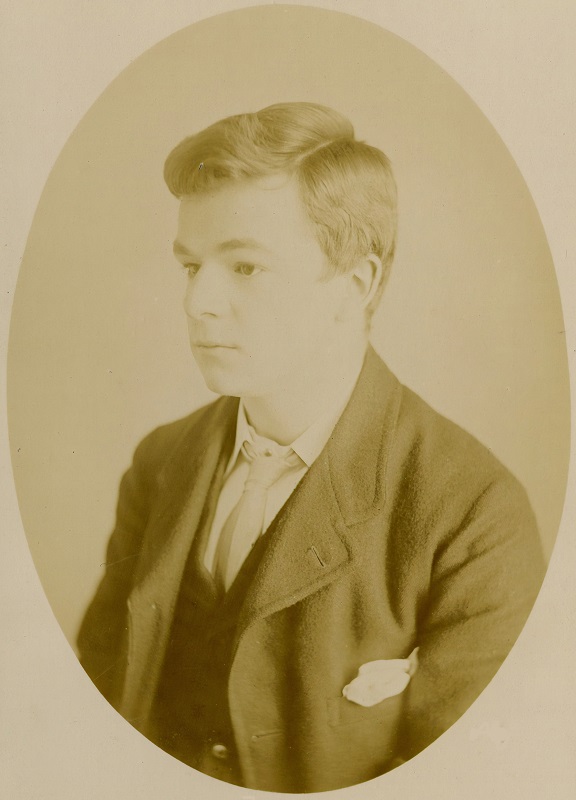
This portrait of P.H. Williams has been forwarded by Olimpiu G. Urcan (Singapore), courtesy of the London Borough of Hackney Archives (photograph reference number D/S/1/3 no.40):
(11554)
From page 244 of 777 “Chess Miniatures in Three” by E. Wallis (Scarborough, 1908):
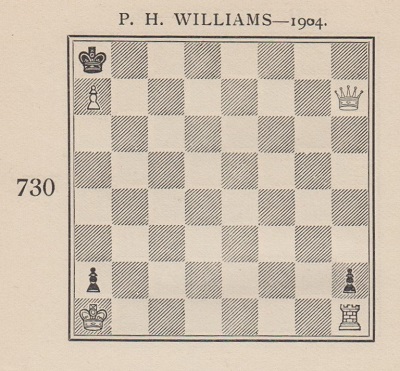
When exactly did this composition (shown earlier in the present article) first appear in print? Problem databases give the source as ‘Christmas Greeting, 1904’, which suggests that it was a personal communication from Williams to colleagues, at least some of whom may be expected to have published it.
An unsuccessful search in the Morning Post has provided, at least, some quotable general remarks by Williams, on page 8 of the 19 December 1904 edition:
‘Regarding the relative merits of slender and ponderous three-movers much may be said. Your readers may notice that my three-movers are always of slight build, and, while I do not claim much difficulty, I do, I believe, secure a fair amount of neatness. When solving the work of others, I put elegance a long way ahead of difficulty. The miniature seems to me the essence of problematic beauty, and though there are, of course, many splendid compositions of heavy build, they do not, as a class, appeal to me. (I speak of three-movers only.) Take, for instance, Loyd’s famous Checkmate prize-winner; the main play is undoubtedly brilliant, but, if the outlying pieces are touched, mating positions will result which are positively hideous, to say nothing of duals. The more ugly the by-play the more is the beauty of the main-play discounted. Not so with a good miniature; play any move of Black, and a beautiful mating position is or should be produced. Duals in a miniature are, to my mind, inexcusable, and I would rather abandon a position than cure a defect by additions, since every added piece seems to weaken the charm of the initial position.’
‘Loyd’s famous Checkmate prize-winner’ (motto: ‘The Steinitz Gambit’) was first published on page 262 of the August 1903 issue of Checkmate:
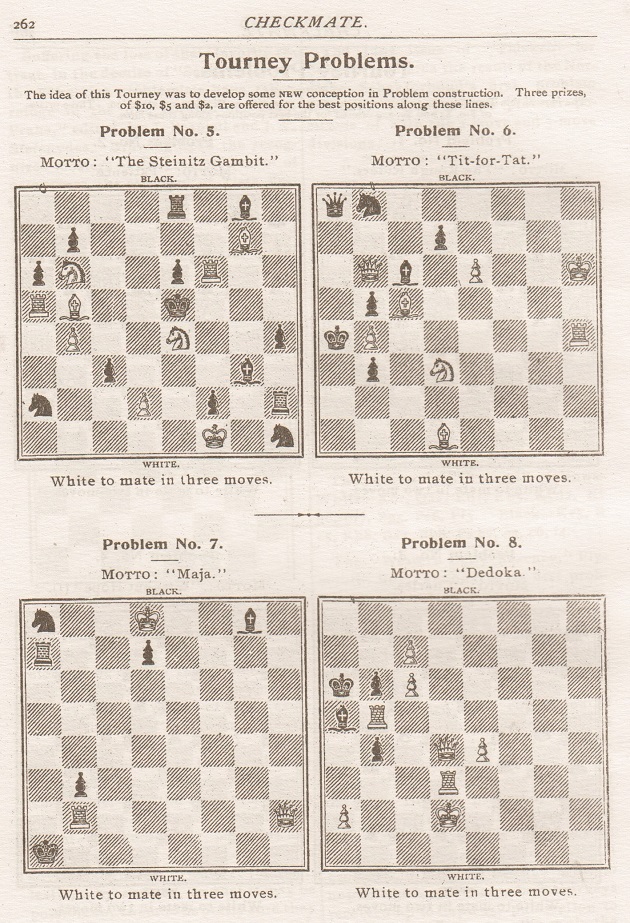
The Canadian magazine announced that Loyd had won first prize ($10) on page 66 of the January 1904 edition.
(11686)
‘I have shown this problem to quick solvers with reputations to guard, and have made enemies of them in consequence of the fact that so simple a position should beat them.’
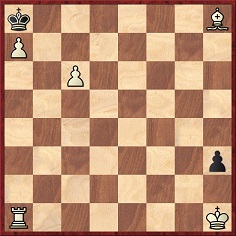
Mate in three
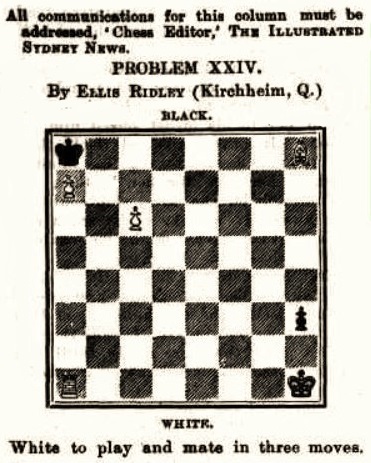
The remark was by P.H. Williams, on pages 76-77 of The Modern Chess Problem (London, 1903). His caption stated ‘Author unknown’, but Michael McDowell (Westcliff-on-sea, England) informs us that the composer and source are in the WinChloe problem database: Ellis Ridley in the Illustrated Sydney News, 25 October 1890.
We add that the newspaper (page 28) stated that Ridley was from ‘Kirchheim, Q[ueensland]’. The place-name was later changed to Haigslea.
To the Chess Notes main page.
To the Archives for other feature articles.
Copyright: Edward Winter. All rights reserved.