Edward Winter
Which is the earliest published game featuring the Caro-Kann Defence?
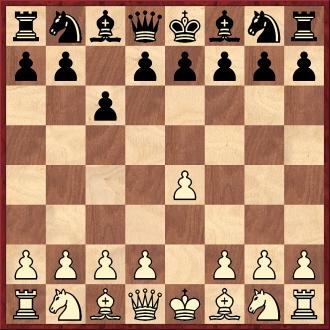
C.N. 42 (see page 260 of Chess Explorations) reported on an 1864 consultation game involving Zukertort (White). We can now say that G.S. Spreckley v A. Mongrédien, Liverpool, 1847 began 1 e4 c6 2 d4 e5 3 dxe5 Qa5+ 4 Nc3 Qxe5 5 Nf3 Qc7 6 Bc4. White won by forcing mate at move 25, and the full score appeared on page 115 of the Chess Player’s Chronicle, 10 April 1847.
A game played in India between Valentine Green and ‘The Brahmin’ opened 1 e4 c6 2 d4 d5 3 Bd3 e6 4 Nf3 Nf6 5 e5 Nfd7 6 c3 c5 and was published on page 111 of Cassell’s Illustrated Family Paper, 16 July 1859.
A slightly earlier game:
N.N. – N.N.1 e4 c6 2 d4 e5 3 dxe5 Qa5+ 4 Nc3 Qxe5 5 Nf3 Qc7 6 e5 Bb4 7 Bc4 Ne7 8 O-O O-O 9 Ne4 h6 10 c3 Ba5 11 Bf4 b5 12 Bb3 Ba6 13 Nd6 b4 14 Nxf7 Kh7 15 N3g5+ ‘and mates by force in a few moves’
Source: Chess Player’s Chronicle, 1845, pages 336-337.
The position after Black’s 5th move also arose in a simultaneous game of Fischer’s against J. Fajkus in Cicero on 20 May 1964. The opening moves were 1 e4 e5 2 Nc3 c6 3 d4 Qc7 4 dxe5 Qxe5 5 Nf3 Qc7. Fischer now played 6 Bd3 and scored a quick win.
The present item focuses on the origins of the name ‘Caro-Kann Defence’.
Max Weiss played 1...c6 four times at Nuremberg, 1883, but the tournament book made no attribution of the move to a particular player or analyst.
On pages 25-26 of the September 1888 Chess Monthly 1...c6 had the following annotation:
‘This move was introduced by the late Herr Kann, of Pest, and adopted in practice by Herr Caro, of Berlin. It gives a safe but dull game.’
The game in question, played in Bradford, was between H.E. Bird and J.H. Blackburne (White) and C. von Bardeleben and M. Weiss. When the score was given on pages 411-412 of the October 1888 BCM there was this note by W.H.K. Pollock:
‘There is nothing to be said against the validity nor anything for the brilliancy of this defence. The Field observes that it was introduced by Herr Kann, of Pesth, and practised by Herr Caro, of Berlin.’
The same material in the BCM was included on pages 78-79 of the Bradford, 1888 tournament book.
On page 271 of the September 1889 International Chess Magazine Steinitz wrote of 1...c6: ‘The late Herr Kann of Vienna introduced this bizarre move into practice among masters.’ A similar remark concerning the same game (Gunsberg v Bauer, Breslau, 1889) appeared on page 289 of the 15 September 1889 issue of La Stratégie: ‘Ce coup est de l’invention de feu M. Kann de Vienne ...’
On page 87 of the March 1891 International Chess Magazine Steinitz made another comment on the origins of 1...c6:
‘This defence was first brought in practice by the late Herr Kann, of Vienna, and afterward analyzed by Herr Caro, of Berlin, who pronounced it a safe line of play for Black.’
The reference books are not always reliable. Page 57 of An
illustrated Dictionary of Chess by Edward R. Brace (London,
1977) claimed that ‘the opening was named after H. Caro of Berlin
and M. Kann of Vienna, both of whom played it in the 1890s’. Kann
died in 1886. (His death was noted in two and a half lines on page
128 of the April 1886 Deutsche Schachzeitung, with no
mention of 1...c6.) The entry on the Caro-Kann Defence in The
Oxford Companion to Chess stated that the recommendations of
both Caro and Kann appeared in Brüderschaft, in 1886,
whereas in reality the games and analysis of Caro alone were
featured in that magazine, with no mention of Kann.
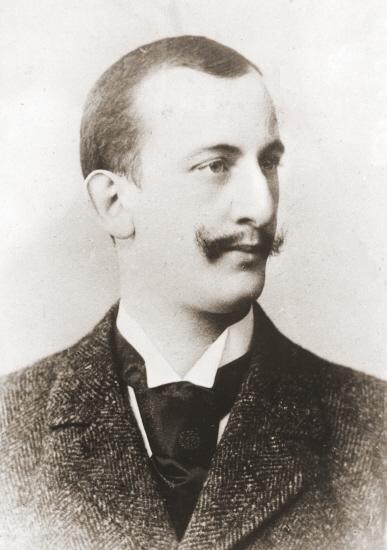
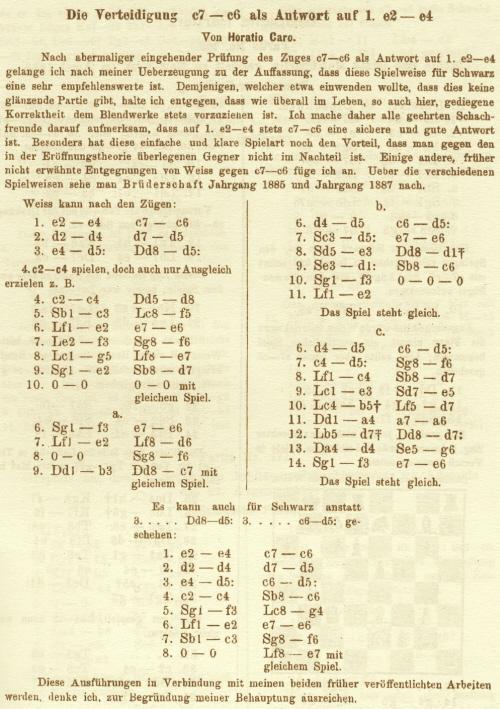
Horatio Caro
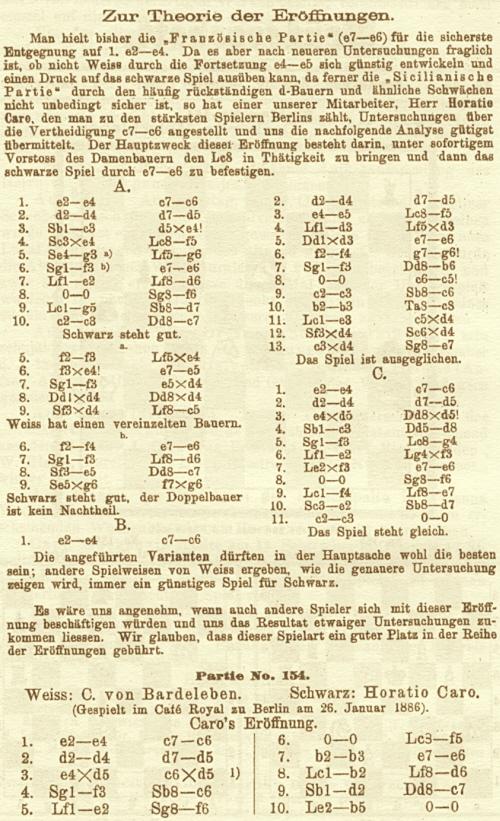
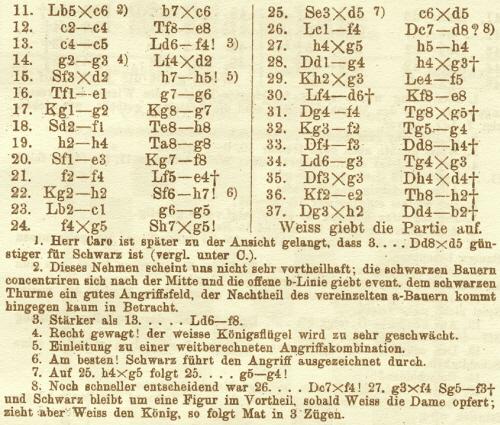
Pages 202-204 of Brüderschaft, 30 October 1886 had material by Caro in ‘Zur Theorie der Eröffnungen’. The first half of the article, reproduced below, discussed 1 e4 c6 and used the term ‘Caro’s Eröffnung’ in a game between von Bardeleben and Caro played in Berlin earlier that year.
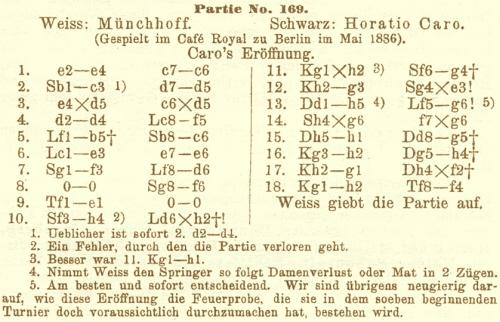
The same heading for the opening appeared on page 219 of the 20 November 1886 issue of the magazine when the game Münchoff v Caro was published:
And from page 222 of the 27 November 1886 issue:
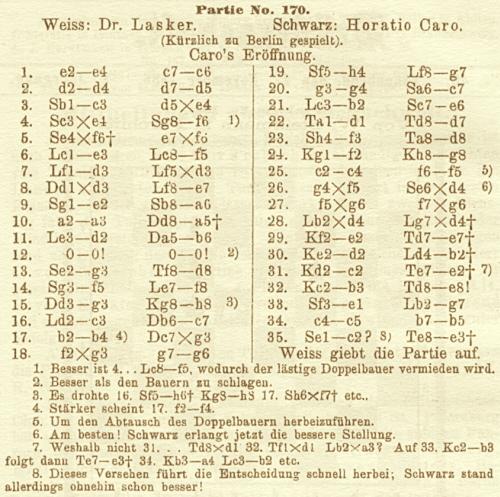
We take ‘Dr Lasker’ to be Berthold Lasker, Emanuel’s elder brother.
In 1887 and 1888 Brüderschaft published a number of games in which Caro played 1...c6 in reply to 1 e4. The heading was invariably ‘Unregelmässige Eröffnung’ (Irregular Opening):
Pages 354-355 of the 22 October 1887 issue had a further article on 1...c6 by Caro:
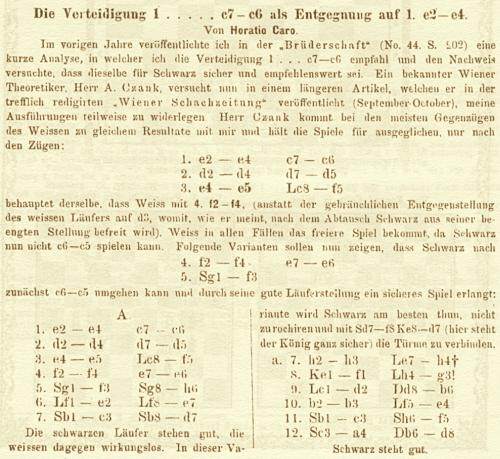
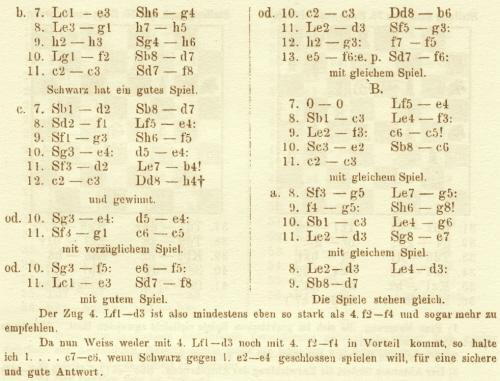
And from page 215 of Brüderschaft, 7 July 1888:
‘Caro-Kann’ as a joint title appeared in an article by Curt von Bardeleben on pages 193-195 of the July 1890 Deutsche Schachzeitung:
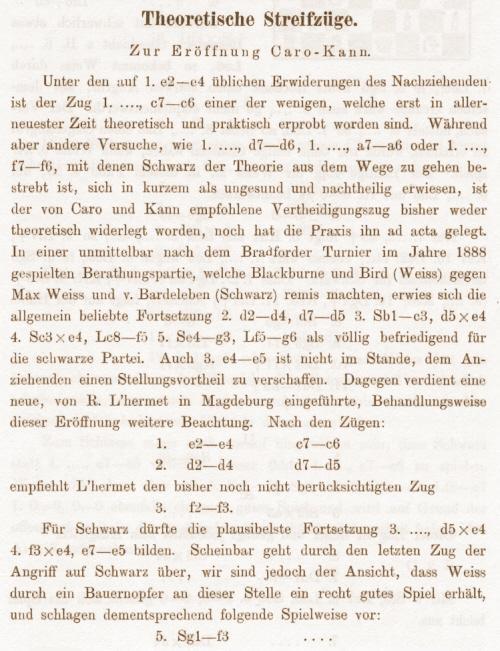
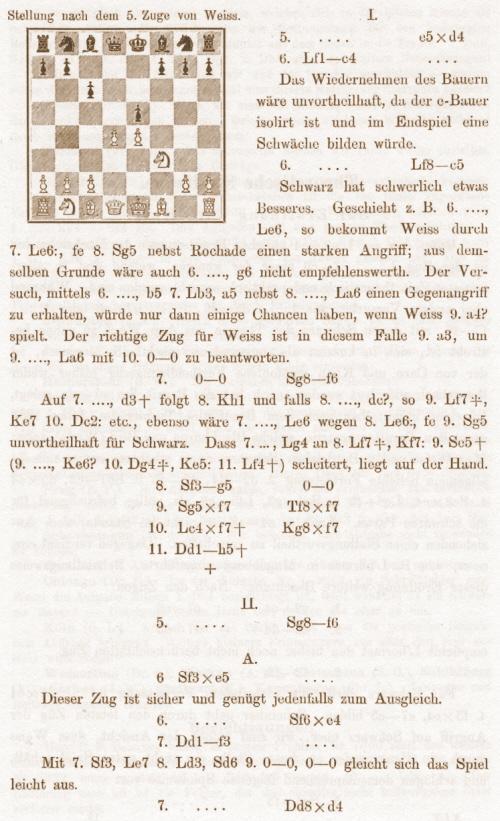
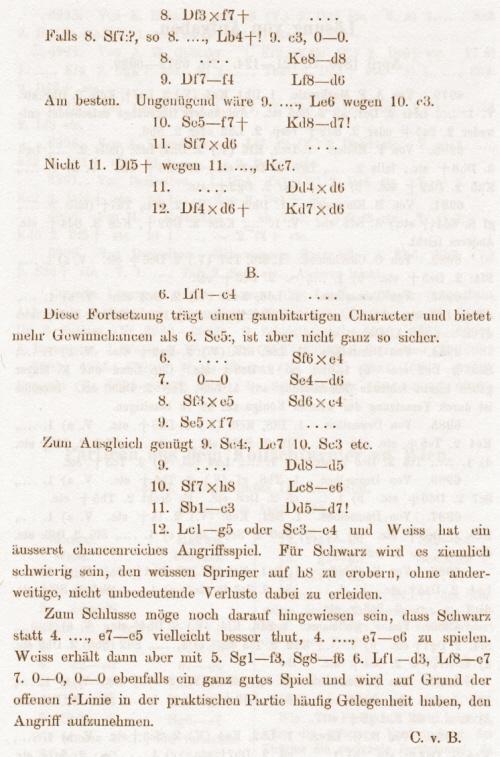
Nonetheless, even in the early years of the twentieth century the term ‘Caro-Kann’ was not always used. For instance, pages 357-358 of La Stratégie, 23 December 1905 gave a cable game between Davidson and Caro. In reply to 1 e4 Caro played 1...c6, but the game was headed ‘Défense Kann’.
What exactly can be demonstrated about Marcus Kann’s contribution to the Caro-Kann Defence?
From Charles Warburton’s My Chess Adventures, page 42:
‘Mr Cairncross replied with the Caro-Kann, an opening which to my mind is uninteresting, sterile, and which permits White altogether too much choice and initiative. It was with something of pleasure, but little surprise, that I learnt of Botvinnik beating Spielmann’s Caro in 11 moves, and Alekhine several times won match games in 12 or 13 moves against it. Typically convincing is the thought of Dr Emanuel Lasker who was known to say “anything is good enough to play once”, but apparently not the Caro-Kann for he never once played it in a match game!’
Where does one start? Botvinnik’s win was in 12 moves; for ‘match’ games (twice) read tournament and/or match; did Alekhine really win ‘several times’?; is the Lasker quote credible?; why the anti-Caro-Kann dogmatism?
(876)
An endnote on page 260 of Chess Explorations:
Alekhine’s (rare) quick wins against the Caro-Kann were discussed in C.N.s 116, 158, 257, 955 and 1118.
C.N. 42 mentioned that the Oxford Encyclopedia of Chess Games, which covered the period 1485-1866, contains only one game with the Caro-Kann Defence: J.H. Zukertort v F. Lehmann and L. Waldstein, Posen, 31 August 1864. It began 1 e4 c6 2 d4 d5 3 e5 f6 4 f4 e6, and White won in 33 moves.
See too the discussion of the Caro-Kann Defence in Book Notes.
Reporting the death in 1992 of Warren H. Goldman, C.N. 1974 referred to his monograph New Ideas in Old Settings, an examination of 1 e4 c6 2 Nc3 d5 3 Qf3, published privately in 1958 and by CHESS, Sutton Coldfield in 1977. See Chess Jottings.
Two more photographs of Caro:
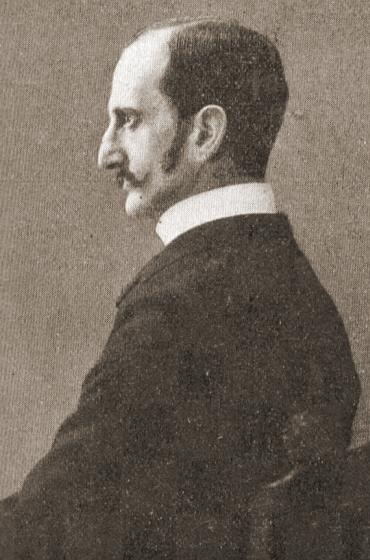
Source: page 443 of the Barmen, 1905 tournament book
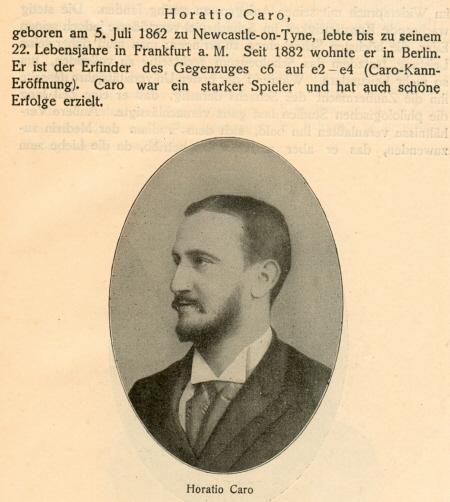
Source: page 353 of the Jubiläums-Ausgabe (1926) of Kagans Neueste Schachnachrichten
Chess Personalia by Jeremy Gaige states that Caro died in London on 15 December 1920. Information about his final years is sought.
Per Skjoldager (Fredericia, Denmark) draws attention to the note to 1...c6 on page 321 of the Carlsbad, 1907 tournament book by Marco and Schlechter:
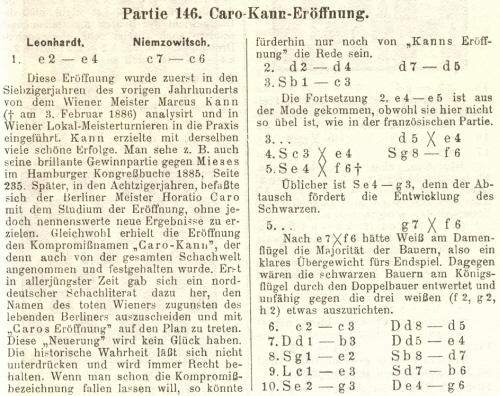
For an English version, by Robert Sherwood, see pages 339-340 of the translation published by Caissa Editions in 2007.
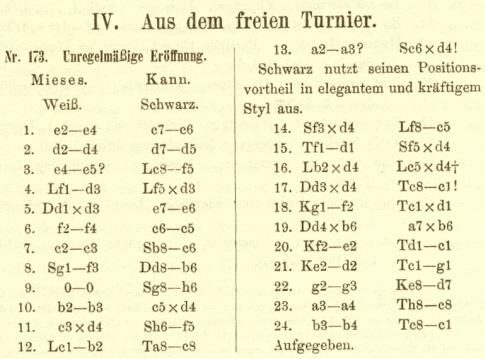
Below is the Mieses v Kann game from page 235 of the Hamburg, 1885 tournament book:
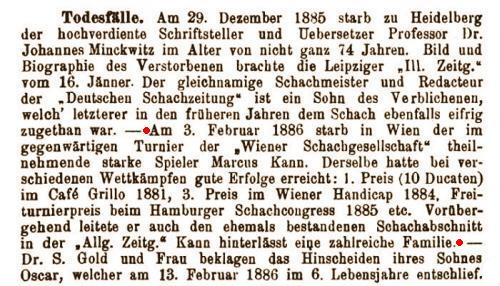
Eduardo Bauzá Mercére (New York, NY, USA) observes that Kann’s obituary on page 81 of Österreichische Lesehalle, March 1886 made no mention of any particular contributions to chess theory:
Mr Bauzá Mercére has also forwarded a game (played in the Turnier der Wiener Schach-Gesellschaft) from pages 74-76 of the May 1881 Österreichische Lesehalle:
Marcus Kann – Alexander Wittek1 Nc3 e5 2 g3 d5 3 e3 Be6 4 d4 exd4 5 Qxd4 Nf6 6 Bd2 Be7 7 h4 Qd7 8 Nf3 c5 9 Qf4 Bd6 10 Qg5 Nc6 11 Qxg7 Ke7 12 e4 Rag8 13 Qh6 Rg6 14 Qe3 d4 15 Qe2 dxc3 16 Bxc3 Nd4 17 Qd3
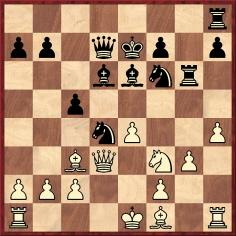
17...Bc4 18 Qd1 Bxf1 19 Kxf1 Ng4 20 Nxd4 cxd4 21 Qxd4 Qb5+ 22 Qd3 Qxd3+ 23 cxd3 Rd8 24 d4 Rf6 25 f4 Bxf4 26 gxf4 Rxf4+ 27 Ke2 Rxe4+ 28 Kf3 f5 29 Rae1 Nf6 30 Rxe4+ fxe4+ 31 Kf4 Rg8 32 Ke5 Re8 33 Rf1 Kf7+ 34 Kd6 Re6+ 35 Kc7 Re7+ 36 Kb8 Ke6 37 Rf4
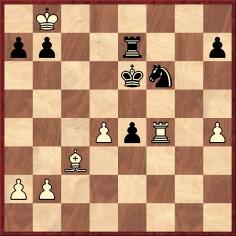
37...e3 38 Kxa7 Rc7 39 Rf1 Nd5 40 Kb8 Rg7 41 Re1 Kf5 42 Ba5 Ke4 43 Bd2 Kxd4 44 Rxe3 Rg8+ 45 White resigns.
Our correspondent adds:
‘Kann’s forename is spelled Markus in the heading to the game, as well as on page 49 of the February 1884 magazine and page 145 of the May 1884 issue.’
On pages 289-290 of Rätsel und Reichtümer der Eröffnung (Leipzig, 1915) Franz Gutmayer reported that he had been acquainted with both Caro and Kann:
‘Ich habe den Kann persönlich gekannt. Er war ein sehr starker Amateur. Im Leben pumpte er gerne die Leute an – im Schachspielen lebte er stolz von eigenen Mitteln. Er hat sich eine eigene Eröffnung kühnlich erfunden: die Kann-Partie. Ich habe auch den Caro kennen gelernt. Ein grüblerischer Geist, der gerne sinnt über Möglichkeiten.’
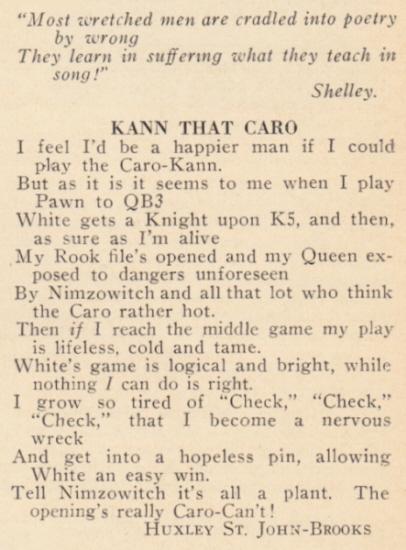
Some comic verse, ‘Kann That Caro’, from page 171 of the November 1932 American Chess Bulletin:
(7439)
Some comments on the Caro-Kann Defence from an interview with Mikhail Botvinnik in the Latvian magazine Šahs as presented by Eliot Hearst on page 135 of the June 1962 Chess Life:
‘This defense limits the possibilities of White. When the defenses P-K4, P-K3 or P-QB4 are employed, White has a much bigger choice of variations than in the case of the Caro-Kann Defense, where Black usually has a very solid position. As a result, in match-play the Caro-Kann is a very efficient weapon, since, in a match, one plays as White to win the game, whereas, as Black, one tries to merely obtain a satisfactory defense. And if, in the last Tal match, White got a slight advantage against this defense, the reason was not because of the opening itself, but because of errors committed later in the game.
... He attempted the move 3 P-K5 against the Caro-Kann, but this variation is not very dangerous, and one cannot prepare only one variation for such a catch. This circumstance naturally offered me the possibility of preparing something new for him each time. This facilitated my work during the games.’
(8399)
Thomas Niessen (Aachen, Germany) draws attention to an article by A. Csánk, ‘Die Vertheidigung 1...c7-c6 als Entgegnung auf 1 e2-e4’, in the Wiener Schachzeitung, 1 September 1887 (pages 49-52) and 1 October 1887 (pages 73-75).
Our correspondent comments:
‘Csánk reports that Marcus Kann, who had died the previous year, was the first to apply the defence, and that Csánk, Ja[c]ques Schwarz and M. Weiss analysed it before Weiss played it at Nuremberg, 1883.’
(8423)
Thomas Niessen has found an earlier specimen of 1...c6 played by M. Kann, on pages 698 and 699 of Allgemeine Sport-Zeitung, 7 August 1884 (A. Csánk v M. Kann, Vienna, 13 February 1884):
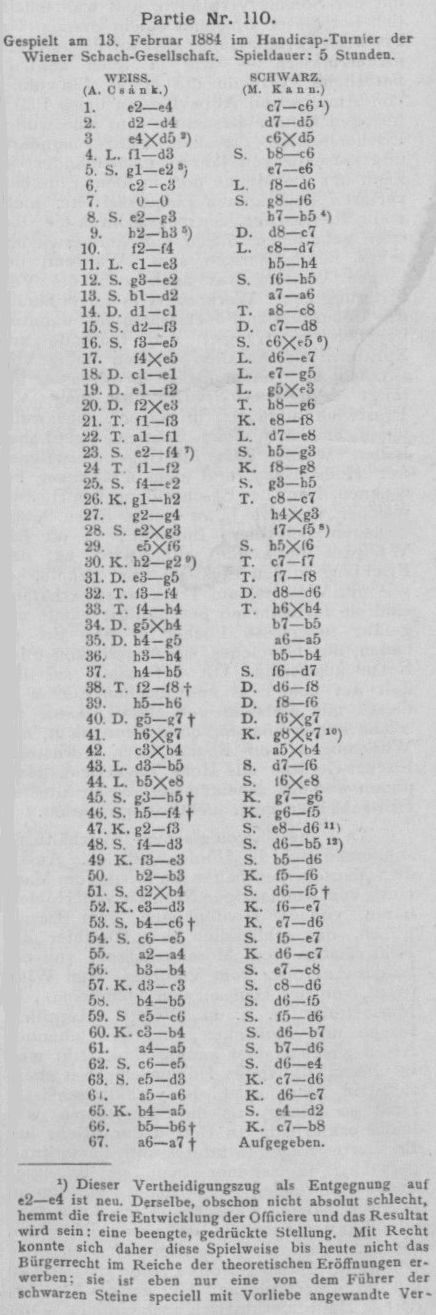
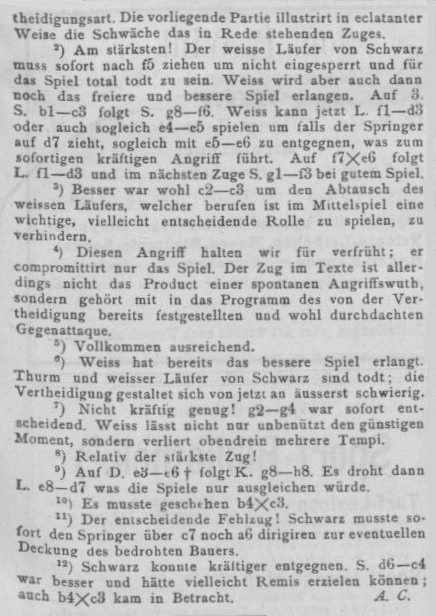
1 e4 c6 2 d4 d5 3 exd5 cxd5 4 Bd3 Nc6 5 Ne2 e6 6 c3 Bd6 7 O-O Nf6 8 Ng3 h5 9 h3 Qc7 10 f4 Bd7 11 Be3 h4 12 Ne2 Nh5 13 Nd2 a6 14 Qc1 Rc8 15 Nf3 Qd8 16 Ne5 Nxe5 17 fxe5 Be7 18 Qe1 Bg5 19 Qf2 Bxe3 20 Qxe3 Rh6 21 Rf3 Kf8 22 Raf1 Be8 23 Nf4 Ng3 24 R1f2 Kg8 25 Ne2 Nh5 26 Kh2 Rc7 27 g4 hxg3+ 28 Nxg3 f5 29 exf6 Nxf6 30 Kg2 Rf7 31 Qg5 Rf8 32 Rf4 Qd6 33 Rh4 Rxh4 34 Qxh4 b5 35 Qg5 a5 36 h4 b4 37 h5 Nd7 38 Rxf8+ Qxf8 39 h6 Qf6 40 Qxg7+ Qxg7 41 hxg7 Kxg7 42 cxb4 axb4 43 Bb5 Nf6 44 Bxe8 Nxe8 45 Nh5+ Kg6 46 Nf4+ Kf5 47 Kf3 Nd6 48 Nd3 Nb5 49 Ke3 Nd6 50 b3 Kf6 51 Nxb4 Nf5+ 52 Kd3 Ke7 53 Nc6+ Kd6 54 Ne5 Ne7 55 a4 Kc7 56 b4 Nc8 57 Kc3 Nd6 58 b5 Nf5 59 Nc6 Nd6 60 Kb4 Nb7 61 a5 Nd6 62 Ne5 Ne4 63 Nd3 Kd6 64 a6 Kc7 65 Ka5 Nd2 66 b6+ Kb8 67 a7+ Resigns.
Our correspondent adds that Kann’s death was reported on page 118 of the 12 February 1886 edition of Allgemeine Sport-Zeitung:
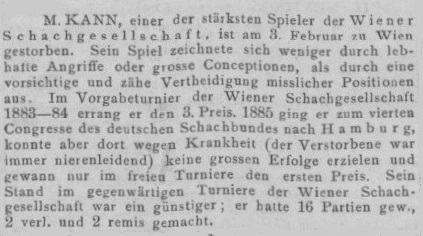
(9431)
From John Townsend (Wokingham, England):
‘Your feature article on the Caro-Kann Defence includes a request for information about Horatio Caro’s final years, and I can provide some information on his last two and a half months. The admission and discharge register, 1919-1921, of the South Grove Institution, Mile End Road, London, a workhouse, includes the following entry for an admission:
“Date: Friday 1 October 1920
Name: Caro Horatio
Calling, if any: Laborer [sic] (Casl.)
Religious Persuasion: Hebrew
When Born: 1863
Infirm Adults: 1
Parish from which Admitted: Infirmary
By whose Order Admitted: Board’s
Date of the Order of Admission: 1.10.20.”In a separate discharge register for the South Grove Institution, an entry dated 15 December 1920 for “Caro Horatio”, an infirm adult, records simply that he is “Dead”.
Both the above records can be viewed on-line.
He was buried in the East Ham Jewish Cemetery in a grave on which a plaque gives his date of death as 15 December 1920. A good photograph of the grave, provided by Geoffrey Gillon, can be seen on the Find A Grave website.’
We note that the Find a Grave website has also lifted a photograph of Caro from C.N. 7249.
(9707)
To the Chess Notes main page.
To the Archives for other feature articles.
Copyright: Edward Winter. All rights reserved.