Edward Winter
In the January 1981 BCM (page 4) G.H. Diggle wrote that Staunton would have cut his throat before penning the hideous expression ‘grandmaster norm’. We seek other examples of linguistic barbarisms. One such is the remark about playing in several ‘Swisses’.
(271)
From page 248 of the January 1983 CHESS:
‘England’s players out-Elo’d their opponents.’
W.H. Cozens (Ilminster, England) writes:
‘The verb to sac is with us; the participle sacing still gives one a jolt.’
(415)
Deep, often original dissection of 47 outstanding games of the 1970s is offered by Jon Speelman in his recent book Best Chess Games 1970-80, published by George Allen & Unwin. The amount of work that Speelman puts into his analysis makes one realize the amount that other writers leave out.
And yet Best Chess Games is a woefully painful read. Immersed in variations, Speelman has forgotten how to write. There is an abundance of primary school vocabulary – words like ‘lots’ and ‘nice’ – while innumerable exclamation marks follow the most common-place statements (so, what a nice lot of exclamation marks!).
The excessive use of the subject pronoun ‘I’ also strikes a jarring note:
‘On looking at my notes to this game, I realise that I have rather shifted the focus from the smoothness of Karpov’s play to one tactical interlude which in fact never occurred. Of course I could have expunged the tactics after Diagram 85; but having spent time on them I prefer to leave them in!’ (Page 122)
As early as the Introduction the reader has to judder and shudder his way through such dismal passages as:
‘This book is entitled The [sic] Best Chess Games 1970-80. Whilst I would certainly admit that such a selection is a pretty subjective matter, I nevertheless think that all the games here are very good. No doubt somebody else would have made a different selection. In any case I have tried to give a wide variety both of types of game and of players.
Finally, I hope that the reader both enjoys playing through these magnificent games and even (without being pompous) learns something from them.’
(Why the reader should be pompous is never explained.)
Scrutiny of the notes reveals that Speelman’s basic error is all too similar to Evans’: so fearful is he of making chess sound dull that he constantly strives to spice up his text, whether by obsessive punctuation or such literary atrocities as:
‘Draško Velimirović is a ferocious attacking player who, having given up most of his pieces during a sacrificial attack, would certainly chuck in the kitchen sink as well if it were allowed!’ (Page 51)
A little later (page 65) there is this description of Kupreichik-Gipslis, Moscow Spartakiad, 1972:
‘... the game looks like a blue-print for a cosmic junkyard!’
Other sentences too mean nothing.
There has probably never been a chess book whose annotations would have been improved by the use of modern symbols rather than prose, but this Speelman work comes close. Active grandmasters are not expected to write like the Brontës, but some basic proficiency at putting words together is essential. The saddest indictment of Speelman’s (lack of) writing style is that it seriously undermines the undoubted quality of the analysis itself. In picking Best Chess Games as his book of the year the Spectator’s Raymond Keene was evidently drawing a charitable veil over J.S.’s tin ear for language and concentrating on the book’s notable strengths. Since most other reviewers have done likewise, we have chosen, whilst acknowledging the excellence of the analysis, to highlight the fact that Best Chess Games offers the worst English mangling for many a long year.
(332)
We acknowledge receipt of the paperback edition of Speelman’s Best Chess Games 1970-80, reviewed in C.N. 332. Meanwhile ‘SC’ in Newsflash (July 1983) provides the laugh of the month by praising the ‘real quality’ of the literary style. Since ‘SC’ himself is not beyond punishing the English language (‘Jon Speelman has set out to, and succeeded in producing a superbly entertaining collection ...’) the praise is not so hard to understand after all.
(510)
From Anne Sunnucks’ The Encyclopaedia of Chess (London, 1976):
‘Throughout his career, Anderssen was handicapped both by his age and by the lack of time for preparation due to his profession.’
To have spent his entire career being handicapped by age must have been a burden indeed.
(363)
From page 309:
‘Born in Kilkenny in Ireland on 19 November 1849, Mason’s family emigrated to the United States when he was a child ...’
The conclusion of our comments about Chess Life in C.N. 496 (see Chess Jottings for the full item):
Worst of all is the reviewers’ pitiful quirk of ending their prose on a note of chummy illiteracy. Two examples:
- The Chess Endgame Study (Chess Life, May 1982):
‘Hey! Wanna see a two-mover?’ (Jim Marfia)
- Modern Chess Openings (Chess Life, November 1982):
‘Anyone wanna help me write a chess book.’ (Jeffrey Kastner)
Neither sentence means anything. Chess Life, a good magazine, desperately needs to revise its choice of reviewers and, dare we say it, go rather more up-market.
The magazine went in the opposite direction, and especially during the period 1985-88. (C.N. 496 was written in 1983.)
From the Opening into the Endgame by Edmar Mednis offers a choice range of clichés, such as:
‘The sharp Grünfeld player will feel like a fish out of water when faced with it.’
‘White should strike at Black’s queenside while the iron is hot.’
‘The fundamental weaknesses in Black’s queenside have come home to roost with vengeance.’ (A classic!)
‘By handing White two tempos on a silver platter Black ensures his loss.’
Another superb example of Mednis’s dexterity with the language:
‘This superficially logical developmental move leads to a prospectless position for Black.’
One can be sure he was proud of that one.
And while the reader is unravelling this comment on Frank Marshall ...
‘He invariably opened with 1 d4, which, however, was no handicap in having the fur start to fly soon thereafter’ ...
... he is liable to overlook that the one fact in that sentence is totally false.
(500)
J. Speelman and J. Tisdall’s Moscow Marathon (London, 1985), which is about the world championship match before last, was a relatively long time in production, although the English is of such low quality that it seems unlikely that the co-authors were the ones who held things up. The personal pronoun ‘I’ is often used, with no indication as to whether it is J.S. or J.T. who is writing, so they must take equal blame for such horrors as ‘Kasparov ... was playing slower and slower’ (page 20) and ‘Match officials were bemoaning the cost of running the event and these are truly staggering’ (page 164). Due to for owing to, trivial is misused, and participles, past and present, are left to dangle:
‘Caught in a quandary of his own design, his bids for counterplay only hastened his downfall.’ (Page 16)
‘Perhaps being a born sceptic, the position on the board did not look so clear to me.’ (Page 188)
Given that neither J.S. nor J.T. is famed for correct use of language, it is a pity that no-one at Unwin Paperbacks took on the kind of editing described by Clive James on page 33 of Falling Towards England (London, 1985):
‘... sorting out tenses, expunging solecisms and re-allocating misplaced clauses to the stump from which they had been torn loose by the sort of non-writing writer for whom grammar is not even a mystery, merely an irrelevance.’
(1079)
See too Clive James and Chess.
The Crowood Press has produced two titles. Winning Endgames by Tony Kosten (Ramsbury, 1987) is a rather slight work, parts of which are written in ahead-of-the-dictionaries English. Page 17: ‘A lot of chessplayers are under the impression that pawn endings are trivial because of the absence of other pieces.’ Or page 117: ‘White makes a trivial draw.’ Page 56 talks of ‘Black’s hopes of a perpetual’, a neologism which appears three times more on pages 92-93. Page 69 has a sentence that could have been penned by Jon Speelman: ‘Botvinnik was probably the finest protagonist of the white side of the Nimzo-Indian ever.’ The other Crowood Press book, Chess Openings by Mike Basman (Ramsbury, 1987), is more substantial and escapes from the treadmill that usually afflicts such beginners’ works, for Basman is good at giving original touches to routine matters. But at page 163 we all but yelped in pain: ‘The above diagram shows that Black is almost back rank mated ...’
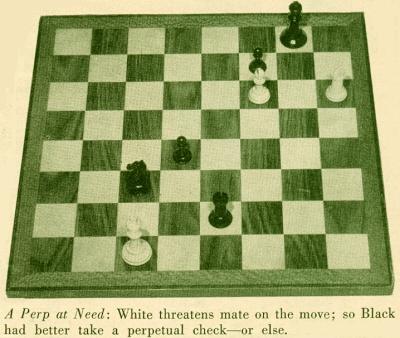
Regarding ‘a perpetual’, an old sighting of the abbreviated Americanism ‘a perp’ may be noted: ‘Since perpetual check or “a perp”, as it is commonly called, occurs often enough during the course of play, it is definitely a worthwhile subject for study.’ That was written by I.A. Horowitz on page 87 of Chess Review, March 1954. A caption on the same page began ‘A Perp at Need’.
From page 113 of Horowitz’s How to Win in the Middle Game of Chess (New York, 1955):
‘Most perpetual checks are of the short variety; for in no time flat a player can see that there is no way out. Occasionally, however, the “perp” is long and arduous.’
Another occurrence is in the heading of an article by Horowitz on page 183 of the June 1951 Chess Review: ‘Two pawns versus a “perp”.’
An entry in the glossary on page 130 of Playing Computer Chess by A. Lawrence and L. Alburt (New York, 1998):
‘Pup: Slang for perpetual check (a.k.a. “perp”).’
From John Roycroft (London):
‘I should like to make a point arising out of C.N. 1405. My complaint about ungrammatical English or poor style in new books by young British players is directed more at the publisher than the author: don’t publishers have standards any more? However, I am less strict than you, for I would accept Tony Kosten’s unambiguous phraseologies as quoted if only they had been oral instead of written. But why does the publisher allow young chess writers to get away with careless oral speech when it isn’t oral at all? Is it only we stick-in-the-muds (h’m – not, I think, sticks-in-the-mud) who claim there is any difference?’
In C.N. 1405 we had ‘back rank mated’; we now note on page 220 of the algebraic edition of Keres’ Practical Chess Endings (translated for Batsford by John Littlewood): ‘White is himself zugzwanged after 1 Bd4+ ...’ Next somebody will be zwischenzuged.
[That word was subsequently seen in a book: ‘... while 16...Bxd4 17 Bxd4 Rfd8 is zwischenzuged with 18 Bf6.’ Page 76 of Strategic Chess. Mastering the Closed Game by Edmar Mednis (Los Angeles, 1993).]In any discussion of linguistic barbarism the name of Jon Speelman rarely remains in the background. Batsford have just issued a reprint of Réti’s Masters of the Chess Board (which, a silly blurb pretends, is ‘the only collection of the best games of all the world’s leading pre-war players from Anderssen to Alekhine’). Speelman provides a Foreword, from which we quote the first paragraph in full:
‘I was very pleased when Batsford asked me to write a new introduction to this book, the more so since, as I freely admit, I have never read it before! Of course, I knew of Masters of the Chess Board as one of the classics. But there are so many chess books and chess tournaments nowadays ... one could, now, justifiably retort not nearly so much chess literature to which genre (if such exists) this most definitely belongs.’
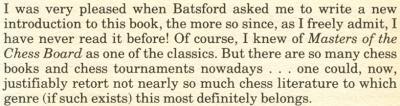
In Réti’s day such gibberish as that last sentence would have been unmercifully expunged by a member of the editorial staff.
Recent issues of the British Chess Federation’s Newsflash have also been a cat’s concert. A sentence from the lead story (‘Short Coasts Home in Iceland’) in the 27 March 1987 issue illustrates how an outright factual inaccuracy can flow from grammatical incapacity:
‘Having won at least once against Kasparov recently (in the London Docklands Speed Chess Challenge), only the Soviet trio of Yusupov, Sokolov, and Karpov can realistically be considered competitors to Nigel in becoming a genuine contender for Kasparov’s title of World Champion.’
In an interview with Julie Anne Desch, the following was said by Speelman regarding his playing strength (Chess Life, June 1988, page 32):
‘In a sense, I go up a bit, go down a bit, up a bit and down a bit. Obviously at the moment I am on an up bit, I’ll probably reach a level lower than what I’m producing at the moment. If it’s still high, then I’ll have to fall again.’
In C.N. 1441 John Roycroft referred to the difference between oral and written style. A complication occurs when books aim to reproduce masters’ own words as broadcast by radio or television, as is shown by Chequers’ recent book The Brussels Encounter, produced with the assistance of the BBC. (Or, as page 3 puts it: ‘Using the “voice-over” techniques made popular by the old Master Game programmes, viewers are given an opportunity to eavesdrop on the grandmasters’ thoughts.’) The question to be resolved is the extent to which conversational slackness should be edited out of the grandmasters’ thoughts. Nobody will want starchy disquisitions, but surely there must be some revision of ungainly colloquialisms (regardless of whether the speaker is of English mother tongue). For instance, Nigel Short says on page 49: ‘... this whole ending ought to have been trivially winning for me ...’
Kasparov’s declarations frequently begin with ‘Okay’, a routine example being ‘Okay, he played Rf1’ (page 103). On page 116 we are even given: ‘Okay, now I think I’m okay’, with several further uses of the word in the rest of the game, which he loses.
In fact, though, contributors of written annotations do not always perform better. Page 13: ‘Short’s 8...a6!? needs further testing as a possibly viable antidote to Kasparov’s favourite line.’ What do the words ‘possibly viable’ add? Another example of this curious construction is on page 45: ‘This is the type of game which encourages Nigel’s supporters to regard him as the possibly leading Western contender to challenge for the world title.’
The book has frequent printing errors (e.g. ‘Ronih’ on page 30 and ‘lessor mortals’ and ‘en pris’ on page 167), but although our review has concentrated on the irritating editing defects, there is no denying that the actual chess content of The Brussels Encounter is highly instructive.
C.N.s 1405 and 1491 quoted two British players writing such things as ‘White makes a trivial draw’ and ‘this whole ending ought to have been trivially winning for me’. This use of the word trivial (as a synonym of easy rather than trifling) now seems firmly entrenched in modern chess circles. The 3/1988 New in Chess has ‘a trivial win’ (W. Watson, page 83) and ‘an absolutely trivial win’ (J. Speelman, page 26). ‘A trivial win’ is also even used by J. Nunn on page 238 of the June [1988] BCM.
More a linguistic matter than a chess one, of course, and perhaps a trifling one at that. But we have never seen this new usage of the word ‘trivial’ anywhere other than in the prose of chess masters.
(1648)
Regarding New in Chess, see too C.N.s 1036 and 1056 in Chess Jottings.
The introductory note to Lasker v Bauer, Amsterdam, 1889 on page 14 of Why Lasker Matters by Andrew Soltis (London, 2005):
‘Okay, it can’t be delayed any longer. This is the brilliancy that made Lasker famous.’
From page 303, at the start of the note to 13 Rxf6 is Lasker v Pirc, Moscow, 1935:
‘Yeah, right, another rook-takes-knight sack in the Sicilian. What’s the big deal?’
Those citations prompt some general thoughts. If paragraphs can
begin with ‘Okay’ and ‘Yeah’, they can finish with ‘Just saying’,
‘Nuff said’ and ‘End of’. Instead of ‘in my opinion’, there is
‘for my money’, ‘my ten cents’ worth is that’ and, more
assertively, ‘fact is’. A bewildering set of abbreviations may be
deployed, such as ‘fwiw’ [for what it’s worth] to introduce, with
specious diffidence, an opinion worth nothing.
Reference is found to people (‘guys’ or ‘dudes’) who ‘took to Twitter’ to ‘slag off’ this or that. Or ‘took to social media’. Or ‘took to the comments section’ of a webpage. We are told what has been posted not at ChessBase.com but ‘over at ChessBase.com’. An appeal for information becomes ‘Anyone out there know ...?’ Prose is sprinkled with ‘ain’t’, ‘dunno’, ‘gotta’, ‘innit’, ‘kinda’, ‘nah’ and ‘wanna’. In debate no expression is too colloquial (‘C’mon, cut us some slack, will yer?’).
Simultaneously such writers may try to look posh, with ‘commence’ instead of ‘begin’ or ‘start’. For examples of the ‘painful amalgam of coarseness and pretension’, in a book on the 1992 Fischer v Spassky match, see Instant Fischer.
Several recent C.N. paragraphs have referred to some unlovely words and turns of phrase of the 1980s. It has been something of a surprise to come across this relatively old one:
‘The simultanee should keep an eye on the rate of progress of the single player ...’
Source: BCM, April 1943, page 74.
From page 66 of Playing to Win by James Plaskett (London, 1988):
‘For the next half-dozen moves a cardinal consideration is the efficacy of possible “sacs-back” on d5.’
(1694)
Citations of chess neologisms are always welcomed, especially if readers can offer first sightings. On page 10 of Modern Art of Attack by Ken Smith and John Hall (Dallas, 1988) we came across a word that was new to us:
‘We witness a case of the player with an uncastleable King being attacked by an opponent whose King had already forfeited its right to castle.’
(1868)
As noted on page 265 of Chess Explorations, the writings of George Koltanowski play havoc with the English language. On page 139 of With the Chess Masters (San Francisco, 1972) he annotated a move as follows:
‘Now White has a strong positional position.’
We wrote the passage below in 1989, regarding the BCM (Editor: Bernard Cafferty):
... its love of speculation was demonstrated by this sample culled from a first reading of the April 1989 issue ... :
‘According to one source, Portisch announced ...’ ‘Last year there was an unconfirmed report that he was told ...’ ‘One version runs that ...’ ‘Since the funds of the GMA are reported as quite low ...’ ‘One report speaks of the possibility that FIDE may be conceded ...’ ‘There is a persistent account in master circles that ...’ ‘A recent German source claimed there was a strong movement ...’ ‘It is also said that the Polgars have ...’
Our comment: ‘will future historians consider the BCM a worthwhile reference source when you publish so much of that sort of thing?’
(1926)
See Rebuttals.
From pages xxxvi-xxxvii of The Great Schools of England by Howard Staunton, a 517-page book which was published in London in 1865:
‘Of all the chief modern languages, English is perhaps the worst spoken and the worst written by educated people. It is written too often with an almost total disregard of euphony, elegance, and even grammar; and it is spoken mincingly or mouthingly, with countless horrible disfigurements. Why should not English be written with as much of precision and propriety and classical finish as French? Why should not Englishmen speak as accurately as Frenchmen? We need not, in England, as respects language, be apprehensive of becoming purists; the danger lies in the opposite direction. Pedantry in speech is an evil; barbarism in speech is a greater evil …
That a boy should be able to speak and write his native language as it ought to be spoken and written, is of more solid and lasting importance than that he should excel in the composition of Greek and Latin verses; yet many a boy can do the latter, who is utterly incompetent to the former.’
(Kingpin, 1999)
From the beginning of Cochrane’s Preface (pages v-vi) to A Treatise on the Game of Chess (London, 1822):
‘When the imagination has been tamed down, by the analyzation of games, little can be expected from a writer on chess in the shape of elegance or even purity of expression: the present Work can pretend to neither. I have addressed myself merely to players who have some knowledge of the game, in a plain and, I hope, intelligible manner, without being particularly attentive to the minuter accuracies of language. Any one who has taken the trouble to examine a work upon chess is soon satisfied that the unvarying succession of technical phrases must tire and disgust the writer, and willingly extends that indulgence to his language which the constant repetition of terms renders absolutely necessary.’
(Kingpin, 2000)
We sometimes jot down unusual turns of chess phraseology, neologisms, etc. For example, page 131 of Chess Review, May 1967 used the phrase ‘Fischer post-mortems his game with Bergras[s]er’.
(2665)
Our feature article The Australian Nimzowitsch quotes C.J.S. Purdy on page 32 of Chess World, 1 February 1950:
‘Black could have “unbackwarded” his KP with ...P-K4, but then 16 P-B4 would help to open the game for the bishops.’
On page 22 of the 1 January 1950 issue of Chess World there appeared a feature entitled ‘The Zugzwanger Zugzwanged’.
C.N. 2783 quoted the following, under the heading ‘Open to misinterpretation’
‘Accustom yourself to play indifferently with Black or White.’
A Handbook of Chess by G.F. Pardon (London, 1860), page 21.
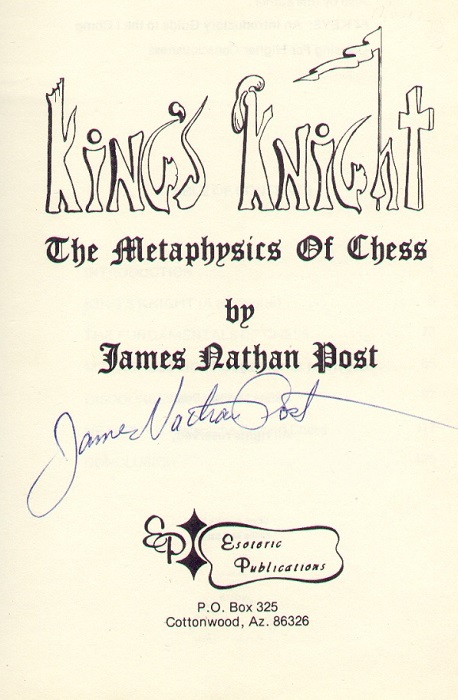
The above is the title page, inscribed by the author, of a verbose chess book published in 1978. For an illustrative quotation we go no further than page 1:
‘Much of mankind’s activity seems to be devoted to participation in “games”, that is, goal oriented oppositionally paired dualities.’
(2847)
We are convalescing satisfactorily after an overdose of Chris Ward’s cheerfully unfledged prose in the April 2003 CHESS, and our masochism has even extended to re-reading the first page of his 1997 book The Genius of Paul Morphy: ‘Once upon a time there was a man who won a lot of games of chess ...’, … ‘even if I say so myself, it’s a pretty good selection …’, ‘… I have never really been a historian …’, etc. etc. Yet it is only proper to acknowledge that Ward’s is not the worst-written book on Morphy. That distinction has to go to Paul Morphy partidas completas by Rogelio Caparrós (Ediciones Eseuve, Madrid, 1993).
The back cover calls it ‘una extraordinaria tarea de investigación’, yet there is no sign that Caparrós himself found a single ‘unknown’ Morphy game. He writes: ‘We used only four main sources for the games, thought [sic] we examined a large number of books on Morphy, but they do not contain any new material.’
The book is supposedly bilingual (‘we translated most of the text to two languages: Spanish and English’), and here we refer only to its introductory pages. The title of David Lawson’s book comes out various ways, including Morphy: The Pride and “Ssorrow” of Chess. Other Morphy games are taken by Caparrós from articles by Lawson in the ‘Brtish’ Chess Magazine. Caparrós refers to the ‘ganes’ of Morphy and ‘blinfolded’ games.
Philip W. Sergeant wrote Morphy’s Games of Chess, but in various places Caparrós gives ‘Phillip’, ‘Sargeant’ and ‘Morphy’s Best Games’. In a passage where P.W.S.’s name, at least, is correct, Caparrós writes: ‘The games of this collection have been rearranged in a way somewhat different as in the most common book, Morphy’s Best Games, of Sergeant.’ That volume, we are told, ‘fails [sic] short because the number of games was limited to 300, allowing the prejudices of the notable British author, to excise the games of Morphy of dubious quality’. The next paragraph calls another book by Sergeant, Morphy Gleanings, ‘Morphy’s Gleanings’. Elsewhere it comes out as ‘Morphy Gleaningas’.
(2902)
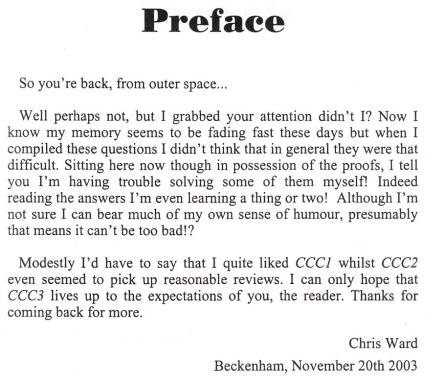
Source: page 3 of Chess Choice Challenge 3 by Chris Ward (London, 2004). The publisher was B.T. Batsford Ltd.
(8849)
An international language which possesses a relatively simple grammatical structure yet which has so often proved beyond the command of chess wordsmiths, and not least Anglo-Saxon ones. But enough about English. Here, we offer some jottings on Esperanto, the language invented by L.L. Zamenhof in 1887.
The above is the first paragraph of C.N. 2938, given in another feature article.
Anyone wishing to make chess history ‘fun’ by spreading unsubstantiated anecdotes and tittle-tattle has only to eschew specifics like dates and places and rely on the shadowy word ‘once’. From 2010 Chess Oddities by A. Dunne (Davenport, 2003) we scoop up the following selection:
‘World Champion Emanuel Lasker was once offered an opium scented cigar …’
‘Aron Nimzovich once broke his leg ...’
‘Aron Nimzovich once stood on his head ...’
‘Pal Benko once thought Mikhail Tal was trying ...’
‘Max Euwe once requested a game for the World Championship be postponed ...’
‘Akiba Rubinstein once won four brilliancy prizes in one tournament.’
‘Anatoly Karpov once listed his hobbies as ...’
‘Mikhail Tal was once signed to play the Devil in a movie ...’
‘Tal was once asked what chess piece he would like to be ...’
(3112)
For many more examples of ‘once’, see our feature article ‘Fun’.
A handily vague term for chroniclers devoid of hard facts is ‘by all accounts’.
Barnie F. Winkelman wrote on page 205 of Chess Review, September 1935:
‘To Lasker chess was (and remains) a contest, a personal encounter in which he frequently avoided the best variations, and sought to give battle on unfamiliar ground. “The winner of a game of chess”, he is reported to have said, “is he who makes the last mistake but one.”’
With terms like ‘is reported to have said’ (and ‘reportedly said’), the floodgates are open for anyone to write anything.
(11998)
From C.N. 3303, including an extract from website homepage of the Fédération Internationale des Echecs and our comment on it:
‘FIDE Honorary Member, Holder of the Order of Grand Commander of the Legion of Grandmasters Aslan Abashidze has made his personal present for chess and Georgian chess federation by having transferred the World Women Chess Championship 2004 to Elista, Republic of Kalmykia, Russia, further to the request of the FIDE President, President of Kalmykia H.E. Kirsan Ilyumzhinov.’
How anybody, or any body, can write in such a way is beyond comprehension.
One of our items (C.N. 4379) on Nick de Firmian’s 2006 edition of Chess Fundamentals drew attention to this remark in his Introduction, concerning the textual changes made to Capablanca’s book:
‘The chess historian should have little trouble deciphering which material is original if he or she is observant.’
We commented:
This ‘he or she’ stuff, incidentally, is de Firmian’s preferred usage, and he foists it on Capablanca throughout. The first sentence in the first chapter of the first part of the original Chess Fundamentals stated: ‘The first thing a student should do, is to familiarise himself with the power of the pieces.’ De Firmian puts instead: ‘The first thing a student should do is to familiarize himself or herself with the power of the pieces.’
A further observation by us, in C.N. 10354:
If, heaven forfend, de Firmian were let loose on Alekhine’s book on Nottingham, 1936, he would come to this note, on page 56 of the original, concerning the third-round game between Alekhine and Tylor:
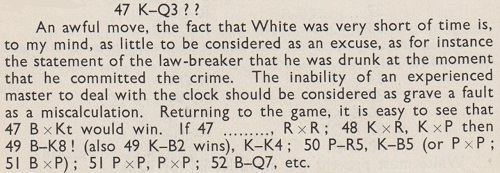
Or, in the ‘style’ imposed by de Firmian:
‘... the statement of the law-breaker that he or she was drunk at the moment that he or she committed the crime.’
Another example can be proposed, in connection with Clive James and Chess, which includes a passage on page 20 of the Introduction to his book From the Land of Shadows (London, 1982), quoted in C.N. 10246:
‘The necessary conceit of the essayist must be that in writing down what is obvious to him he is not wasting his reader’s time. The value of what he does will depend on the quality of his perception, not on the length of his manuscript.’
That could give:
‘The necessary conceit of the essayist must be that in writing down what is obvious to him or her he or she is not wasting his or her reader’s time. The value of what he or she does will depend on the quality of his or her perception, not on the length of his or her manuscript.’
However, the plural is an option:
‘The necessary conceit of essayists must be that in writing down what is obvious to them they are not wasting their reader’s [readers’] time. The value of what they do will depend on the quality of their perception, not on the length of their manuscript.’
See also C.N.s 9075 and 10973. The latter item included the following:
‘The player who completes his development first is said to have the initiative, because he is thus able to start making blunders while his opponent is still occupied in bringing out his men.’
That remark from page 14 of “Among These Mates” by Chielamangus (Sydney, 1939) was given in C.N. 1858 (see page 246 of Chess Explorations).
A modern alternative:
‘The player who completes his or her development first is said to have the initiative, because he or she is thus able to start making blunders while his or her opponent is still occupied in bringing out his or her men or women.’
We note an increasing tendency for ‘writers’ to end sentences, or pseudo-sentences, with a question mark rather than a full stop, e.g. in cases where the opening words are ‘I wonder if’, ‘I thought that’, ‘He asked whether’, ‘Perhaps’, ‘Maybe’, ‘Possibly’ and ‘Surely’.
See too C.N. 9887.
‘After having finished high school his mother presented him a royal gift.’
Source: page 11 of Chess Comet Charousek by Victor A. Charuchin (Unterhaching, 1997).
Chess news reports indicate a growing belief that prose is somehow enlivened if the plainest words are avoided. When a player wins first prize in a tournament, the verb ‘wins’ commonly loses out to ‘bags’, ‘claims’, ‘collects’, ‘grabs’, ‘picks up’, ‘scoops’, ‘takes home’, etc. ¨ (Addition: further verbs include ‘annexes’, ‘captures’, ‘carries off’, ‘cashes in’, ‘chalks up’, ‘clinches’, ‘comes away with’, ‘comes back with’, ‘comes back home with’, ‘comes home with’, ‘farms’, ‘garners’, ‘gets his hands on’, ‘goes away with’, ‘goes back with’, ‘goes back home with’, ‘goes home with’, ‘lands’, ‘nabs’, ‘nets’, ‘notches up’, ‘reaps’, ‘runs away with’, ‘runs off with’, ‘scoops up’, ‘seals’, ‘secures’, ‘seizes’, ‘snags’, ‘snaps up, ‘snatches’, ‘takes away’, ‘takes back’, ‘takes back home’, ‘walks away with’, ‘walks back with’, ‘walks back home with’, ‘walks home with’, and ‘walks off with’. The verb ‘to prevail’ instead of ‘to win’ is also a favourite.)
[Consolidated version of the previous paragraph:
Chess news reports indicate a growing belief that prose is somehow enlivened if the plainest words are avoided. When a player wins first prize in a tournament, the verb ‘wins’ commonly loses out to ‘annexes’, ‘bags’, ‘captures’, ‘carries off’, ‘cashes in’, ‘chalks up’ , ‘claims’, ‘clinches’, ‘collects’, ‘comes away with’, ‘comes back with’, ‘comes back home with’, ‘comes home with’, ‘farms’, ‘garners’, ‘gets his hands on’, ‘goes away with’, ‘goes back home with’, ‘goes back with’, ‘goes home with’, ‘grabs’, ‘lands’, ‘nabs’, ‘nets’, ‘notches up’, ‘picks up’, ‘pockets’, ‘reaps’, ‘runs away with’, ‘runs off with’, ‘seals’, ‘scoops’, ‘scoops up’, ‘secures’, ‘seizes’, ‘snags’, ‘snaps up’, ‘snatches’, ‘takes away’, ‘takes back’, ‘takes back home’, ‘takes home’, ‘walks away with’, ‘walks back home with’, ‘walks back with’, ‘walks home with’, ‘walks off with’, etc. The verb ‘to prevail’ instead of ‘to win’ is also a favourite.]
Another addition to the musings on chess and the English language concerns the use, particularly in the United States, of ‘would’ in historical narratives. For instance, ‘Alekhine died in 1946, and two years later Botvinnik would become world champion’, instead of simply ‘became world champion’.
The following examples come from the first page of the article about Henry Chadwick in Lasker & His Contemporaries which was referred to in Chess and Baseball:
‘A native of England, Chadwick came to the United States with his family in 1837, settled in Brooklyn, became a journalist and would be recognized as the first significant sports writer in the United States. ... As Mac Souders, writing in the Baseball Research Journal for 1986, would describe it, Chadwick would become “a one-man press association for baseball in the New York City area”. Chadwick would report on sports and recreational activities for decades ... And he would author and edit numerous baseball books and pamphlets ... He would receive the title “Father of Baseball” early in his career ...’
(8632)
To lapse into journalese, Carlsen and Anand are ‘set’ to play a ‘revenge match’. Use of that latter term (instead of ‘return match’ or ‘re-match’) is not new, and the oldest instance that we recall is on page 169 of CHESS, March 1947: a reference to ‘the Alekhine-Euwe revenge match’. The writer was Botvinnik (see Interregnum), and ‘матч-реванш’ is a common term in Russian, just as‘Revanche’ occurs in the equivalent German and French phrases.
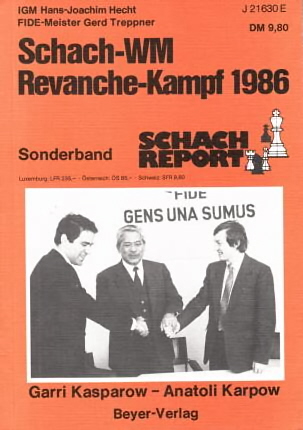
Whether ‘revenge match’ is good English is debatable, but it was used by Fred Reinfeld (‘a prompt revenge match’ between Euwe and Alekhine in 1937) on page 213 of The Great Chess Masters and Their Games (New York, 1952).
(8649)
The front cover of Learn Chess Quick by Brian Byfield and Alan Orpin (London, 2010):
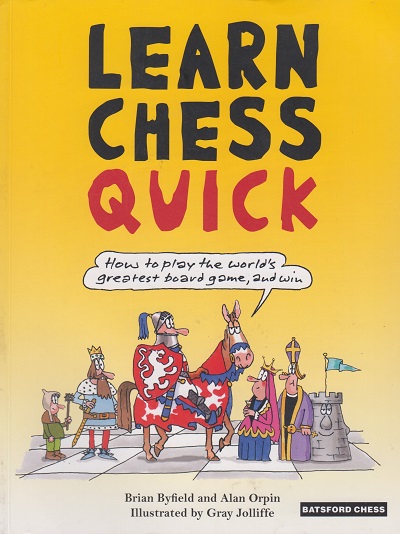
The back cover jokes that Byfield ‘first picked up the game when he knocked over his father’s board at the age of two’. The lad done good.
‘Tells of’ is a formulation favoured by writers unconcerned with specifics. From page 133 of The Complete Chess Addict by M. Fox and R. James (London, 1987):
‘B.H. Wood tells of this débâcle in a postal tournament. After 1 e4, Black replied: “...b6 2 Any, Bb7.” Now “any” is a useful postal chess time-saver; it’s shorthand for “any move you care to make”. So White replied with the diabolical “2 Ba6 Bb7 3 Bxb7” (and wins the rook as well).’
Where Wood told of this is not mentioned. We recall, though, that on page 279 of the June 1961 CHESS he reported that another magazine had told of a king’s-side version:
‘Chess Review tells of a postal chess player who rather recklessly wrote his White opponent thus: “Whatever you play, my first two moves are 1...P-KN3 and 2...B-N2.”
No prizes for guessing White’s first three moves.’
However, what Chess Review (April 1961, page 102) had told of contained no ‘Whatever you play ...’ remark and was merely a gleaning from an unspecified issue of another magazine ...
For further details, see the remainder of C.N. 8942, as well as C.N. 8963.
‘Would’ can be strange, and C.N. 8632 (see above) mentioned its unnecessary inclusion in historical narratives (‘Alekhine died in 1946, and two years later Botvinnik would become world champion’, instead of simply ‘became world champion’). Another quirk, favoured by presenters of history programmes on television, is recourse to ‘would have’ to disguise speculation or mind-reading: ‘It is in this room that he would have decided to ...’ Then there is all the prolixity in quizzes. ‘Would you be ready?’ is answered not by ‘Yes’ but by ‘I would indeed’, and later we may hear, ‘I wouldn’t have a clue’ or the frightful excuse for ignorance of something uncontemporary: ‘that would be before my time’. Asked in a chess quiz to identify the player who was nicknamed ‘the Black Death’, a contestant could well use four words instead of one: ‘that would be Blackburne’. A more challenging question is: which chess writer used the pseudonym ‘Eze’? That would be Telling.
(9051)
Page 94 of Thomas Frère and the Brotherhood of Chess by Martin Frère Hillyer (Jefferson, 2007) has this wouldpile:

It may be wondered why so many people nowadays put question marks after indirect questions? And maybe/perhaps stranger still, question marks after maybe/perhaps? And after other ordinary statements which are not questions? We assume that there is some explanation?
(9054)
In his column on page 31 of the Observer, 3 September 1972 Clive James remarked that in sports broadcasts Frank Bough ...
‘puts the emphasis on his prepositions and breaks into a shout when you LEAST expect it ...’
Since then, emphasis on prepositions has been increasingly noticeable, and we have even heard a television news presenter welcoming an interviewee down the line with ‘Good afternoon to you’. On Internet chess broadcasts there is now an epidemic. For example:
‘Let’s have a look at that game.’ ‘A nice move by him.’ ‘Things went really well for him.’ ‘He is now in the lead.’
(9117)
Another quirk of certain commentators, and particularly inferior ones, is the excessive use of ‘just’, almost as much as in television cookery programmes (‘White can just play Bc4 and then just castle and just centralize his rook’/‘Just put it in a frying pan and then just fry it off and just serve it up’). There is also a usage which recalls the days when Peter Jones (1920-2000) was the Chairman of the BBC radio programme Twenty Questions. If a panellist enquired whether the mystery object ‘is something like a giraffe’, he would ask, ‘what is like a giraffe?’ Chess broadcasts frequently contain phrases such as ‘If White just plays a move like Qb5 ...’, meaning ‘If White plays Qb5’. We note too (in chess broadcasts and in television news bulletins) the increasing recourse to ‘because’ as a multi-purpose conjunction: ‘This is the scene in the hall because shortly play will be starting.’ (Or, possibly, ‘will be starting’; it is not only prepositions that are emphasized erratically.) On a more positive note, we have yet to witness an Internet broadcaster employing a formulation favoured nowadays by television journalists when introducing filmed interviews: ‘This is what the Prime Minister had to say’ (rather than ‘said’).
During post-mortem interviews, the chess hosts must listen tolerantly to what the players have to say, even if they have to say it with the stream-of-consciousness approach heard in so many sports broadcasts: ‘OK, well, you know, I don’t know, you know, well, maybe he could just have tried to just, OK, maybe, I don’t know, you know.’ Yet at least these unburdenments illustrate the difficulty of chess even for the greatest masters, in contrast to all those atrociously written certainties which some Twitter-users dash off before dashing off to dash off something else.
The simple ‘X said’ often loses out, for some reason, to ‘X turned round and said’ or ‘X came out and said’.
Addition on 19 April 2024:
Increasingly in spoken commentaries we hear not ‘if ...Qb6, then ...’ but ‘if ...Qb6 things, then ...’
From Olimpiu G. Urcan (Singapore):
‘On the subject of tweeting, which you mentioned in C.N. 9085, this is the kind of thing all too easily found:’
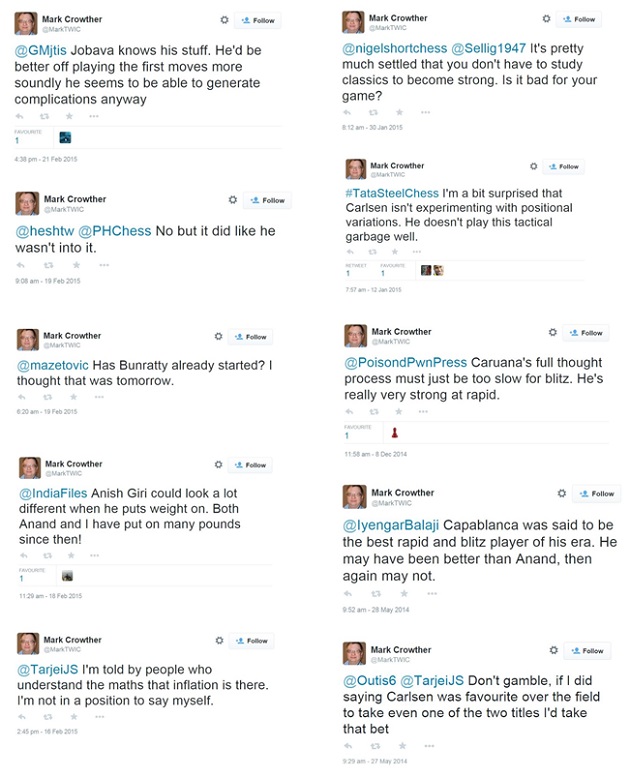
‘A knight is a knight’ (C.N. 9253) brings to mind the cliché ‘a pawn is a pawn’ (a phrase used in a brief sketch by ‘W.C.G.’ on page 131 of the April 1885 BCM). C.N.s 642 and 7673 mentioned ‘an interesting game in all its phases’ and ‘the rest is a matter of technique’, and two others are ‘this move is better than its reputation’ and ‘the pawns fall like ripe apples’.
Readers are invited to keep their eyes peeled for any recent annotational clichés which have been spreading like wildfire, left, right and centre.
(9256)
Mike Salter (Sydney, Australia) expresses dislike of annotators’ unhelpful use of the single-word sentence ‘Desperation’ towards the end of games; he has counted 17 occurrences in Lessons from My Games by Reuben Fine (New York, 1958).
Fine also used the word frequently in Chess Marches On! (New York, 1945). One example is in C.N. 8353.
(9330)
Among chess commentators ostensibly of English mother tongue, some of the worst prose is still being turned out by Mark Crowther. On 25 June 2015 he posted an obituary of Walter Browne, who, he says, died in ‘Navada’. (Another obvious misspelling: ‘visable’.) Uninterested in treating Browne with respect and unable to construct a basic sentence, Crowther writes that Browne was ‘numerous opens’ and was ‘five medals’. The heading even has ‘Watter’ Browne.
A 1988 citation above has ‘uncastleable’, in connection with the king. Another unusual, though older, word is ‘unqueenable’. A heading on page 88 of Easy Guide to Chess by B.H. Wood (Sutton Coldfield, 1942) was ‘That unqueenable rook’s pawn’, and the word was also used, within quotation marks, on page 110 of CHESS, February 1950.
(9468)
The book mentioned in C.N. 3804, Doctor Goebbels His Life and Death (London, 1960), which Heinrich Fraenkel (‘Assiac’) co-wrote with Roger Manvell, had a curiously ambiguous phrase at the start of page 259:
‘At the beginning of the winter of 1944 France was lost to Germany ...’
There are worse ways of gauging magazines than by scrutinizing their photograph captions. Has care been taken? Are there babyish puns? Is worthwhile information conveyed, or are readers told what they can see for themselves?
As noted in How to Write about Chess, one caption trundled out occurs when people are shown laughing or smiling together: the reader is notified that they are ‘sharing a joke’ (or, for variety, ‘enjoying a joke’). Examples: ‘Producer Jimmy Komack (far left) and Erik Estrada share a joke’ (Chess Life, September 1988, page 32). ‘Short and Karpov enjoying a joke at Amsterdam 1991’ (CHESS, June 1992, page 11).
If caption-writers wish to entertain, and not just inform, a modicum of imagination is required.
(9606)
See too C.N. 10598.
Other thoughts on how a picture may be described:
Those merely talking are ‘deep in conversation’.
Avoid simplistic speculation based on facial appearance (‘X appears to be thinking/looks like he wants ...’, etc.).
Caption-writers are not mind-readers.
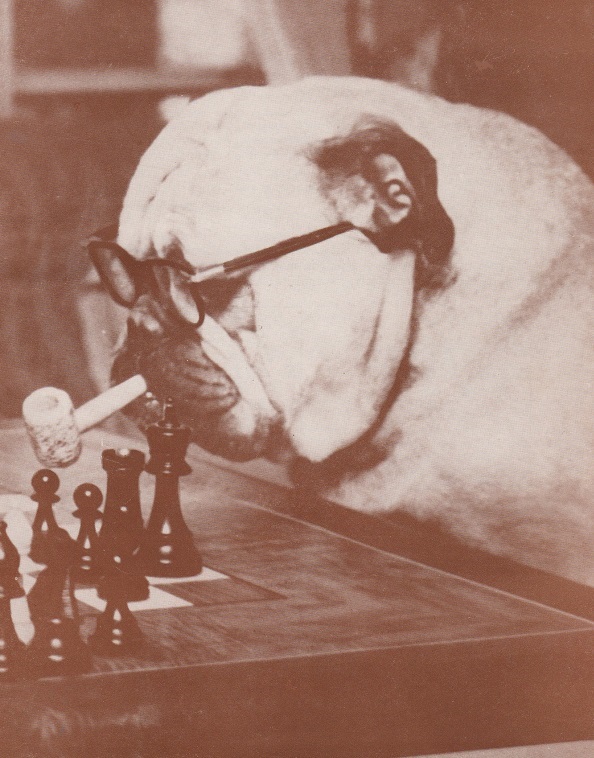
Chess Review, January 1955, front cover
This is the kind of photograph that writers and editors seem incapable of reproducing without a trite pun.
(10456)
See also Chess
Corn Corner.
From page 316 of Capablanca move by move by Cyrus Lakdawala (London, 2012)

Faulty punctuation apart, a more scrupulous publisher than Everyman Chess would have made Mr Lakdawala either verify the matter or delete the paragraph. Readers deserve better than talk of an article ‘titled something like’ and ‘a quote which went something like’.
(10345)
Chess Broadcasts on the Internet mentions commentators’ habit of saying ‘a move like Qb5’ when they mean Qb5. In chess books we now note a tendency towards ‘something like’.
(10349)
The words ‘incredible’ and ‘incredibly’ are misused by inferior writers. An example comes from page 147 of the Complete Book of Beginning Chess by Raymond Keene (New York, 2003):
‘It is an incredible disadvantage to have to conduct a standard middlegame with your king stuck in the firing line.’
Many examples of that writer’s inability to produce correct English are given in our feature articles on him.
See too A Sorry Case, which shows countless instance of incorrect language, typos, etc. by Eric Schiller. One comment of ours concerning his Encyclopedia of Chess Wisdom (New York, 1999):‘There are of course slow ways of chasing denied away …’ (page 131). From the context, it would seem that ‘chasing the knight away’ was meant. Another example comes on page 145: ‘it can also crate threats’. With all Schiller’s typos, one could pass denied away crating lists.
Bad writers often have an exaggerated liking for exclamation marks. See, for instance, Chess Problems, Play and Personalities by Barry Martin (Beddington, 2018), a book discussed briefly in C.N. 11186.
An example of Mr Martin’s defective grammar comes from page 168, in a section on Victor Korchnoi:
‘Born 23 March 1931, his father, a Christian, taught literature, and his mother of Jewish origin was a pianist.’
A strident critic of FIDE, Barry Martin misspells a Federation President’s name (page 22), the Federation’s name (page 83) and the Federation’s motto (page 246).
In most cases, to put an exclamation mark is to pat oneself on the back.
A note on page 175 of Chess World, August 1961:
‘White’s dilemma is that if he retires, where is his compo for the pawn?’
The on-line Oxford English Dictionary calls ‘compo’ (compensation) ‘Australian and New Zealand slang’
A pseudo-patriotic cliché to be discouraged is in David Howell’s chess column in The Times, 18 January 2020:
‘... along with commentary by Britain’s own Nigel Short.’
A modern equivalent of the ‘Yes No Interlude’ on Take Your Pick would be to bang a gong whenever someone on radio or television begins an answer with ‘Erm’, ‘Well’, or ‘So’.
A comment of ours in Instant Fischer (‘Kasparov has trouble not contradicting himself over what he said last Tuesday’) was quoted by Olimpiu G. Urcan on Twitter on 23 February 2021, accompanied by a clip from the 1937 Laurel and Hardy film Way Out West in which, replying to ‘What did he die of?’, Stan Laurel said, ‘I think he died of a Tuesday ...’ A question of language arises: why, in such cases, is Tuesday the most effective day to mention?
We have put the matter to Stephen Fry, who replies:
‘No question that Tuesday is the funniest day. Always has been. Though Douglas Adams came up with that line “This must be Thursday. I never could get the hang of Thursdays” which shows Thursday comes in a good second. Monday wouldn’t work because there’s a reason why “I don’t like Mondays” as Bob Geldof sang. Wednesday is just too much of a mouthful to zing. Friday is too associated with payday and the end of the week, and the other two days are reserved for weekend properties. So perhaps it’s more a process of elimination … I wonder if any continental languages have equivalents. Is Mittwoch as funny as Dienstag?
Tuesday doesn’t follow the “hard C” rule (see the film The Sunshine Boys for a wonderful scene involving hard Cs).
Noël Coward often pondered why some place names are funny, and even claimed that in America funny place names are only funny because the word itself is inherently amusing “Schenectady” “Kalamazoo” “Albuquerque" – whereas the British find certain places funny for less obvious reasons: “Neasden" and “Purley” might elicit a laugh, whereas “Hendon” and “Portsmouth” for example wouldn’t. Hugh [Laurie] and I got much mileage out of Uttoxeter, mileage that Exeter or Huddersfield would never have offered …’
(11857)
To the Chess Notes main page.
To the Archives for other feature articles.
Copyright: Edward Winter. All rights reserved.