Edward Winter
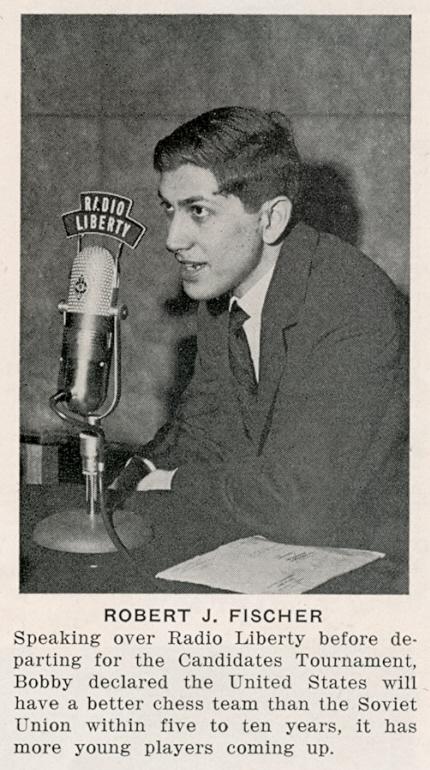
Chess Review, August 1962,
page 227
From page 274 of the July 1923 BCM:
‘At the invitation of the British Broadcasting Company, Mr B.G. Laws on Saturday, the 16th ult., broadcast a short paper “The Art of the Chess Problem”, as an experiment. This included the presenting of three popular graceful problems selected to encourage likely students, at the same time entertaining and instructing those who already are interested. This is the first occasion in the history of chess that the medium of broadcasting has been used to popularise the subject.’
The event was also reported on page 135 of the July-August 1923 American Chess Bulletin, which quoted from The Times:
‘Music, the drama, art, politics, news, all have their place in broadcasting programmes, and now that chess has entered the portals it is to be hoped it has come to stay. Marconi House might keep its eye on such meetings as that of the British Chess Federation, for if the plea be justified that musical excerpts have resulted in a greater number of people booking seats for the various operas, then the interests of the oldest game in the world are well worth its consideration.’
Another quote from around the same time comes from page 9 of the January 1924 American Chess Bulletin:
‘According to the Minnesota Daily Star, in which J.M. Juran conducts a chess column, Dr E.E. Munns of Minneapolis broadcasted a talk on chess over the radio on December 15, urging encouragement of the games at school and in the home. He also gave a short discussion on the theory of the game and included some of Dr Emanuel Lasker’s maxims. Finally, he read a letter from Frank J. Marshall, United States champion.’
(2266)
An article on pages 113-114 of the Chess Budget, 23 January 1926 began:
‘At last the British Broadcasting Co. have become aware of the fact that there is such a game as chess and that there are a large number of people in this country who take an interest in it.’
It referred to presentations on the radio by Tinsley and V. Menchik, but complained that Great Britain was far behind Germany, for example, where at least two stations were giving chess talks and lessons.
Page 125 of the 30 January 1926 issue of the Chess Budget specified that it ‘was not Mr E.S. Tinsley, the chess editor of The Times, who gave the wireless exposition of chess – but his brother, Mr S. Tinsley’. Vera Menchik’s radio engagement was briefly mentioned on page 53 of the February 1926 BCM.
(2552)
From page 19 of the Cheltenham Chronicle and Gloucestershire Graphic, 3 November 1928:
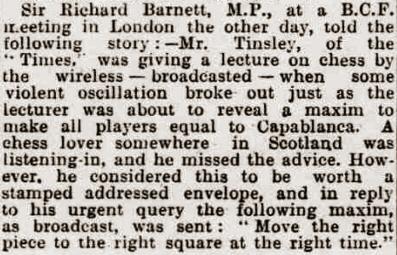
Wanted: other sightings of the maxim ‘Move the right piece to the right square at the right time’.
(8415)
In an article on the inside front cover of Chess Review, October 1951 Irving Chernev made a statement on which we would welcome particulars:
‘Reshevsky made his debut on the radio by singing a love song.’
As listed under ‘Broadcasting (radio and television)’ in the Factfinder, a number of C.N. items have discussed recordings of old masters in sound and/or vision, but very few specimens have yet been found, even though, in other fields, audio recordings from over a century ago are extant. For example, 19 sketches (patter and song) performed by Dan Leno (see C.N.s 4646 and 4647) between November 1901 and April 1903 are commercially available on a CD from Windyridge.
(4702)
1 g3 d5 2 Bg2 Nf6 3 f4 c5 4 Nf3 Nc6 5 c3 e6 6 d3 Qc7 7 O-O Be7 8 e4 dxe4 9 dxe4 Nxe4 10 Ne5 Nd6 11 Nxc6 bxc6 12 Qa4 O-O 13 Be3 Rb8 14 b3 Nb5 15 Rc1 Rd8 16 Qe4 Rd5 17 Qc2 Bb7 18 Qf2 Nd6 19 g4 f5 20 c4 Rd3 21 g5 Rd8 22 Nc3 Bc8 23 Na4 Ne4 24 Bxe4 fxe4 25 Nb2 R3d4 26 Re1 Rf8 27 Bxd4 Rxf4
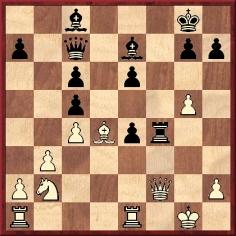
28 Rxe4 Rxe4 29 Rf1 Bd6 30 Be3 Bxh2+ 31 Kg2 Bd6 32 Qf3 Rh4 33 Rh1 Rxh1 34 Kxh1 Qf7 35 Kg2 Bd7 36 Qd1 Qe7 37 Qf3 e5 38 Qe4 Qe6. At this point White withdrew.
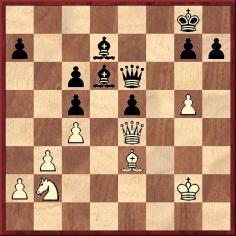
‘One of the finest games of chess ever played’ was the description on page 155 of the July 1952 Chess World. The same page had derision for Klein’s suggestion that in the final position he had a won game.
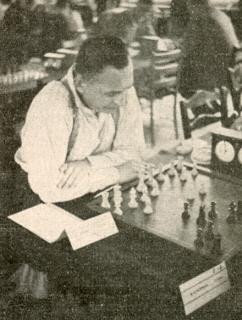
Ernst Klein
Coverage of the game and of Klein’s controversial withdrawal was published in three issues of CHESS: July 1952, page 191 (report); August 1952, pages 218-219 (letter from Klein) and 222-223 (annotations by Barda); September 1952, page 237 (letter from Klein).
(5510)
In C.N. 938 (see pages 122-123 of Chess Explorations) Dale Brandreth asked about the existence of sound recordings featuring such old masters as Lasker, Capablanca and Alekhine, and the question is now raised again by Steve Wrinn (Syracuse, NY, USA). Noting that in 2003 a brief interview with Alekhine (recorded by the BBC in 1938) was presented at the Chess Café, he asks if any similar material can be found.
We have often wondered whether recordings have survived of Capablanca’s radio lectures in Spanish in the early 1940s.
(5838)
Pages 85-87 of The Unknown Capablanca by David Hooper and Dale Brandreth (London, 1975) gave a draw between Capablanca-Kmoch and Euwe-Lilienthal, Hilversum, 16 January 1935. ‘As the moves were played so they were broadcast on the radio. Three grandmasters took part, an unusual event which drew a huge audience.’
Following the death of Sir Clement Freud on 15 April 2009, we reproduce a photograph from page 121 of CHESS, January 1973:
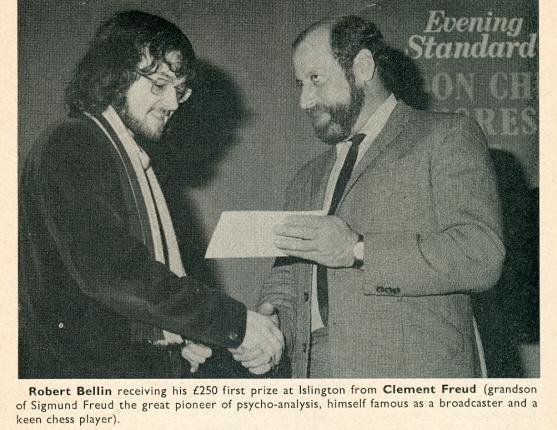
(6081)
Two well-known chess features on the radio were Capablanca’s lectures during the Second World War and the BBC series anthologized in Chess Treasury of the Air by Terence Tiller (Harmondsworth, 1966). For a comment on Fischer’s use of the medium in later life, see the Afterword in Instant Fischer.
From page 251 of the June 1938 BCM:
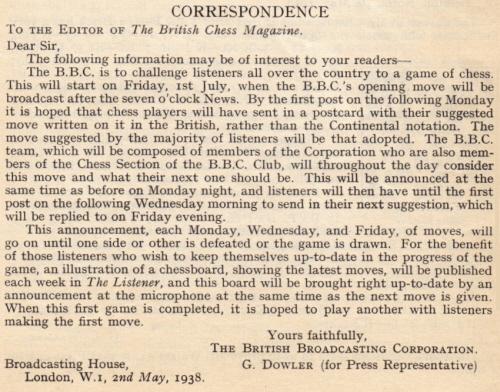
The game was published on page 12 of the Lancaster Guardian, 28 October 1938 (chess column by W. Spark):
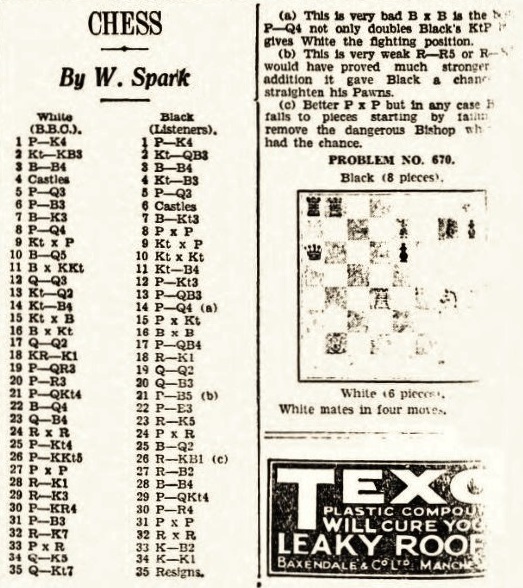
1 e4 e5 2 Nf3 Nc6 3 Bc4 Bc5 4 O-O Nf6 5 d3 d6 6 c3 O-O 7 Be3 Bb6 8 d4 exd4 9 Nxd4 Nxe4 10 Bd5 Nxd4 11 Bxe4 Nf5 12 Qd3 g6 13 Nd2 c6 14 Nc4 d5 15 Nxb6 axb6 16 Bxf5 Bxf5 17 Qd2 c5 18 Rfe1 Re8 19 a3 Qd7 20 h3 Qc6 21 b4 c4 22 Bd4 f6 23 Qf4 Re4 24 Rxe4 dxe4 25 g4 Bd7 26 g5 Rf8 27 gxf6 Rf7 28 Re1 Bf5 29 Re3 b5 30 h4 h5 31 f3 exf3 32 Re7 Rxe7 33 fxe7 Kf7 34 Qe5 Ke8 35 Qg7 Resigns.
The conclusion of a report on a girls’ tournament (won by Vera Menchik) at the Imperial Chess Club, London on page 53 of the February 1926 BCM:
‘Miss Menchik wound up a most strenuous day by fulfilling an engagement at 10.30 p.m. with the British Broadcasting Company to give the result of the tournament over the wireless.’
From page 122 of the September-October 1935 American Chess Bulletin:
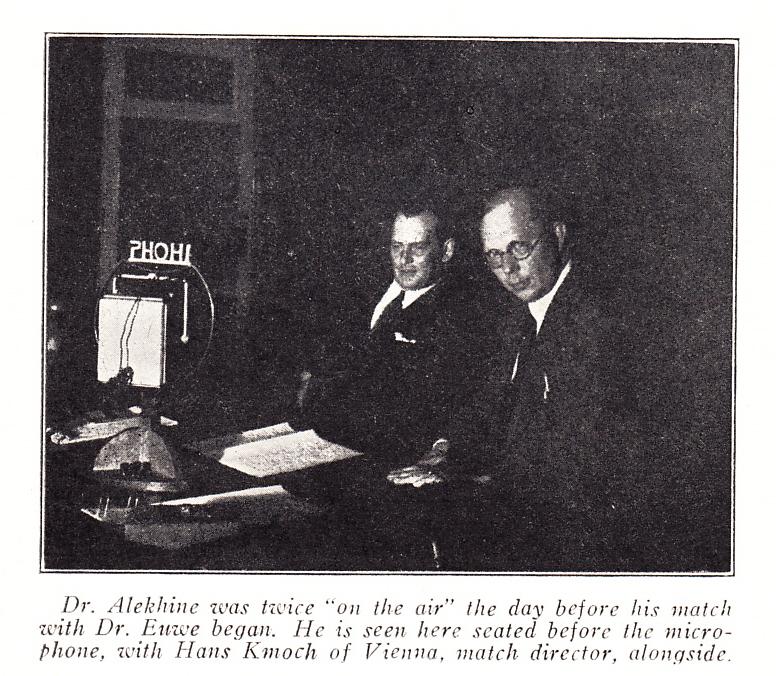
‘The Nottingham tournament was exceptional in yet another respect. The British Broadcasting Corporation suddenly became aware of the existence of the game of chess and agreed to give broadcasts on the opening and closing days of the tournament. The chief speakers on each occasion were A.J. Mackenzie, the controller, and Alderman Derbyshire, but Dr Max Euwe, Señor Capablanca and R.H.S. Stevenson also spoke.
There were also several broadcasts direct from the University buildings to Holland by Dr Euwe and others, and because of the keen interest in the tournament shown in Russia, there was a regular telephone service with Moscow, and the controller was actually interviewed over the telephone by the “Moscow Evening News”.’
Source: pages xvii-xviii of Alekhine’s Nottingham, 1936 tournament book (in W.H. Watts’ Introduction).
On page xviii Watts discussed the closing dinner at the Victoria Hotel, Nottingham on 28 August 1936:
‘... much interest was shown in recordings of the broadcasts which were reproduced during the evening.’
Page 519 of the October 1936 BCM also referred to the closing dinner:
‘There was a pause from 8 to 8-15 while the account of the congress on the wireless news was turned on, and the gathering listened to Dr Euwe, J.R. Capablanca, J.N. Derbyshire and A.J. Mackenzie.’
From page 3 of the 14 September 1936 CHESS:
‘Several radio broadcasters were arranged at which Dr Euwe, Señor Capablanca and others spoke; one of these broadcasts was switched on in the course of the farewell banquet for prize-winners and contestants from abroad. The Radio Times visualized a running commentary on a chess congress as a possibility of the future. During the congress Dr Euwe broadcasted several times from a room in the University to all stations in Holland.’
The Radio Times billings for the radio broadcasts about the Nottingham, 1936 tournament can be viewed on-line courtesy of the BBC’s Genome project (C.N. 8887):
7 August issue of the magazine, page 26 (for the broadcast on 10 August);
21 August issue of the magazine, page 58 (for the broadcast on 28 August).
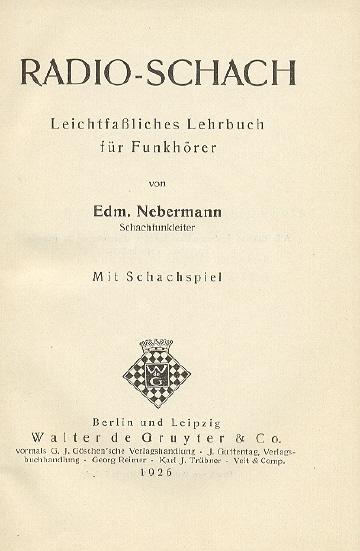
We are grateful to David DeLucia (Darien, CT, USA) for permission to reproduce here four items from his collection which were shown on pages 266-267 of volume two of In Memoriam (Darien, 2012):
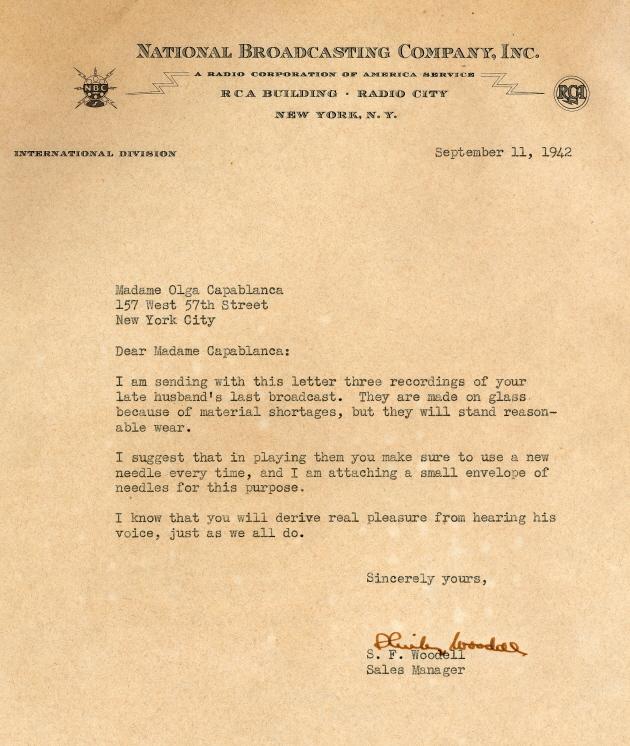
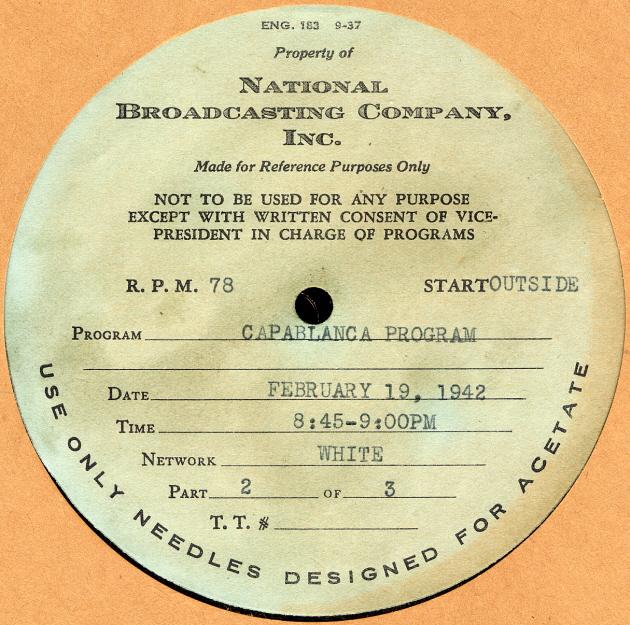
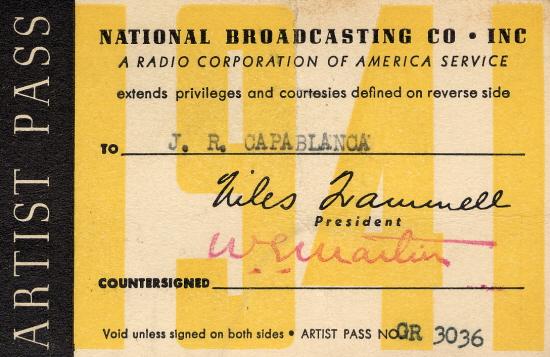
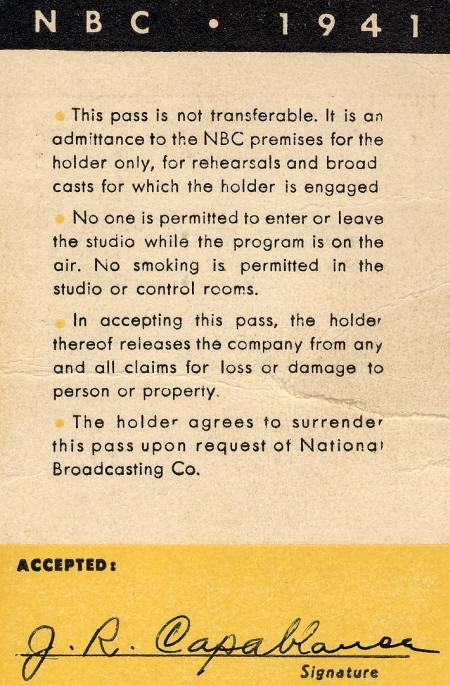
For the text of a radio talk on chess by Samuel Tinsley, see C.N. 8725.
Pages 57-58 of CHESS, 29 November 1958 had an article entitled ‘Chess on the Air’. The first paragraph:
‘Starting at seven p.m. each Tuesday since the end of September, the BBC has given us a half-hour of chess. Never before in the history of British broadcasting has chess had such a show. Previously, it has been inexcusably neglected: only angling – equally numbering hundreds of thousands of devotees but equally hard to “put over” on the air – has suffered so badly.’
A game between listeners and C.H.O’D. Alexander was published on pages 227-230 of CHESS, 23 May 1959.
From pages 97-98 of the March 1934 BCM:
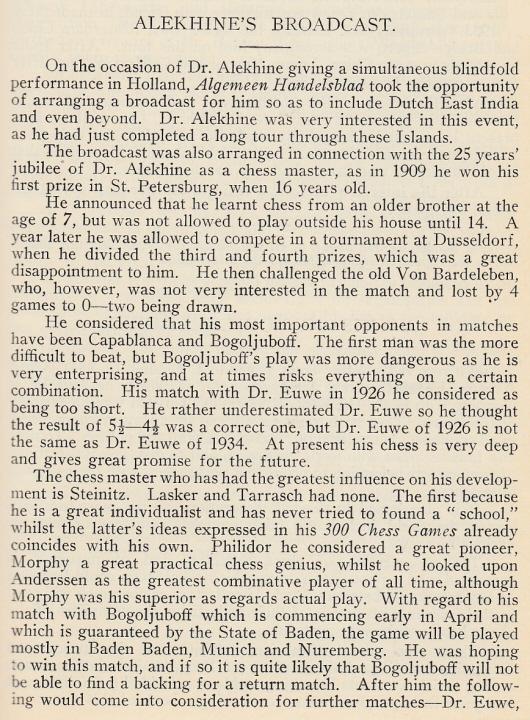
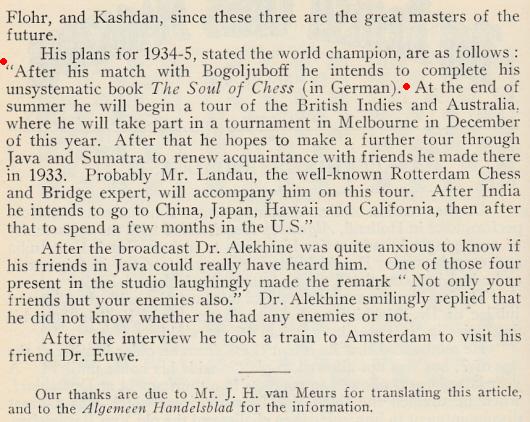
A small correction was published on page 181 of the April 1934 issue:
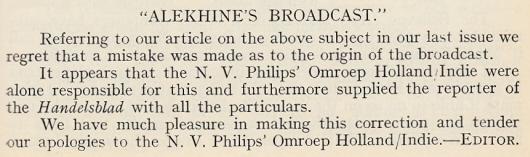
Regarding the ‘unsystematic book The Soul of Chess (in German)’ referred to in the BCM report, on pages 5-6 of Alekhine Nazi Articles (Olomouc, 2002) K. Whyld speculated that, although no such book ever appeared, ‘perhaps some of the ideas that were in Alekhine’s mind at that time appeared in the PZ [Pariser Zeitung] series’.
From page 5 of Curious Chess Facts by Irving Chernev (New York, 1937):
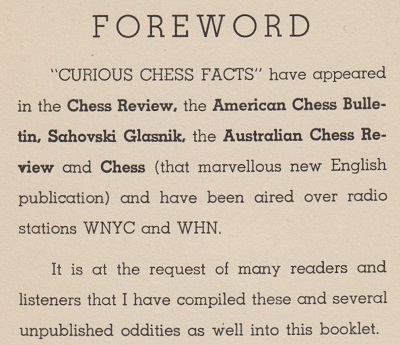
It is unclear from the wording whether Chernev himself broadcast the material on the radio.
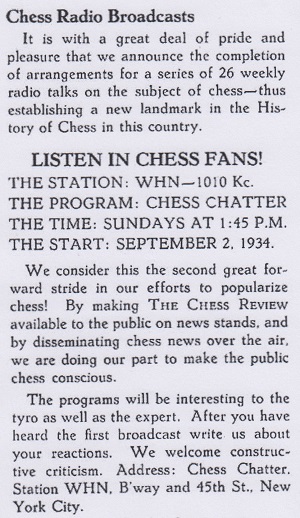
A radio project had been announced on page 146 of the September 1934 Chess Review:
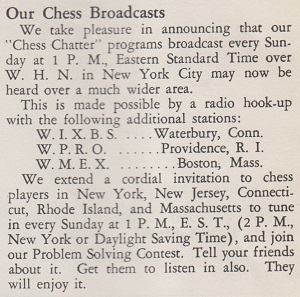
A follow-up item was published on page 102 of the May 1935 issue:
(10136)
A reference to chess by the brilliant BBC broadcaster Eddie Mair.
(10792)
Eddie Mair, primarily a radio broadcaster, left the BBC to join LBC in 2018.
From page 3 of the Chess Amateur, October 1926:
‘Norag, the Hamburg wireless station, has engaged the famous master A. Nimzowitsch to broadcast a series of talks in October and November.’
For later references to Nimzowitsch and radio broadcasts, see pages 189 and 192 of Aaron Nimzowitsch 1928-1935 by Rudolf Reinhardt (Berlin, 2010), or pages 191 and 194 of the English edition (Alkmaar, 2013).
(10845)
Olimpiu G. Urcan (Singapore) informs us that he has acquired from the Netherlands Institute for Sound and Vision the right to post on his Patreon webpage a brief audio file of Capablanca speaking in English during the AVRO tournament, on the occasion of his 50th birthday (19 November 1938).
(11337)
An addition has been submitted by Michael McDowell (Westcliff-on-sea, England), from page 2 of The Problemist, January 1959:
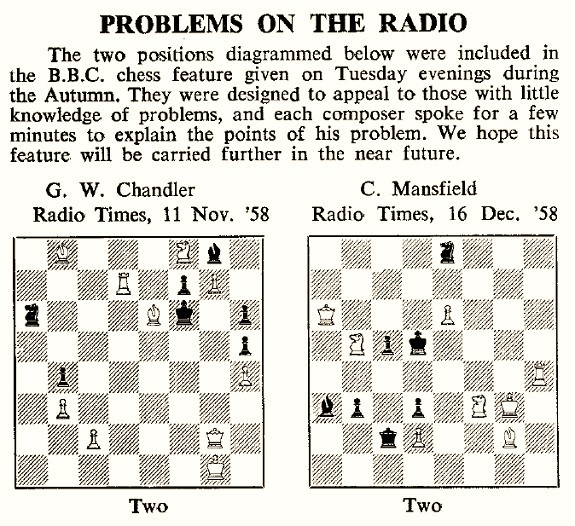
We add the related features in the Radio Times:
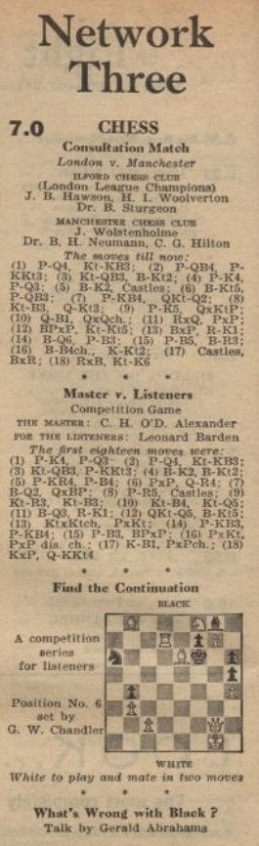
7 November 1958, page 34 (concerning a broadcast on 11 November 1958)
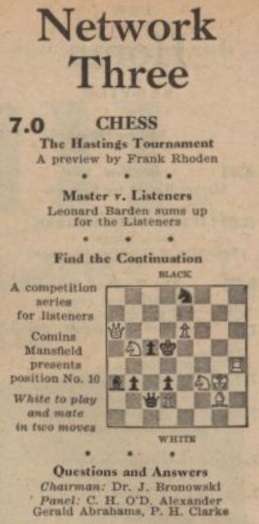
12 December 1958, page 30 (concerning a broadcast on 16 December 1958)
(11848)
Browsing on the Radio Times website, we have noted the billing for a 45-minute radio play, The Queen’s Retreat by Tanika Gupta, broadcast on BBC Radio Four on 1 June 1999.
(11849)
C.N. 10977 referred to the unavailability of any sound recording featuring Emanuel Lasker, but now Olimpiu G. Urcan has found an instance on the Beeld en Geluid website and has secured permission for the file to be presented by us:
It was broadcast by the Dutch station KRO on 5 November 1935, during the Alekhine v Euwe world championship match. The interviewer, it seems, was Salo Landau.
The following transcript of Lasker being interviewed in Dutch has been provided, together with an English translation, by Hans Renette (Bierbeek, Belgium):
‘Ja, ja, ook zij hebben getoond zwakke zijden te hebben. Zo is de mens nu eenmaal. Niet steeds übermensch. Wat is de mens zonder enige zwakte? [Dat] bestaat alleen in de verbeelding.
Hoe kan Euwe van de zwakke zijde van Aljechin profiteren?
Indien hij speelt wat Aljechin niet goed ligt. Meer voor de hand ligt de vraag: wat zal Aljechin doen om zijn zwakke zijden te versterken? Dat hij daarmee tussen het spelen van de partijen druk bezig is, daaraan bestaat voor mij geen twijfel.
Zal het hem lukken?
Ik zal je een geheim toevertrouwen. Deze jonge man heeft talent. [De interviewer lacht.] Dat zeker. Dus wat een geniaal mens bereiken kan en hoe snel en handig hij iets kan aanleren, kan immers niemand raden.
Als ik het goed begrijp, heeft Euwe dus goede kansen als hij met wit speelt mits hij met de damepion opent. Maar hoe staat het met zijn verdediging als hij met zwart speelt?
Tot nu toe heeft hij met zwart ongunstig gespeeld. Vier partijen verloren met zwart is allesbehalve mooi. Maar vijf winstpunten met wit en slechts een verliespartij met deze kleur is uitstekend.
We zullen het zo zeggen: wie met wit speelt heeft een voordeel?
Zo was het niet altijd. Zukertort was van mening was dat e2-e4 een slechte zet was die door e7-e5 weerlegd werd en Aljechin’s loopbaan onderlijnt dit. Hij heeft met zwart in de Spaanse partij, die toch als zeer sterk geldt, zo goed als alle partijen gewonnen en geen enkele daarvan verloren, haast dertig jaren.
Tegenwoordig echter worden de meeste partijen door wit gewonnen?
Maar dat is individueel en afwisselend. Sommige meesters voelen zich beter thuis in de verdediging en anderen voelen zich meer op hun gemak als ze kunnen aanvallen.
Hoe komt dat dan, dokter?
Alles in het leven gaat op en neer. Zo is het ook hier. In het ene tijdperk winnen de witte stukken, in het andere, de andere keer, winnen de zwarte. Ik zal u liever vertellen wanneer Euwe zich echt in zijn element voelt.’
‘Yes, yes, they too showed weaknesses. That is how man is. Not always an übermensch. What would a man be without weaknesses? That exists only in the imagination.
How can Euwe take advantage of Alekhine’s weak side?
By playing that which does not suit Alekhine. But the more obvious question is: what will Alekhine do to strengthen his weaknesses? I have no doubt that he is working on that between the games.
Will he succeed?
I shall entrust you with a secret. This young man has talent. [The interviewer laughs.] That is for sure. How much a genius can achieve and how quickly and skilfully he can learn something – that is anybody’s guess.
If I understand correctly, Euwe has good chances when playing White – provided that he opens with the queen’s pawn. But what about his defence with Black?
So far he has played inauspiciously with Black. Losing four games with Black is anything but good. But five wins and just one loss with White – that is excellent.
Can we put it this way: White has the advantage?
It was not always like that. Zukertort considered e2-e4 a bad move, refuted by e7-e5, and Alekhine’s career underlines this. With Black against the Spanish Opening, known, after all, as a very strong opening, he has won almost all his games and did not lose a single one for nearly 30 years.
However, nowadays are not most games won by White?
But that is individual and variable. Some masters feel more at home in defence, and others feel more at ease when they are able to attack.
How can this be explained, Doctor?
Everything in life goes up and down. The same also here. In one period, the white pieces win, in another the black pieces do. I would prefer to tell you when Euwe truly feels in his element.’
Richard Forster (Winterthur, Switzerland) points out that Lasker mentioned the radio broadcast in two letters to his wife Martha (xeroxes courtesy of Jurgen Stigter, Amsterdam). On 31 October 1935, Lasker wrote from Amsterdam:
‘Jetzt arbeite ich an meinem nächsten holländischen Vortrag vom 5ten Nov Abends 9.45min, indem fortgesetzt unter Leitung von Alex Frank Übungen an der Aussprache mache.’
[‘Now I am working on my next talk in Dutch for 5 November, 9.45 PM, by doing constant pronunciation training under the guidance of Alex Frank.’]
For some details concerning the journalist and actor Alex Frank (1888-1950), see this webpage.
On the day of the radio broadcast, 5 November 1935, Lasker informed his wife late at night:
‘Alle sind erstaunt, dass ich so gut auf holländisch geredet habe. Landau + Alex Frank waren entzückt, auch die Leute vom Radio selbst.’
[‘Everyone is amazed how well I spoke Dutch. Landau and Alex Frank were delighted, as were the radio people themselves.’]
(11905)
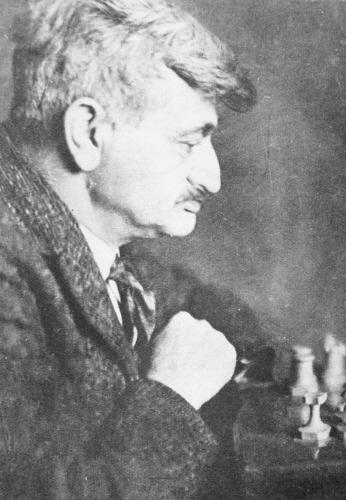
Emanuel Lasker (see A Series of Books on Lasker)
For ease of reference, we add below links to recordings of the voices of Capablanca, Alekhine and Euwe (some of which, accompanied by moving images are also mentioned in Chess Masters on Film):
Alekhine (French); Euwe (Dutch);
Alekhine (French); Euwe (German);
To the Chess Notes main page.
To the Archives for other feature articles.
Copyright: Edward Winter. All rights reserved.