Edward Winter
See C.N. 5761.
We list a selection of articles about chess and psychology in old periodicals:
A book by Peter Fuller entitled The Champions and subtitled ‘The secret motives in games and sports’ (Urizen Books, New York, 1977) discusses figures from the worlds of chess, bullfighting, boxing and motor-racing. The chess chapter (pages 49-104) has plenty of trivia and tripe about the masters of yesteryear (the first paragraph states, ‘Steinitz claimed to have played God at pawn odds and won’) but is essentially about Fischer, viewed from a psychoanalytical standpoint.
The results are spectacular. Fuller opines that Fischer’s queen sacrifice in his famous game against Donald Byrne in 1956 ‘is central to the understanding of Fischer’s psychological motivations in chess’ and that ‘more has been written about this queen sacrifice than about any other single move made this century’ (pages 71-72). The implications for Fischer were, it is indicated on page 81, greater than anybody could have imagined:
‘Although Fischer played excessively aggressive chess, it remained difficult to demonstrate manhood through a non-physical game, in which the queen is represented as the main ally.
His need to disguise his internal Regina affected chess and life. On the board it was first expressed in the queen sacrifice. The historic move paralleled his ego-ambition to deny identification with his mother, simultaneously symbolizing a refusal to accept the option of homosexuality, and a defiant rejection of infantile dependence. A reversal of usual chess practice, it paralleled a reversal he was trying to bring about with himself.’
These observations were considered so judicious that the sentence beginning ‘The historic move’ was paraded on the back of the dust-jacket. Yet it is on page 100 that the chapter attains its high-water mark:
‘For some Russians, as Lenin warned, chess may become an alternative to revolutionary thought: instead of confronting the failure of the revolution in terms of history, players may attempt to achieve individualistic solutions on the chess board, and these become inextricably bound up with their own private conflicts. Chess, and its accompanying strategical and tactical theory, may thus be pursued as a way of working out a better form of regicide, and of evading reality and retreating into a private world at the same time.
We may correspondingly speculate (and it is no more than that) that the dramatic upsurge of interest in Fischer in the sixties, combined with the sudden birth of chess as a major cultural component in America, was in part related to the continuing national preoccupation with the assassination of President Kennedy. Interest in the game may socially have been a way of mastering the guilt and anxiety inevitably associated with the murder of a leader. The wish to return to the traumatic event may thus parallel, within a broader context, the desire of Freud’s grandson to return to the scene of his mother’s departure in order to find a way of binding the anxiety associated with it. It is at least possible that chess thus provides a way of repeating rather than remembering national as well as personal conflicts.’
(3100)
See The Byrne v Fischer ‘Game of the Century’.
In C.N. 559 William Hartston (Cambridge, England) quoted a sentence from a 1960 paper by Félix Martí-Ibáñez:
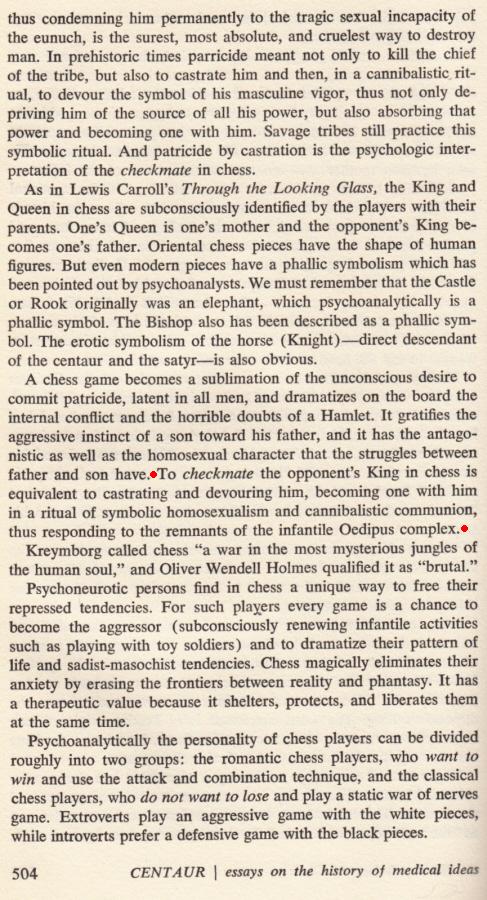
‘To checkmate the opponent’s king in chess is equivalent to castrating and devouring him, becoming one with him in a ritual of symbolic homosexualism and cannibalistic communion, thus responding to the remnants of the infantile Oedipus complex.’
We now note a slightly earlier appearance of the passage, on page 504 of Martí-Ibáñez’s book Centaur: Essays on the History of Medical Ideas (New York, 1958). It is in an essay ‘On the Psychology of Chess’ (pages 501-508):
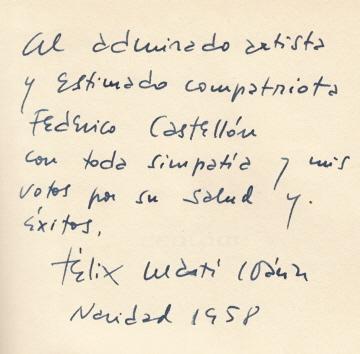
The author’s inscription in our copy:
(7456)
A very scholarly work is Jeu d’échecs et sciences humaines by Jacques Dextreit and Norbert Engel (Payot, 1981) although unfortunately it has so far made virtually no impression outside France. The chapter headings indicate the scope: 1) position du jeu d’échecs 2) jeu d’échecs et psychanalyse 3) jeu d’échecs et psychiatrie 4) jeu d’échecs et psychologie 5) jeu d’échecs et éducation 6) jeu d’échecs et sociologie 7) jeu d’échecs et écritures 8) jeu d’échecs et société. It is hard to imagine that chess writers on any of these themes will in future dare neglect this important book (which is complete with 38 pages of notes and a 14-page bibliography). The only truly weak spot is the first part of the chapter on chess and psychiatry, which is lamentably superficial in recounting the old masters’ (real or imagined) quirks.
(754)
Dr P.C. Wason (Goring-on-Thames, England) sends the following extract from Metamagical Themas by Douglas R. Hofstadter (London, 1985), pages 208-209:
‘A brilliant chess move, once the game is over and can be viewed in retrospect, can be seen as logical – as “the correct thing to do in that situation”. But brilliant moves do not originate from the kind of logical analysis that occurs after the game; there is no time during the game to check out all the logical consequences of a move. Good chess moves spring from the organization of a good chess mind: a set of perceptions arranged in such a way that certain kinds of ideas leap to mind when certain subtle patterns or cues are present. This way that perceptions have of triggering old and buried memories underlies skill in any type of human activity, not only chess. It’s just that in chess the skill is particularly deceptive, because after the fact, it can all be justified by logical analysis, a fact that seems to hint that the original idea came from logic.
Writing lovely melodies is another one of those deceptive arts. To the mathematically inclined, notes seem like numbers and melodies like number patterns. Therefore all the beauty of a melody seems as if it ought to be describable in some simple mathematical way. But so far, no formula has produced even a single good melody. Of course, you can look back at any melody and write a formula that will produce it and variations on it. But that is retrospective, not prospective. Lovely chess moves and lovely melodies (and lovely theorems in mathematics, etc.) have this in common: every one has idiosyncratic nuances that seem logical a posteriori but that are not easy to anticipate a priori. To the mathematical mind, chess-playing skill and melody-writing skill and theorem-discovering skill seem obviously formalizable, but the truth turns out to be tantalizingly more complex than that. Too many subtle balances are involved.’
(1498)
Ken Whyld (Caistor, England) comments:
‘This touches on a matter which is completely ignored in most creative and sporting activities. What the great performers say afterwards is not what motivated them at the moment of truth, and never can be. Chess students are perhaps the most easily deceived because they believe chess to be entirely logical. But at a high level there are so many other factors which can never be captured in words. So what we get is a verbal justification for a move, and we can never know what really triggered it. Behind that insight lies, for me, the real importance of computer research into chess.’
(1571)
See also C.N. 7198.
Few topics lend themselves so readily to waffle as does ‘chess psychology’. (C.N. 5616)
John Blackstone (Las Vegas, NV, USA) notes pages 189-192 of Introduction to Psychology by Robert M. Yerkes (New York, 1911):
The game-score is: 1 e4 e5 2 d4 exd4 3 Nf3 Nf6 4 e5 Ne4 5 Qxd4 Nc5 6 Bc4 Nc6 7 Qf4 Ne6 8 Bxe6 dxe6 9 Qg3 Ne7 10 O-O Qd5 11 Nc3 Qc4 12 Nd2 Qc6 13 Nb3 Nf5 14 Qh3 b6 15 Bg5 h6

16 Rad1 Bb7 17 f3 hxg5 18 Qxh8 Ne3 19 Nd4 Qc4 20 Ndb5 Nxf1 21 Rd4 Qc5 22 Kxf1 Ba6 23 Rd3 Bxb5 24 Nxb5 Qxb5 25 White resigns.
More information on the game is sought. An immediate question is whether E.E. Southard’s opponent, ‘F.J.M.’, was Frank James Marshall.

Elmer Ernest Southard (1876-1920)
(6350)
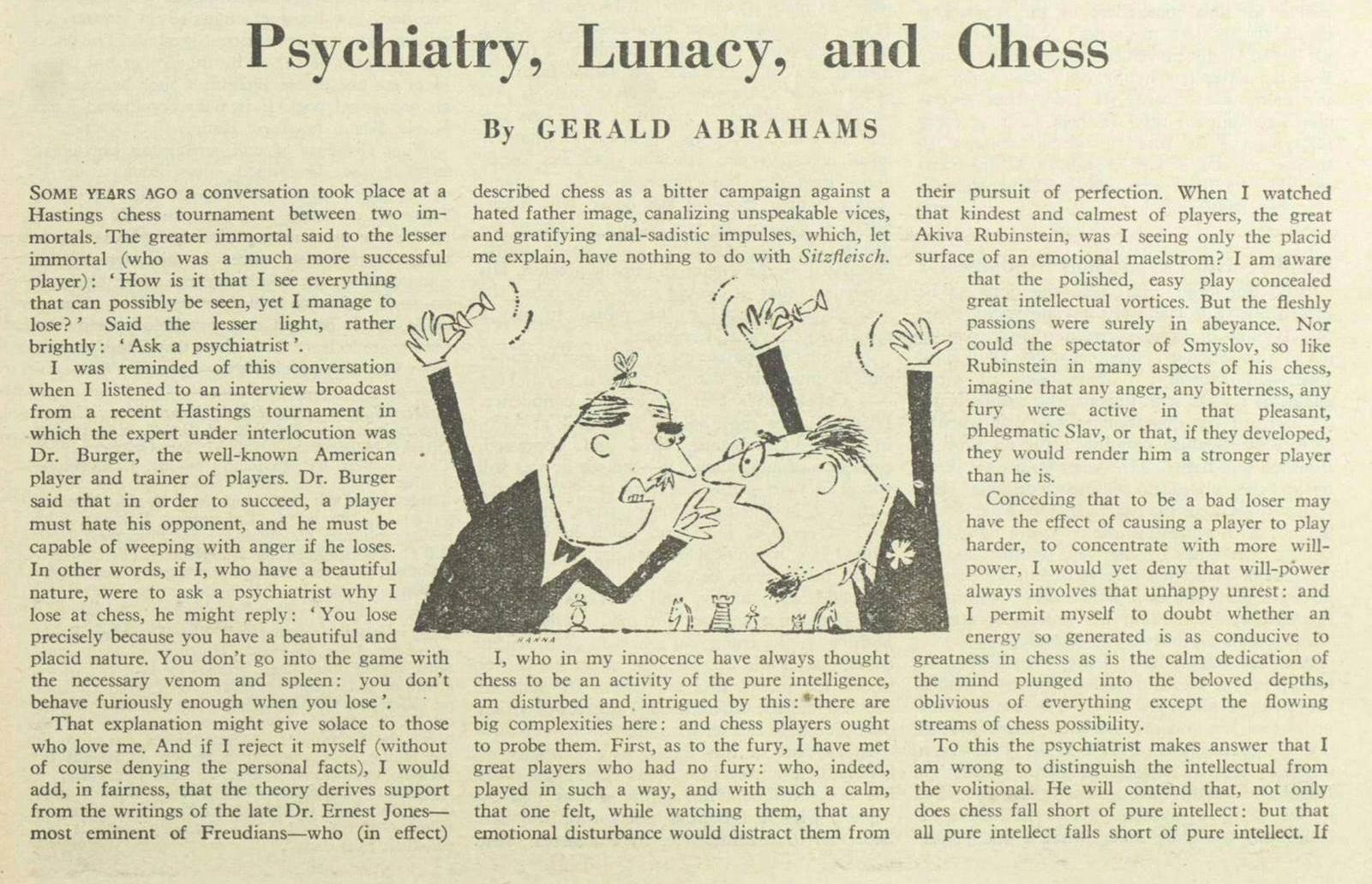
Olimpiu G. Urcan (Singapore) has supplied an article by Gerald Abrahams from pages 743-744 of The Listener, 27 October 1960:
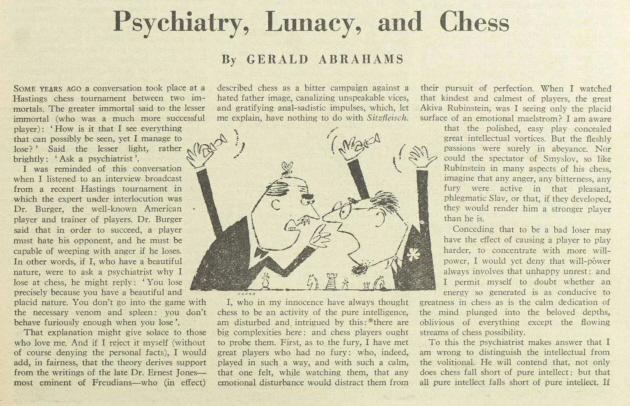
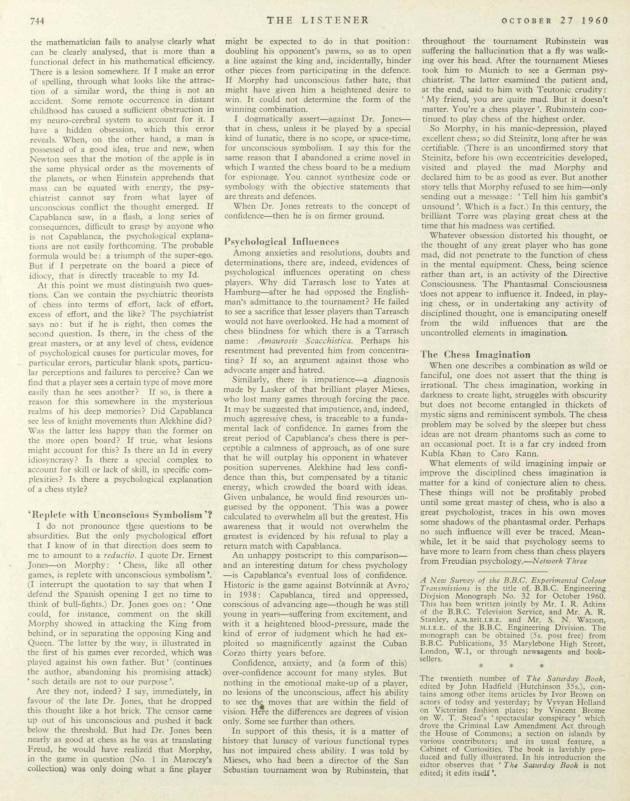
The text is markedly different from the article of the same title reproduced on pages 26-36 of Abrahams’ book Not Only Chess (London, 1974).
(8139)
A remark by C.J.S. Purdy:
‘Against a wary chessplayer the possibilities of applied psychology by an opponent are very limited. The real psychological opponent of every player is himself.’
Source: an article entitled ‘Psychology in Chess’ in Chess World, November 1957, pages 230-232.
(10193)
Below is a remark by G.H. Diggle from an article in the December 1981 Newsflash which was reproduced on page 78 of Chess Characters (Geneva, 1984). See too C.N. 7805.
‘Sixty years ago there were dotted around the provinces (either in small struggling clubs or once a week in “private house soirées”) players with only each other’s chess intellects to feed on who would loyally stick to the game without improving one iota through whole decades. ... Many of them were characters of as great psychological interest as a Fischer or a Korchnoi; for to imagine that “psychological motifs” and whatnot are the exclusive monopoly of grandmasters is to fall into the snobbish fallacy of the Sergeant Major who (when a poor Private reported sick with a “pain in the abdomen”) roared at him: “You ’ave a stummick! Only orficers has abdomens!”’
(11166)
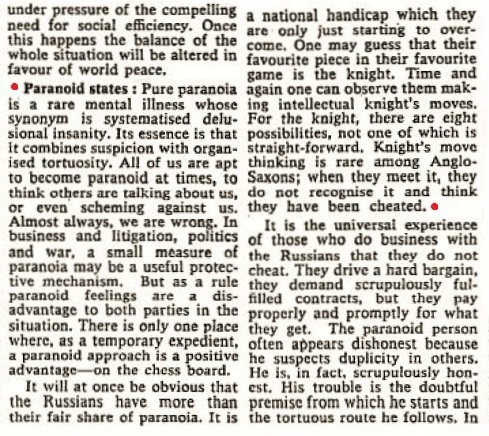
Pages 25-26 of the Magazine Section of the Sunday Times, 26 November 1961 had an article entitled ‘The Mind of the Russians’ by Lord Taylor, introduced as follows:
‘For generations the Russians have been the great enigma: the Revolution has shrouded their personality still more. Lord Taylor, psychiatrist and politician, here uses the techniques of modern scientific analysis to disentangle their complex make-up.’
Page 26 had this text:
Nowadays, one could expect immediate reports that ‘furious’ readers ‘took to Twitter’ to ‘shut down’ Lord Taylor, but CHESS held back for nearly nine months:
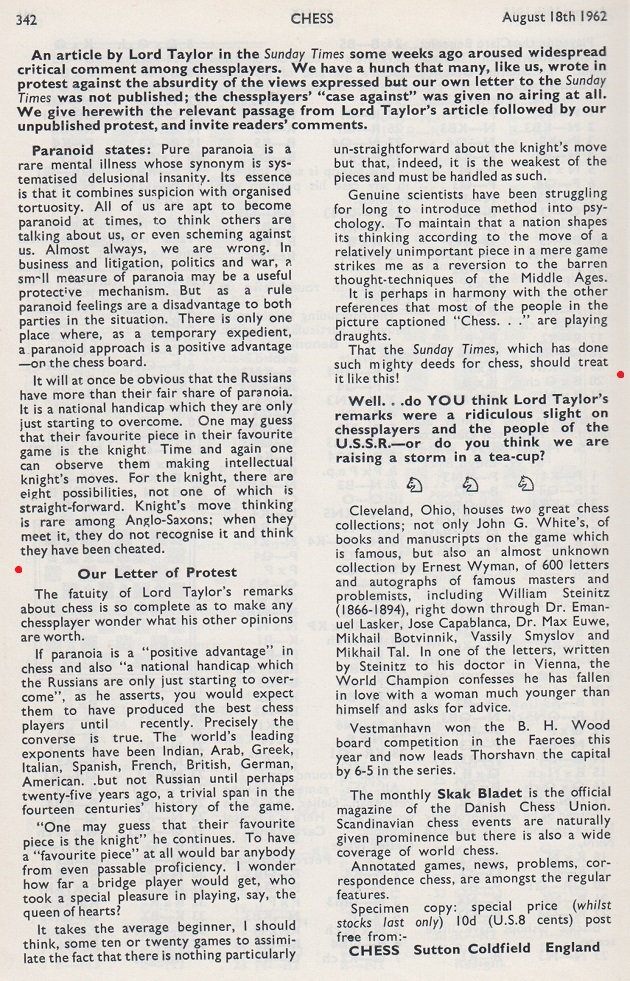
After another long wait, CHESS readers were allowed to chime in, on pages 137-138 of the February 1963 issue. One sentence from the heading:
‘Many letters received, if printed, would have landed us in the law courts.’
The tardy publication of the original feature in CHESS and the heading’s reference to ‘the Sunday Times some weeks ago’ have resulted in Lord Taylor’s article being dated 1962, rather than 1961, by a number of writers. See, for instance, page 43 of Soviet Chess by D.J. Richards (Oxford, 1965).
(11229)
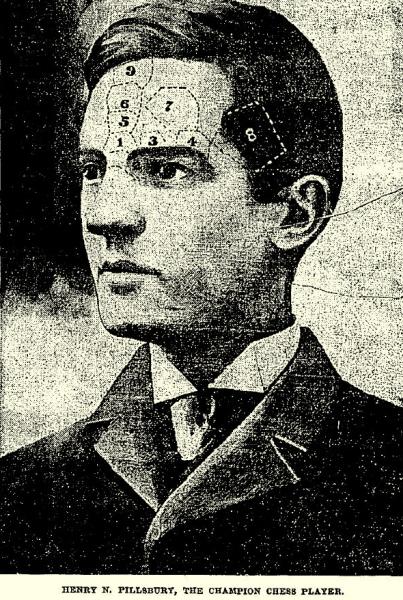
Much has been written about Emanuel Lasker and psychology at the chess board; see, for instance, pages 3-25 of Winning with Chess Psychology by Pal Benko and Burt Hochberg (New York, 1991). Réti’s observations on Lasker in Masters of the Chess Board are well known, but when did public discussion begin of Lasker’s ‘psychological’ approach to the game?
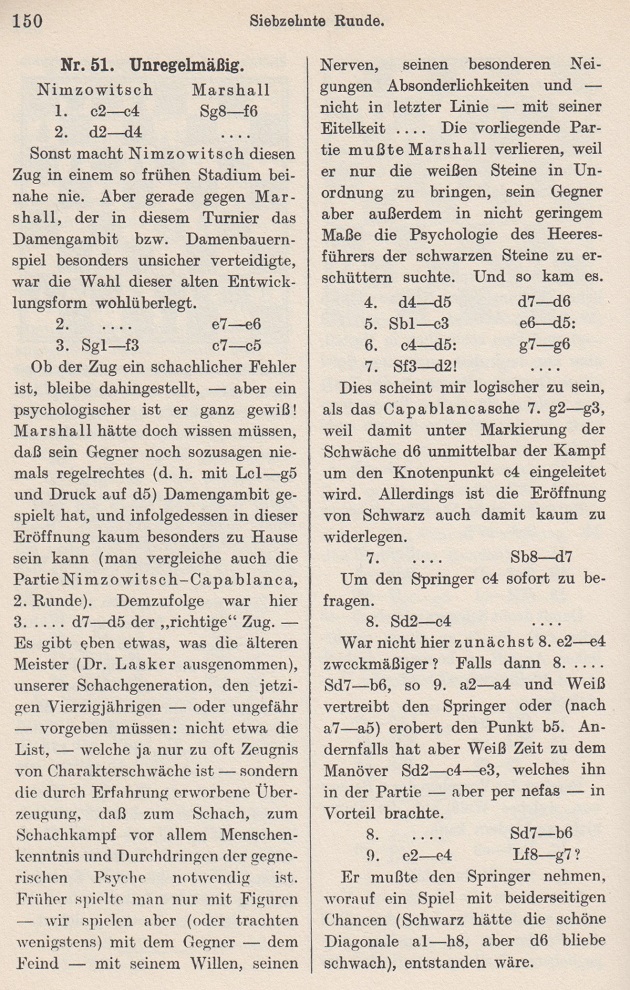
Alekhine made some notable comments about chess psychology, including a reference to Lasker, on page 150 of his book Das New Yorker Schachturnier 1927 (Berlin, 1928):
Addition on 25 October 2025:
‘Rowson offers an analysis of chess psychology and chess thinking that, in both depth and practical value, is unequalled in all of chess literature.’
Source: Daniel Naroditsky, Chess Life, November 2018, page 48. The reference is to Jonathan Rowson’s Chess for Zebras (London, 2005).
From an article Capablanca: Why Chess Is Popular on page 24 of the Brooklyn Daily Eagle, 14 February 1930:
‘A good chess player must have imagination as well as logic in his makeup. Neither quality can stand alone to arrive at satisfactory results in the game. Reflection is necessary, and quick judgment, the better to profit by one’s opponent’s mistakes. When two great masters are playing it is, of course, out of the question to count on actual mistakes, but he who perceives first his adversary’s plans and intentions is he who wins ultimately.
In that process the chess player requires, in addition to imagination and logic, an equally good supply of psychological talent, for by such means he can gauge his opponent’s character, which gives a clue to his projects in mind.’
See too Reuben Fine, Chess and Psychology and Chess and Insanity.
To the Chess Notes main page.
To the Archives for other feature articles.
Copyright: Edward Winter. All rights reserved.