Edward Winter
‘I’m not good at attention to detail ... I couldn’t have run a corner shop – absolutely impossible!’
Raymond Keene (See the ‘Attention to detail’ section below.)
***
An extensive selection of items demonstrating Raymond Keene’s unreformable slovenliness and worse.
From page 266 of Chess Explorations:
C.N. 331 questioned the exact role in Batsford Chess Openings of Garry Kasparov, who was referred to as a co-author. In a letter dated 16 September 1983 (published in C.N. 583) Raymond Keene therefore offered us a copy of Kasparov’s contribution, in return for a cheque for £50 payable to a chess charity. We immediately accepted, but no material was ever provided, and nearly two years elapsed before Mr Keene offered us a refund.
By then the level of Kasparov’s involvement had been confirmed in two letters received from the book’s ‘Research Editor’, Eric Schiller. Although they were published in full (in C.N.s 844 and 870), Mr Schiller made persistent claims that they had been edited or quoted out of context, a falsehood which he continued to propagate even after C.N. 1737 had reproduced his original letters photographically.
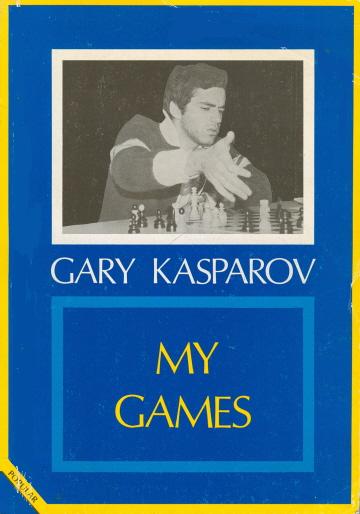
C.N.s 507, 583 and 588 also drew attention to Batsford’s misuse of Kasparov’s name in connection with two other books, Fighting Chess and My Games.
Concerning the £50 matter, on 14 December 1983 Kenneth Whyld (Caistor, England) wrote to us:
‘You’ve called their bluff, but they will wriggle out.’
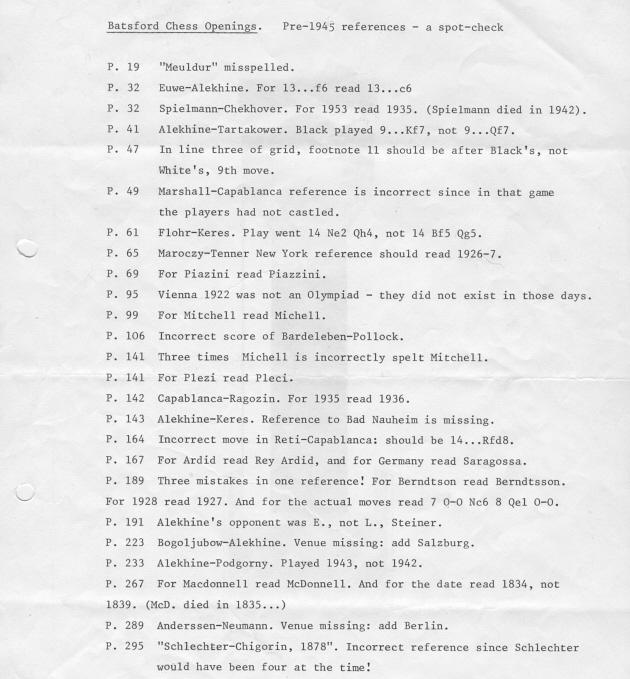
C.N.s 945 and 1159 (given below, and see too pages 150-152 of Chess Explorations) referred to our spot-check of 60 pre-1945 game references in Batsford Chess Openings, which showed that there were errors in no fewer than 36 of them:
As pointed out on page 232 of the Christmas 1984 issue of CHESS, a spot-check that we made of 60 pre-1945 references in Batsford Chess Openings showed factual errors in no fewer than 36.
For instance:
Page 141: Three times Michell is incorrectly spelt Mitchell.
Page 164: Incorrect move in Réti-Capablanca; should be 14...Rfd8.
Page 189: Three mistakes in one reference. For Berndtson read Berndtsson. For 1928 read 1927. And for the actual moves read 7 O-O Nc6 8 Qe1 O-O.
Page 295: ‘Schlechter-Chigorin, 1878’. Incorrect reference since Schlechter would have been four at the time.
Page 297: Maróczy-Marshall. White’s 12th move was Re1, not Rd1.
Page 309: For Fatirni read Fahrni.
Page 333: Reference to Fleissig-Mackenzie, Vienna, 1882 is wrong (completely different position after ...Ng3).
(945)
Regarding our spot-check of Batsford Chess Openings, most of the errors (but not all of them) have been corrected in the ‘4th Revised Impression January 1986’, and we receive an acknowledgement from Raymond Keene in the book. And yet this new BCO is the clearest possible proof that getting facts right is not uppermost in the minds of the Batsford band.
In C.N. 945 we commented: ‘Since doing the above spot-check, we have noted roughly the same percentage of error for other such references in BCO.’ An identical point was made in our letter to Peter Kemmis Betty of Batsford dated 7 February 1985:
‘... you may care to know that subsequent perusal of this unhappy book has shown the same percentage of error. Naturally I should be prepared to pass on details if approached by one of the authors, so that future editions may be corrected.’
Our offer of a second list was never accepted, and we therefore assumed, with our characteristic naïveté, that the various authors had decided to undertake the necessary correction work themselves. Will we never learn? The ‘4th Revised Impression January 1986’ still has a profusion of deficiencies. To show the extent of the problem as clearly as possible we shall take the references to just one great master, Alekhine. (We select him for no better reason than that he is ‘co-author’ Kasparov’s great hero.) Our spot-check list included the following corrections:
Page 32: Euwe-Alekhine. For 13...f6 read 13...c6.
Page 41: Alekhine-Tartakower. Black played 9...Kf7, not 9...Qf7.
Page 95: Rubinstein-Alekhine. Vienna, 1922 was not an Olympiad.
Page 99: Alekhine’s opponent was Michell, not Mitchell.
Page 167: Alekhine’s opponent was Rey Ardid, not ‘Ardid’, and the game was played at Saragossa, not ‘Germany’.
Page 191: Alekhine’s opponent was E., not L., Steiner.
Page 223: Alekhine-Podgorný. Played in 1943, not 1942.
Page 297: Bernstein-Alekhine. For 1934 read 1933.
But what about all the other examples of carelessness that could just as well have been mentioned, and which still appear incorrectly in BCO (4th attempt)? For instance:
Page 47: Alekhine-Prins. Venue missing.
Page 73: For Alekhine’s opponent read Kussman.
Page 80: Euwe-Alekhine, match 1935. Two mistakes. 14 Ne4 should read 14 Nxe5 and Alekhine, not Euwe, was White.
Page 99: ‘Rubinstein-Alekhine, 1924’. And yet we drew attention to this error in C.N. 917.
Page 143: ‘Euwe-Alekhine, match 1937’. The moves in question did not occur in any of the match games. Would it have been too much trouble to check in Alekhine’s second Best Games volume? That would have given the information that the moves were played in the 1926-27 Euwe-Alekhine match. (It might also have been noted that Alekhine gave 14 Qa4 a ‘?’.)
Page 150: Rabinovich-Alekhine, Moscow, 1920. Omission of an acknowledgement to Alekhine for analysis up to move 17.
Page 157: López Esnaola-Alekhine. For ‘Spain’ read Vitoria. (Checking that in Morán’s book on Alekhine takes a few moments.)
That is one player. It is now the BCO co-authors’ job to undertake a thorough overhaul of references to everyone else before they presume to offer the public a 5th Revised Impression.
(1159)
Below is the original list prepared by us at the time:
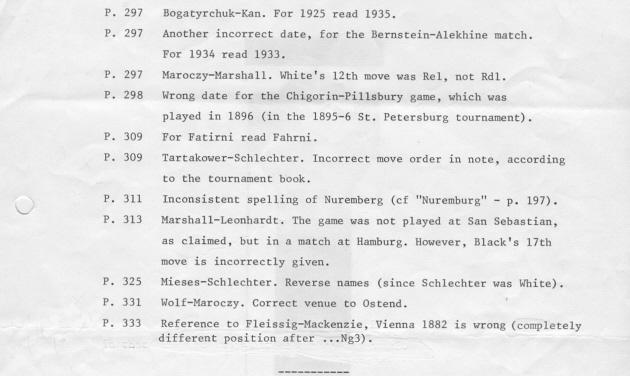
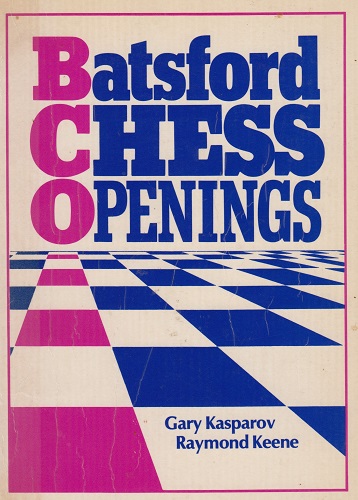
Regarding the attempts by those involved in Batsford Chess Openings to dupe the public over its authorship, C.N. 6372 noted that the most recent revelations come in the article Ex Acton ad Astra.
The following is from the biographical note on Raymond Keene on the back cover of his Complete Book of Beginning Chess (Las Vegas, 2018):
‘He was the co-author, with Garry Kasparov and Eric Schiller [our emphasis], of Batsford Chess Openings, the all-time best-selling opening reference book.’
That is not what the public was told at the time (1982):
From John Donaldson (Berkeley, CA, USA):
‘Simon Constam of Hamilton, Canada raises a very interesting question. Page 12 of The Grünfeld Defence by William Hartston (London, 1971) gives the sequence 1 d4 Nf6 2 c4 g6 3 Nc3 d5 4 cxd5 Nxd5 5 e4 Nxc3 6 bxc3 c5 7 Nf3 Bg7 8 Be2 O-O 9 O-O b6 10 Be3 Bb7 11 e5 cxd4 12 cxd4 Na6 13 Qa4 Nc7, with the better game for Black, Rubinstein-Alekhine, 1924. I have seen no source on either Rubinstein or Alekhine that gives this game and could find no encounter in MegaDatabase 2005 that reached the position after 13...Nc7. Any help on resolving this mystery would be gratefully appreciated.’
Why and when this faulty game reference started appearing in chess literature is unknown to us, but we mentioned it in C.N. 917 after noting the citation ‘Rubinstein-Alekhine, match 1924’ on page 99 of that gaffes-à-gogo book Batsford Chess Openings (London, 1982).
(3607)
The BCM has produced a neat tournament book (exceptionally well illustrated with photographs of the competitors and of their score-sheets – although in the case of the latter it is not always made clear who was the writer) which has excellent annotations from a wide variety of sources. The editor, Raymond Keene, has not managed to avoid repeating the mistake made in Aron Nimzowitsch: A Reappraisal of stating that New York, 1927 decided who was to challenge Capa for the world championship. As is well-known, Alekhine’s challenge had already been confirmed beforehand.
We were at a loss to understand a quote attributed to William Winter on page 65 of London, 1927:
‘For my win over Nimzowitsch I am partly indebted to Amos Burn. Before the tournament I happened to mention to him that Nimzowitsch was playing a system, beginning with 1 b3 ... The old master told me that in his younger days he had played many games with the Rev. John Owen who regularly adopted this opening ...’
The trouble with all this is that Burn had died nearly two years before the London tourney took place.
(586)
Raymond Keene, a contributor [to Chess Express, a new fortnightly newspaper published by Nathan Goldberg], describes the venture as ‘the biggest publishing event in more than 50 years in this country’. This reference is meaningless since there was no other big event around 1930. (In passing, we were far from pleased with the same writer’s claim that the world championship semi-finals were to be ‘the greatest chess event in Britain since 1851’. But Mr Keene, we now realize, is fond of these anti-historical hypes. We recall another from page 174 of his (and Levy’s) book on the 1974 Nice Olympiad to the effect that actions of FIDE and Euwe ‘represent the biggest scandal the chess world has seen since Staunton refused to play a match with Morphy’. We hope that this wild dumping of inappropriate comparisons and precedents will stop.
(640)
After just one issue of Chess Express had been published some had already made up their minds. Raymond Keene:
‘It is without doubt the best chess publication I have ever seen.’
(677)
Notwithstanding Raymond Keene’s currente calamo praise for Chess Express, the magazine folded after a small number of issues, as noted in C.N. 782. We found it a deeply unimpressive publication.
Welcoming and recycling any praise from Raymond Keene suggests, at best, naivety or lack of principle.
The match was a semi-final.
On 16 September 1983 Raymond Keene submitted to Chess Notes a letter in which he took exception to ‘a totally incorrect comment’ which, he alleged, we had made in C.N. 507 regarding the Batsford book Fighting Chess. He asked us ‘to withdraw your damaging comment in the next issue of your organ’.
His letter was published in full in C.N. 583, together with proof that, as a matter of plain fact, it was he himself who was wrong.
On pages 111-114 of the August 1984 CHESS we contributed an article ‘Problems with British Chess Literature’, criticizing such trends as the large number of errors and general sloppiness. Although the article did not mention Raymond Keene, he replied on behalf of B.T. Batsford Ltd. on pages 146-147 of the October 1984 CHESS. His first paragraph sought to discredit us by asserting that our argument was:
Raymond Keene did not give a single example of a factual inaccuracy by us, and continued to refuse to do so, despite our persistent challenges. Further exchanges appeared in CHESS, and in an article on pages 122-123 of the August 1985 issue he claimed that many points made by us in a letter published on pages 231-233 of the Christmas 1984 issue were:‘... severely weakened by factual inaccuracies.’
‘... bogus and misleading.’
In support of this, he presented one alleged example (concerning the Kasparov book My Games) and added:
‘Such a blatant inaccuracy from Mr Winter surely merits an apology or retraction.’
However, as demonstrated by us in the mid-July 1986 issue of CHESS (page 177) and as is clearly shown by the My Games book, it was, once again, Raymond Keene himself who was incorrect. Thus the single example provided by him to support his thesis that we had been ‘bogus and misleading’ was wrong as a matter of public record. Raymond Keene never apologized.
Our response to Raymond Keene’s October 1984 CHESS article was published in edited form. We give here the full original version (letter to B.H. Wood dated 27 October 1984).
An extract from C.N. 587:
And now yet another Batsford book by Kasparov: My Games. Once again it is absolutely unclear how much G.K. was involved in this book apart from writing page XIII and annotating ten games. Some of the game-scores making up the bulk of the book are annotated with symbols but nowhere is it stated whether Kasparov and/or the editors (Marović and Klarić) are responsible for these.
The text of C.N. 608:
In terms of new chess literature this magazine has been accused of being uncommonly hard to please.
We note, however, that the October and November [1983] BCMs review Chess for Tomorrow’s Champions, My Games ‘by Kasparov’ and 100 Classics of the Chessboard with a lack of appreciation that warms the heart.
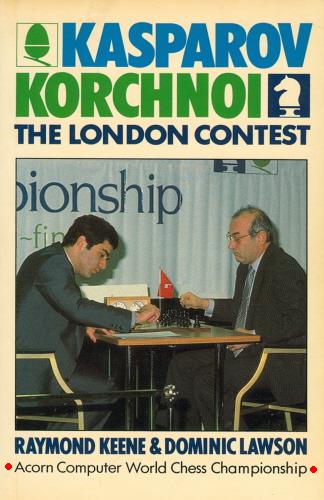
The main issue arising out of Docklands Encounter by Raymond Keene and others (the identity of the others depends upon which title page one reads) is not the jarring geography (Yasser Seirawan was not ‘born in England’ but in Damascus) or the hapless history (‘Not since the days of Alekhine has the incumbent of the supreme title captured first prize in so many top events’ – in fact Karpov is well ahead in this respect) or the vapid verbiage (‘Vacations, or holidays as we call them rather banally in Britain, are what you make of them’) or the dubious dogma (Korchnoi is ‘greater even than Lasker at defending and saving difficult positions’) or the gruesome grammar (‘With such diverse membership, there will be obviously be conflicts’) or the ... – but no, one should not dwell on such blemishes in this rapidly produced hardback (‘A Batsford/US Chess Federation book’) which has the same breathless spy-thriller style as Kasparov-Korchnoi,The London Contest: ‘Seconds before the event was due to start it was realized that the boards and sets had not arrived. However, swift telephone calls to the Pentagon, the Vatican and That’s Life solved the problem with minutes to spare.’ In short, much of the background material is garbage, or rubbish as we call it rather banally in Britain.
The chief point at stake is not even the book’s curious belief that the reader will view with reverential wonder the glamorous world of wealth and power that is portrayed. Page 17: ‘Richard Desmond did, however, offer everyone a lift in his gold Rolls Royce (number plate RJD 1) ...’ After a line like that one feels that if an Atlantic crossing had to be made, only Concorde would do. And so it proves, on page 135: ‘FIDE President Florencio Campomanes flew by Concorde.’
Far more important than this tinselry is the fact that for the first time a book has gone all the way in publicizing the sponsor of an event. It is true that The London Contest paved the way, notably with a front cover that boldly stated ‘Acorn Computer World Chess Championship’ (thus proving that what counted was the sponsor’s name and not a correct description of the event), but Docklands Encounter goes much further. Chess fans are even offered three gripping photos ‘View across Millwall Dock’, ‘The proposed STOLport site at the Royal Docks’ and ‘Northern and Shell’s spectacular new building on Millwall Dock’. The book starts with eight and a half pages of history of Docklands that show signs of having been stitched on as an afterthought.
Our question to readers is whether we are alone in feeling ill-at-ease about such prominence being given to a sponsor. Is there a case for saying good luck to sponsors in securing all the publicity they can by any means, or do readers share our opinion that books should not be over-run with advertising matter?
Final remarks: the bibliography acknowledges the work’s debt to The Decline and Fall of the Roman Empire. The annotations are of the Anmerkungen von E. Bogoljubow kind mentioned in C.N. 698. From the dust-jacket (which, surprisingly, features the Docklands) we learn that the author is ‘a regular commentator on BBC-2 chess programmes’.
The last letter received from Mr Keene was dated 5 February 1984. Over a year’s wait and then ...
‘London SW7, 1 April 1985
Dear Mr Winter,
I should like to deal as briefly as possible with the various points of discussion that we have pending:
a) You are correct about my error over the Graz tournament reference in Fighting Chess, and I therefore naturally withdraw my request that you retract your comment.
b) I also accept your correction of my statement in the Batsford catalogue that Fighting Chess is “the very first anthology of Kasparov’s games to appear in the West”.
c) I further acknowledge that at the time the Batsford catalogue twice neglected to mention Nikitin in connection with the Scheveningen Sicilian book, despite my claim to the contrary in my letter to you of 16 September 1983.
d) It is true that you received three contradictory defences of Batsford’s publishing policy in 1983. In view of this confusion I suggested to Mr Peter Kemmis Betty that the subject should be dropped.
e) The letter that Eric Schiller wrote to you (dated 6 October 1984) is, I am afraid to confess to you, not what I expected or hoped. Now that the role of others in Batsford Chess Openings has been revealed, I make a public pledge: no future editions will appear with only Kasparov and myself credited as authors.
f) As regards the question of photocopies, I admit that my conduct has been inexcusable. Not only have I failed to honour my offer but I have not even kept you in touch with the real situation; I note with great shame that even now you have not received your 50 pounds back.
g) I apologise for my statement (16 September 1983) that Batsford were involved in the photocopies question. You can imagine my embarrassment when the Batsford Managing Director wrote to you on 22 October 1984 that the company had no connection with my offer at all.
h) Turning to the subject of my letter in the October 1984 CHESS, I am sorry for having accused you of factual errors. I gave no examples and now accept that there were no mistakes in your August 1984 CHESS article.
i) I accept your counter-arguments in the Christmas CHESS, and in particular your rebuttal of my statistics. But then, as I wrote in Massacre in Merano (page 13), “I studied Modern Languages at Cambridge, not Mathematics”.
j) I regret, too, my “outrageously misleading” reference to the photocopies question in my October article.
k) Your adverse comments in my Docklands Encounter are justified.
l) It is awkward for me to reply to your revelation of the 36-error-spot-check of BCO. I am reluctant to accept much of the blame myself although, since I am referred to as co-author of the book, I suppose I must.
For your information, I have written along similar lines as the above to CHESS, since I now believe that frankness and honesty are essential. You will recall that in the June 1979 issue I wrote that “I would answer anything, on condition that my accuser was courageous enough to put his or her name to any charges they had to make”, although in fact no reply ever appeared from me regarding the allegation made by Mrs Stean that I had dishonoured my contract with Korchnoi. I shall therefore give my belated response to CHESS readers on that question too.
If you would like any other information please do not hesitate to write to me and I undertake to reply to you by return as a service to the cause of truth.
Yours sincerely,
Raymond Keene’
If only, if only ... The above letter has been ‘ghosted’ by us.
(967)
The Karpov-Kasparov world championship match was terminated on Friday, 15 February 1985; just 11 days later we received our ordered copy of The Moscow Challenge by Raymond Keene. Batsford’s speedy publication (and, let it not be forgotten, distribution) is a remarkable tour de force.
Since most reviews will, presumably, concentrate on the game annotations, we prefer to discuss the background and historical features. As regards general ‘atmosphere’ material, the author has adopted the novel approach of writing mainly about himself: ‘Baguio 1978, where I acted as Korchnoi’s chief second’; ‘One day I plan to write the definitive chess bestiary’; ‘He has been taking me out to the Journalists’ Club, Literary Club and other places which house exclusive Moscow restaurants’; ‘I was invited to give a lecture ... I also demonstrated the game Keene-Kovačević, Amsterdam (IBM) 1973, and gave a simultaneous display scoring 65 per cent’; ‘I was being interviewed live on Soviet TV ...’; ‘Before Game 15 I gave another simul and lecture’; ‘I am often stopped in the street for autographs, and in the press centre I can scarcely move from my chair without being deluged with requests for articles, interviews, book translations etc.’; ‘On Sunday, a free day, I went to a Bach organ recital ...’; ‘At the start of the World Championship copies of the book USSR v Rest of the World, which I co-authored with David Goodman, were presented to both Karpov and Kasparov’; ‘Back to London as guest of Bill Hartston for the world première of Tim Rice’s new musical “CHESS”’; ‘This game I annotated in German from the NDR (North German TV) HQ in Hamburg, where I was appearing as guest lecturer on Helmut Pfleger’s weekly programme’; ‘... the main interest switched to Salonika where I was acting as BCF delegate to the FIDE Congress and member of the Olympiad Appeal Committee’; ‘Today I inadvertently joined the Houses of Parliament ...’; ‘When I acted as Korchnoi’s second against Karpov in 1978 at Baguio ...’
Yes, it is as bad as that, often less a match book than a personal diary – or campaign brochure ...
The historical matter is not egocentric, it is simply inaccurate. Page 1 gives the wrong starting-date of the 1927 championship match; on page 2 Raymond Keene repeats yet again his mistaken claim that New York, 1927 decided Capablanca’s challenger (although we drew attention to this error in C.N. 586); is it true (page 4) that ‘in a recent interview the World Champion recalled that the first chess book he studied was written by the great Cuban’? Not according to the April 1982 BCM, page 159, where Karpov is reported as saying that his first book was Panov’s work on Capa; page 6, Mr Keene will see that his views on Hugh Alexander are wrong if he reads C.N. 693; pages 7-10, most of the statistics regarding Lasker are false – he played seven world championship matches, not eight; page 9, we are told that it is ‘staggering’ that Steinitz’s tournament record during the period he was champion (1886-1894) was ‘abysmal’. Should a writer not at least check his facts before so criticizing a great player? The truth is that Steinitz did not play in a single tournament during the period under consideration.
The Moscow Challenge ends with a hurried account of the closing proceedings. Rather than merely giving a non-specialist article (the piece appeared almost word for word in The Spectator of 23 February), the author might have held on for a day or two more in order to present more thorough and reflective coverage.
No doubt the same publishing/writing team will be back in action for the planned K-K ‘re-match’, and we hope to see a vast improvement. Anyone who remains unconvinced by our criticisms of The Moscow Challenge should take a look at page 62, for instance, and decide whether, in all honesty, it can be claimed to say anything of interest or value.
(976)
Regarding the remark about Steinitz’s tournament record being ‘abysmal’, we drew attention to the error on page 200 of the May 1985 BCM. On page 256 of the June 1985 issue Mr Keene responded with the astounding claim that ‘in calling Steinitz’s tournament record “abysmal” he was criticising it on the grounds of lack of activity’. By that logic, we pointed out on page 305 of the July 1985 BCM, Fischer’s post-1970 tournament record could be labelled ‘abysmal’.
Mr Keene’s ignorance of Steinitz was also demonstrated on page 35 of his volume Duels of the Mind (London, 1991), where he stated that Steinitz published a book called Modern Chess Theory. No such work exists. (We pointed this out in a footnote on page 266 of Kings, Commoners and Knaves.)
On page 60 of the 2 November 1991 Spectator Raymond Keene stated that Steinitz died in 1901.
See also World Champion Combinations, which comments regarding page 9 of that book, by Raymond Keene and Eric Schiller:The position from the second game of the 1896-97 world championship match between Lasker and Steinitz has the authors overlooking an elementary mate in two moves (i.e. Nb3+ rather than Re4+, as pointed out on page 366 of the December 1896 Deutsche Schachzeitung).
Raymond Keene’s mistake ‘his book Modern Chess Theory in 1889’ had also appeared earlier, on page 138 of his 1988 Pocket Book of Chess, and despite our above-mentioned correction in Kings, Commoners and Knaves, Mr Keene persisted with it in an online article dated 24 April 2021:
‘His ideas are published in his book Modern Chess Theory in 1889.’
That text remains online today [22 February 2024] even though it was specifically corrected by Tim Harding on the English Chess Forum in May 2021.
Can readers help us collect examples of writings which state the opposite of the intended message? In the Preface to Becoming a Grandmaster (London, 1977) Raymond Keene says he would be pleased if his GM title did not help others involved in a similar quest.
(980)
From Hugh Myers (Davenport, IA, USA):
‘I notice an 1859 Suhle-Anderssen game that started 1 b3 e5 2 Bb2 Nc6 3 e3 Nf6 4 Bb5 Bd6 (0-1, 25). Mr Raymond Keene, who I hear has been writing a book about openings history, said this about that variation in his Nimzowitsch/Larsen Attack (page 14):
“A very interesting idea is William Hartston’s 4...Bd6!?.”’
(999)
See page 191 of Chess Explorations.
The June [1985] BCM correspondence column has a contribution from Raymond Keene which we recommend all C.N. readers to study with close attention. This is not the place for disproof of his letter, but we cannot resist quoting its conclusion:
‘... what annoys me about E.G. Winter’s criticism is that he wields the accusation “error” rather too often against other writers, instead of accepting that they may have weighed up the available evidence and come to their own conclusion!’
An intriguing comment from the person who (forgive us for mentioning it again) accused us in the October 1984 CHESS of ‘factual inaccuracies’ without a scrap of justification.
It seems an appropriate moment to raise some further issues:
a) How many games were played in the 1927 world championship match? The obvious reply is 34, but on page 14 of his 1978 Karpov-Korchnoi book Mr Keene claims 35. As he does again on page 124 ... and yet again on page 138. A triple error? Perhaps, but let us suspend judgement until Mr Keene submits his evidence, ideally a 35th game-score.
b) His article ‘Reflections on Montreal’ (BCM August 1979, page 358) has a ‘Table V’ with an ‘Age of Winner’ column for certain major tournaments. Mr Keene appears to have made seven errors out of ten references – but has he? It could be that he has discovered that the world champions were not born when we all thought they were. Jeremy Gaige should stand by.
c) Batsford’s two classic reprints are superbly produced but cheapened by bad introductions by Mr Keene. For the prestigious Staunton Handbook he has more or less just lifted two chunks out of the BCM Staunton book (pages v and 15 – written by him or by R.N. Coles?). However, it is the introduction to Löwenthal’s Morphy collection that is relevant here, and above all Mr Keene’s treatment of M.’s games with L. himself. R.D.K. states that Morphy was 13 (instead of 12, as given correctly in the book itself, page 350) and says only two games were played. That is what used to be believed but David Lawson’s biography went into the matter in enormous depth to show that there were three games (pages 24-35). Then Raymond Keene claims this Löwenthal collection was ‘endorsed by Morphy himself’. Headlong into another trap. In fact, the preface thought to be by Morphy was not written by him (Lawson, page 30) and ‘Morphy knew nothing about the Bohn edition’ (same page). Instead of getting everything wrong, Mr Keene might have given attention to the fact that the ‘drawn’ Petroff Defence game (Löwenthal, pages 352-355) was actually a win for Morphy, as demonstrated by Lawson. We would hardly dare suggest that Mr Keene was unaware of all this research when penning his introduction, so we look forward to seeing the counter-evidence that convinced him – after tireless weighing-up – that Lawson is not to be believed.
(1015)
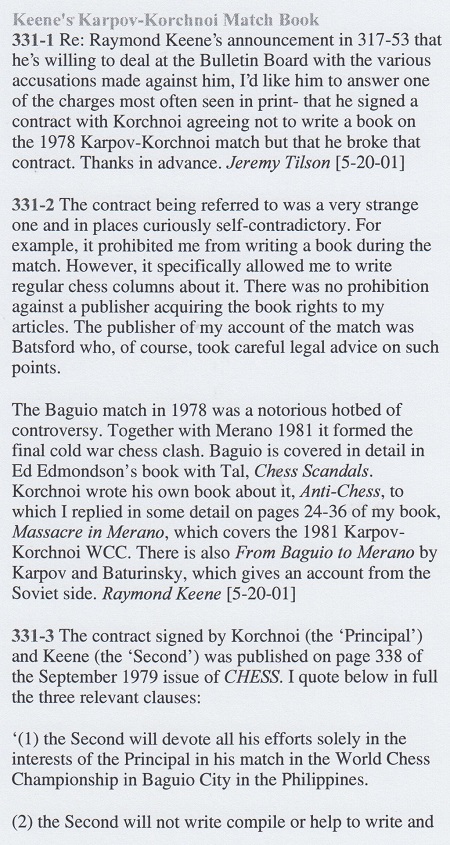
At the Chess Café Bulletin Board on 20 May 2001 Raymond Keene defended himself over the accusation that he had violated his contract with Korchnoi. The complete thread of three postings:
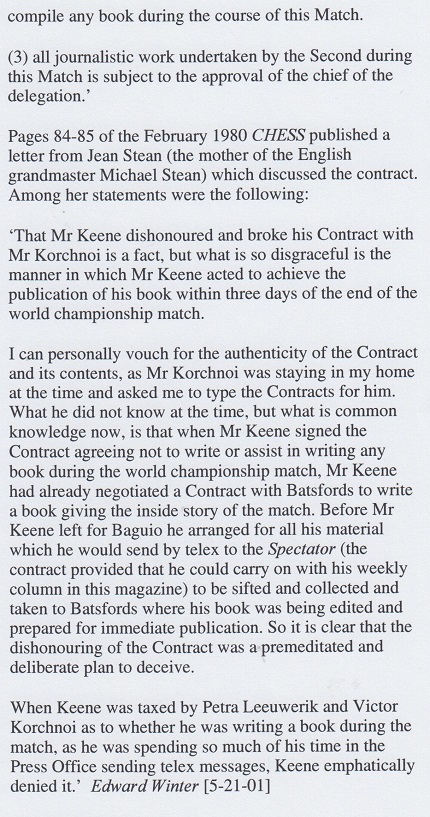
Below is the full letter from Michael Stean’s mother, which was was published on pages 84-85 of the February 1980 CHESS:
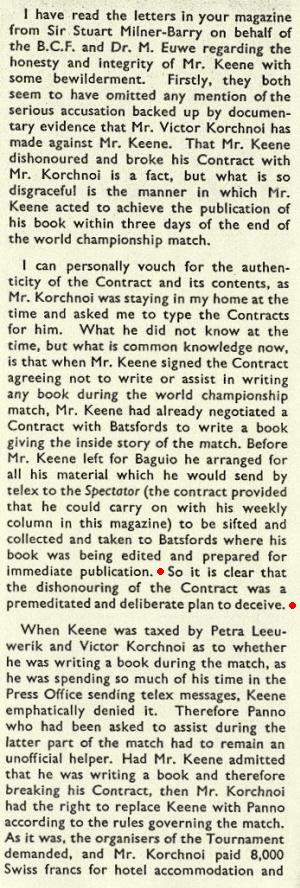
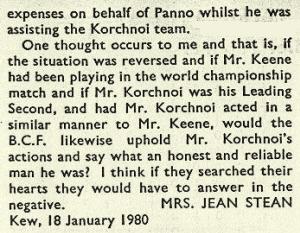
Addition on 31 March 2024:
From Mark Erickson (Richland, WA, USA):
‘The authors of Korchnoi Year by Year: Volume II (1969-1980) (Elk and Ruby Publishing House, sine loco, 2024), Hans Renette and Tibor Karolyi, state (page 358) that they had an interview with Raymond Keene. After quoting from Mrs Jean Stean’s letter to CHESS, the book reports, on pages 382-383:
“B.H. Wood, the magazine’s editor, queried Keene about the contract, but he didn’t get a reply. When we spoke to Keene, he stated that Stean’s mother for some reason didn’t want him to write a book. Keene claims that it was necessary to write the book, as otherwise the engagement was not worth it. He knew the contract she drew up was ‘rubbish’ and treated it like that.”
From page 440:
“While Korchnoi was presented as the victim of a boycott, Raymond Keene reacted and blamed his former boss of practising the same recipe on him ...”
This concerned the 1979 Biel tournament (in which Korchnoi played but Mr Keene’s invitation was withdrawn):
“By the end of April, Keene had asked for considerable financial compensation of 10,000 Swiss francs.”’
From page 73 of The English Chess Explosion by M. Chandler and R. Keene (London, 1981):
‘No-one remembers Reshevsky’s losses as an 11-year-old, but everyone knows it was at this age he beat the former World Championship Candidate, Janowski.’
Everyone knows no such thing, for the simple reason that it is untrue. Reshevsky was ten, as the book itself had stated earlier (page 35):
‘Short’s achievement was even more momentous than Capablanca’s match win against Corzo in Havana in 1900 when Capa was 12, and almost on a par with the game won by 10 year old Reshevsky against the veteran GM Janowsky in 1922.’
However, that reference is wrong on other matters. The match took place in 1901, not 1900, and Capa’s age should read 13, not 12. Note too the slapdash inconsistency: two different spellings, Janowski/Janowsky.
Mr Keene’s Times column of 13 July 1985 describes Steinitz as Czech. By that logic he should have called Chigorin Soviet rather than Russian.
Then in The Times of 24 August 1985, page 14 we see Raymond Keene vaunting a scoop:
‘Imagine my delight, then, at discovering the moves of a win by Alekhine against another player of the very highest class, which has so far eluded publication in any of the English language collections of Alekhine’s games. It has been known for some time that Alekhine’s lifetime score against Paul Keres consisted of five wins, one loss and eight draws, yet one of Alekhine’s wins proved impossible to track down.
At last, the score of the game emerged from an obscure Estonian document after a long search through the library of Bob Wade, the British Chess Federation coach. This week, I present this lost game to readers ...’
Before Mr Keene becomes even more carried away with his discovery, perhaps we could point out that the Alekhine-Keres game-score is given, with notes by J.H. Blake, on page 483 of the October 1935 BCM. Finding it there took 30 seconds.
There was no correction or apology in The Times. Raymond Keene can shrug off anything.
The value of The Evolution of Chess Opening Theory by Raymond Keene (Oxford, 1985) lies in the provision of a substantial amount of translated material from the old masters which is not readily available elsewhere. A good example is Réti’s article on Tarrasch, which will be quite an eye-opener for anyone tempted to place the classicists and hypermoderns into hermetically-sealed opposing camps.
The linking material between quotations is slight, too slight to give an adequate picture of the evolution referred to in the title. In the Introduction the author writes: ‘I eventually decided to attack the project by quoting, in more or less chronological order, from the writings, analysis and games of those authorities who have done most to influence thinking about opening theory at given moments in chess history ...’ (Which is, of course, the quickest way to fill a book.)
In fact, the trouble with the quotation approach is that it is all or nothing – there is no smooth, balanced, detailed study of opening development. Let us take the example of Alekhine (his predecessor Capablanca and successor Euwe are barely mentioned in the entire book). Alekhine’s influence on opening theory was colossal (one recalls the contemporary quip that opening theory was made up of Alekhine’s games and a few variations), but studious treatment of it would have required detailed examination of his games and writings. Instead of that, we are offered just a chapter on Alekhine’s Defence, which would be an unsatisfactory approach even if that chapter were correctly researched. It is not. It is ‘largely culled’ from one single book – again the easy way out – and everything is left in the air. The reader is not informed that Alekhine himself rather turned against 1 e4 Nf6, to the extent that by the Second World War he was calling it ‘dubious’. This highlights a further defect in the ‘evolution’: for this book it is more or less as if the 1930s and half the 1940s did not exist. The sudden arrival at Bronstein on page 136 gives quite a jolt.
The omission of anything by Euwe, whose contribution to opening theory was also massive, is not to be pardoned simply by being acknowledged in the Introduction. Chapter 15 is Fischer. Chapter 16 is Kasparov. No comment.
Lack of research is also indicated by such statements as the one on page 102: ‘Not that Tarrasch refused to try out hypermodern openings, but when he did it was usually a disaster.’ To see that this is nonsense one has only to take up the tournament books of the 1920s. For the nth time Mr Keene is wrong about New York, 1927 (page 171: a ‘Candidates’ Tournament’). One’s doubts about his concern for historical truth are also reinforced by the reference to Kasparov’s ‘fascinating innovation’ (page 215). We had all that in the January 1983 CHESS. However, in the March-April 1983 issue George Botterill pointed out that the line had already been noted by him (G.B.) in print in 1980. But R.D.K. is not to be disturbed by a trifling fact like that.
There are too many plugs for Raymond Keene’s own books (but barely any for other people’s); we are only one page into the Introduction by the time the habitual ‘when I was Korchnoi’s second’ routine is being run.
(1069)
Raymond Keene on page 205 of the May 1986 BCM:
‘The BCF has never opposed the return match. In fact, we are quite obviously intending to organise it or at least the first half.’
This is in direct contradiction with his reply to Jonathan Mestel in the December 1985 Newsflash:
‘I take your point that the revenge match clause should probably not exist.’
In his public letter of 16 January 1986 to Aly Amin, Mr Keene stated that Karpov had too many privileges, one of which was ‘the right to a revenge match’.
The Chess Tournament – London 1851 by Staunton has just been reprinted – superbly – by Batsford, as has Nimzowitsch’s Chess Praxis. Mr Raymond Keene’s willingness to supply his company with a Foreword to the latter work is not readily comprehensible when one recalls his words on page 4 of Aron Nimzowitsch: A Reappraisal:
‘The English of My System is, by and large, very good and makes a brave effort to capture the spirit of Nimzowitsch’s original German, but, unfortunately, the same cannot be said of the translation of Chess Praxis which I find a poor, maimed torso of Nimzowitsch’s original. If you have no alternative read the translation by all means, but if you possess the merest smattering of German I urge you to read the original. It is well worth the effort.’
(1231)
Yet there are people who find such inconsistencies unblameworthy. After we pointed out Raymond Keene’s Chess Praxis contradiction (C.N. 1231) on page 282 of the September 1986 CHESS, a reply from Mr James Pratt of Basingstoke was printed on page 326 of the November 1986 issue:
‘... Now to Mr Winter. He informs us that Batsford don’t do as good a job as they possibly could. Of course everything can be improved – what is heaven for? Take Chess Praxis by Nimzovich. Keene in A.N. – A Reappraisal – written quite a while ago – points out how poor the translation is in Praxis. Mr Winter points out that he has changed his mind. So what? He’s entitled to. Short and Botterill call Praxis the best chess book they know. If your correspondents wish to attack each other they should either do so over the board or by private letter. “The play’s the thing”.’
Similar crassness from the same Mr Pratt (who is clearly no intellectual power-house) appeared in item b) of C.N. 711. On 21 December 1986 we replied to CHESS, but of course the letter was not published:
The Pratt Guide to Criticism (November CHESS) is fascinating. Since nothing is ever perfect, Winter should not criticize Batsford. Keene, on the other hand, may freely criticize Chess Praxis and contradict himself subsequently. Winter, however, is wrong to criticize such inconsistency. Pratt may write a public letter to criticize Winter for not criticizing Keene in a private letter.
(1424)
Newsflash has a new editor, David Goodman. His first action, it would seem, was to drop the Badmaster column, the only item of permanent value. Mr Goodman has not yet said anything critical about his brother-in-law, Raymond Keene, but no doubt the BCF will insist upon fairness and objectivity. Issue 2 does, however, have an intriguing quote from Mr Jeremy Hanley, the Member of Parliament for Richmond and Barnes: Raymond Keene is the ‘greatest chess Ambassador that Britain has’.
It is not indicated which international chess magazines are read by the Member for Richmond and Barnes. Surely not C.N. Nor the South African Chess Player, which has accused Mr Keene of exploiting the South African issue to gain votes. Nor Europe Echecs (France), which has quoted Korchnoi as stating that he has ‘broken off diplomatic relations with that person’. Nor Schacknytt (Sweden), which called one of Mr Keene’s K-K match books ‘en katastrof’. Nor Schach-Echo (Federal Republic of Germany), which has accused him of ‘dancing at too many weddings’. Nor Die Schachwoche (Switzerland), which scoffs at his role in the termination/telex issue. Nor the Myers Openings Bulletin (USA), which reports that ‘Keene’s hypocrisy is not confined to the termination of the Karpov-Kasparov match’.
Mr Hanley MP ought perhaps to refer to issues 643, 644 and 645 of the British magazine Private Eye, which give detailed accounts of a number of Mr Keene’s ‘wheelings and dealings’. ...
But, above all, the Right Honourable Member should procure copies of the ‘FIDE Facts’ sheets which are being published by the American Friends of FIDE.
(1245)
Concerning the Termination, at chessgames.com on 10 January 2008 Raymond Keene wrote the following (quoted here in full):
‘<sitzkrieg> you are in violation of the guidelines and your comments shd be taken down-however i cant resist pointing out a couple of things-
1 i have never knowingly purveyed any kind of falsehood in anything i have written
2 in the extract you quote winter seems to be unable to reconcile the facts that i sent off a telex message in the morning while elsewhere i refer to my message reaching moscow later that day-what he has forgotten -presumably because he does not get out and about much-is that moscow is three hours later in time than the uk, so it was perfectly possible to send a telex in uk morning time, while at the same time it was much later in the afternoon in moscow! that rather obviously explains why it was possible for me to know about events happening in moscow in their afternoon time while it was still morning time in london. this is so blazingly obvious i have never bothered to point it out before.
on top of that-in spite of winters desperate rearguard actions to defend the now defunct corrupt commie state- history has served its verdict on that disgraceful episode-if any umpire or arbiter in any other sport had halted the contest at the point campomanes did he wd have been lynched!’
Mr Keene mentions only one specific matter, and it is untrue. We have never overlooked the obvious existence of a three-hour time-difference between the United Kingdom and Moscow. Indeed, we drew attention to it in C.N. 1222 at the time the Keene/Tisdall telex came to light: ‘the identical text was also sent direct to Moscow, at 10:13:52 GMT (Moscow time minus three).’
On 16 January 2008, on the same chessgames.com page, a reader quoted our above factual rebuttal on the GMT question, and the same day Raymond Keene posted, inter alia, the following:
‘pls dont quote winter here on my section any more-he is very hostile to me and i dont appreciate his comments appearing here especially when he is obfuscating the issue-debating him is a complete waste of time since he is always right and never ever makes mistakes.’
This is classic Keene. We are falsely accused of having made mistakes and never admitting them – in an episode where it is Raymond Keene who has made mistakes and refused to admit them.
It is yet another example of his ineradicable mendacity. Nothing by Raymond Keene should be taken on trust, and especially about his critics, his cronies or himself.
Below are the key parts of a letter to us dated 1 January 1986 from the General Secretary of FIDE, Dr Lim Kok-Ann:
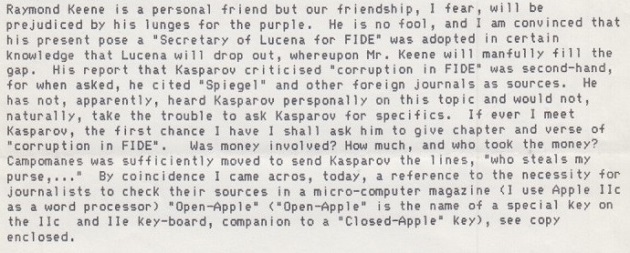
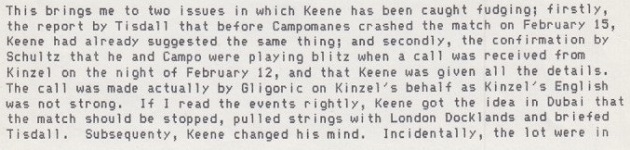

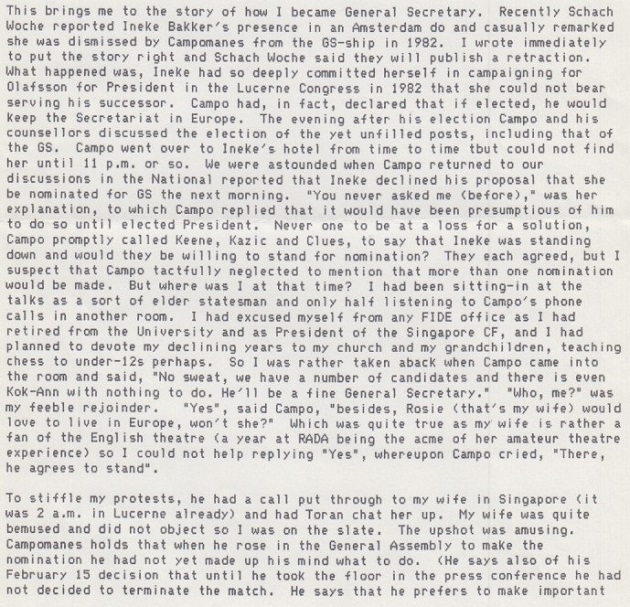
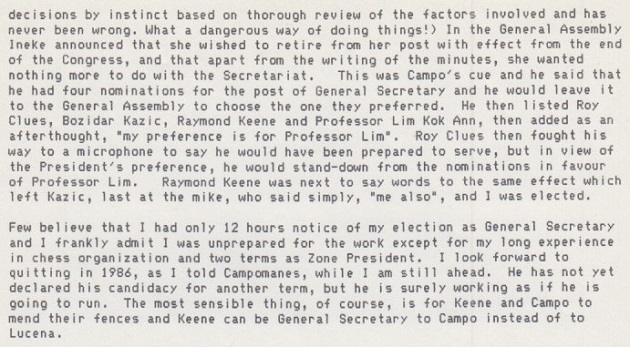
We also reproduce here another letter from Lim Kok-Ann, dated 13 January 1986:
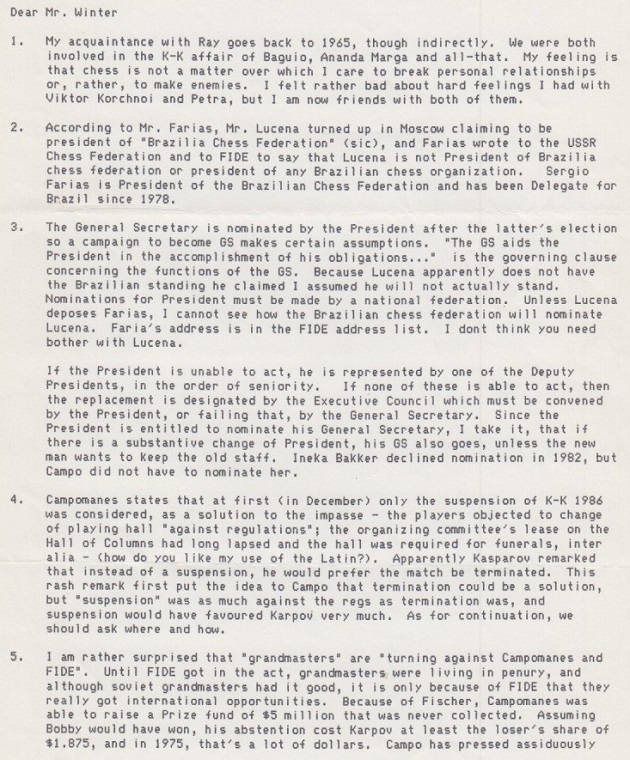
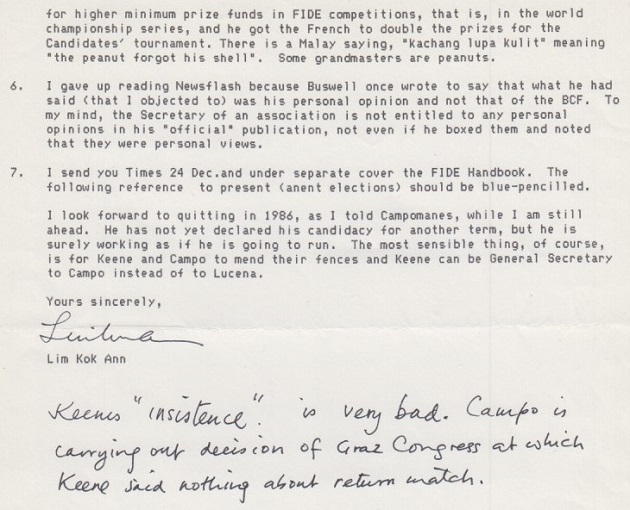
(11856)
Another observation by Lim Kok Ann:
‘... the abuse heaped on Campo by Western media led by Raymond Keene who averred that Campo had been summoned to Moscow by Karpov to save him, and having to answer the disinformation put out by Keene and his allies.’
Below is the FIDE President’s Circular Letter No. 3 1985/86, dated 25 February 1986. It includes an extensive ‘Review of Press Reports’ by Lim Kok-Ann, the Federation’s General Secretary:
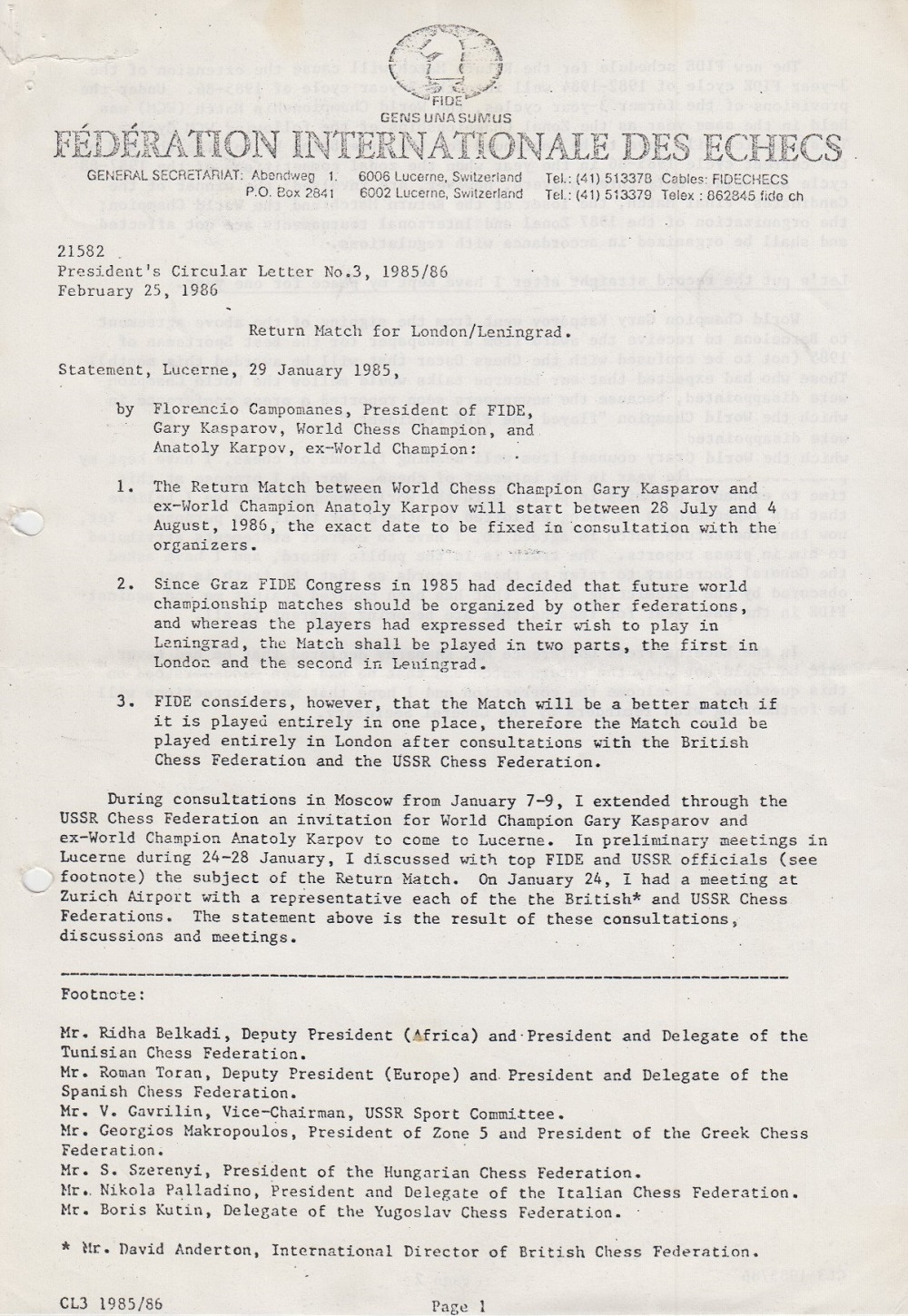
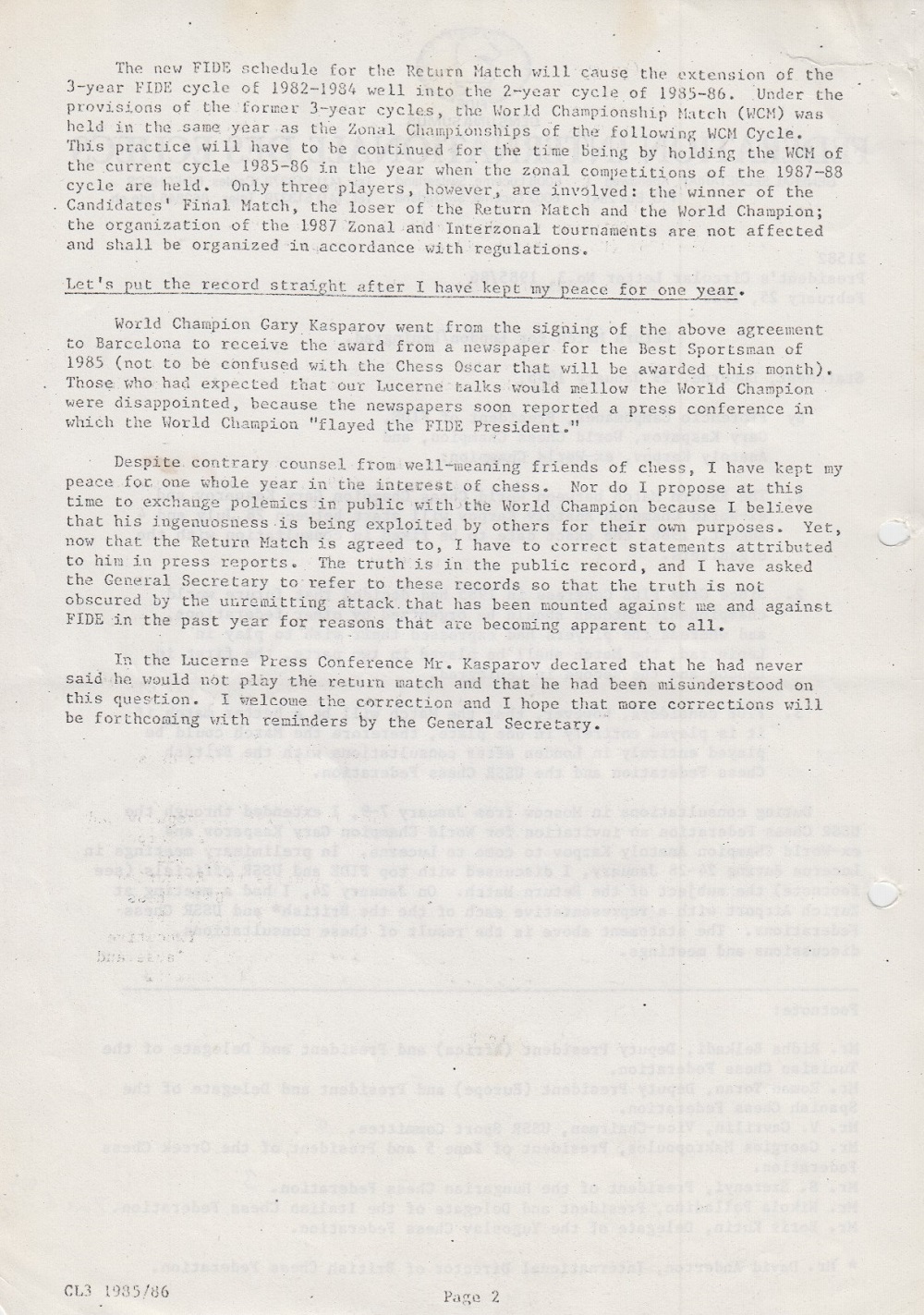
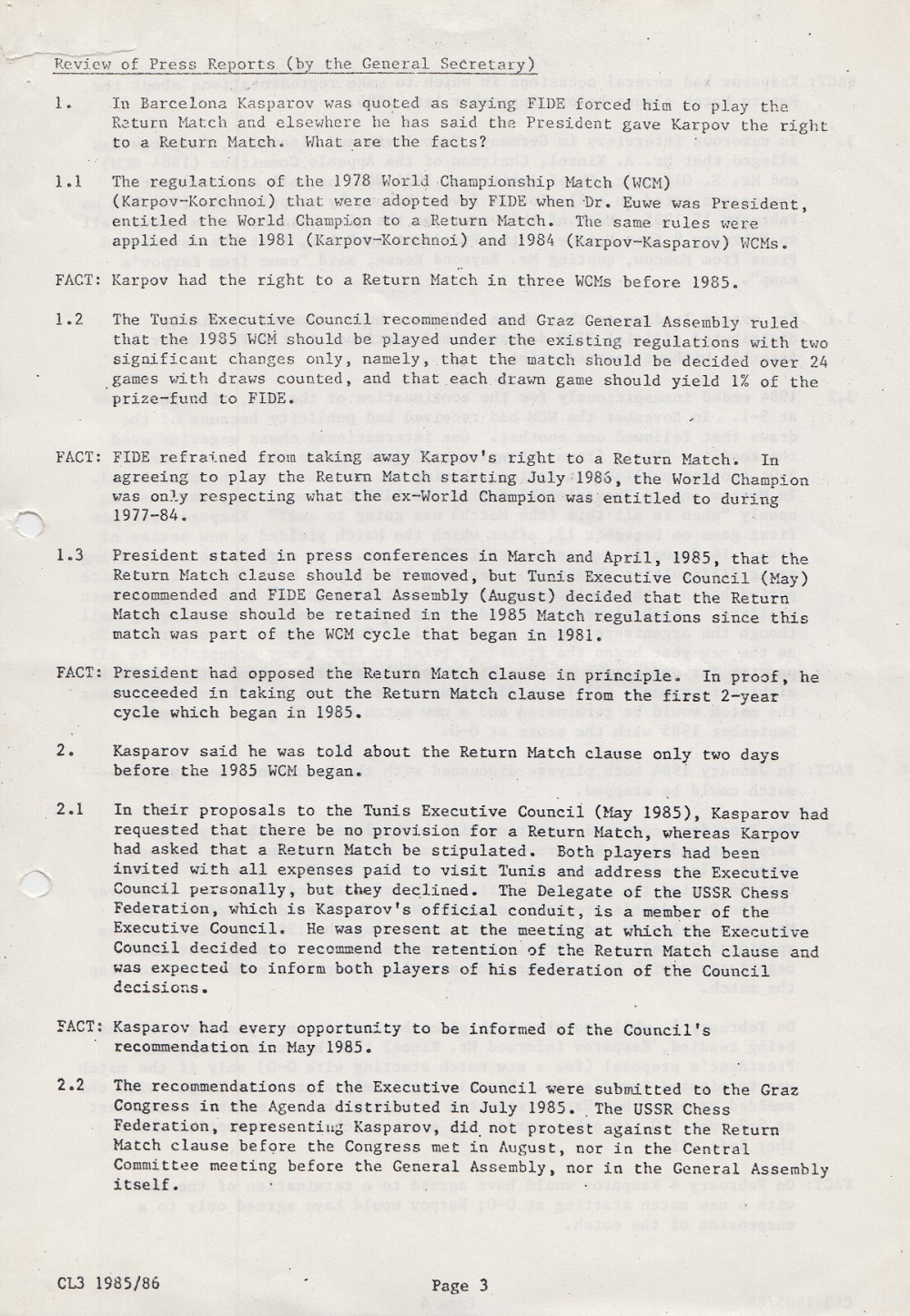
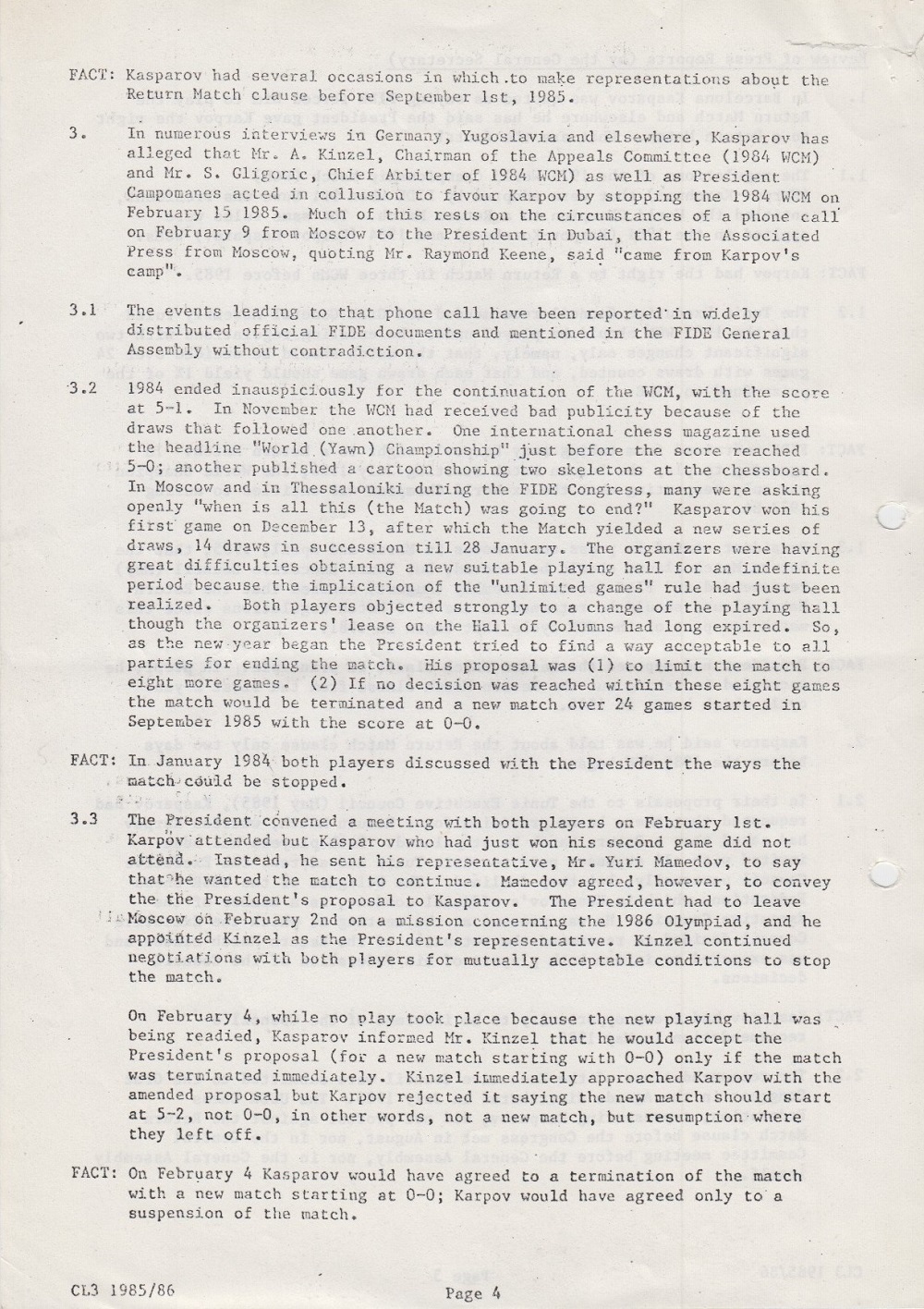
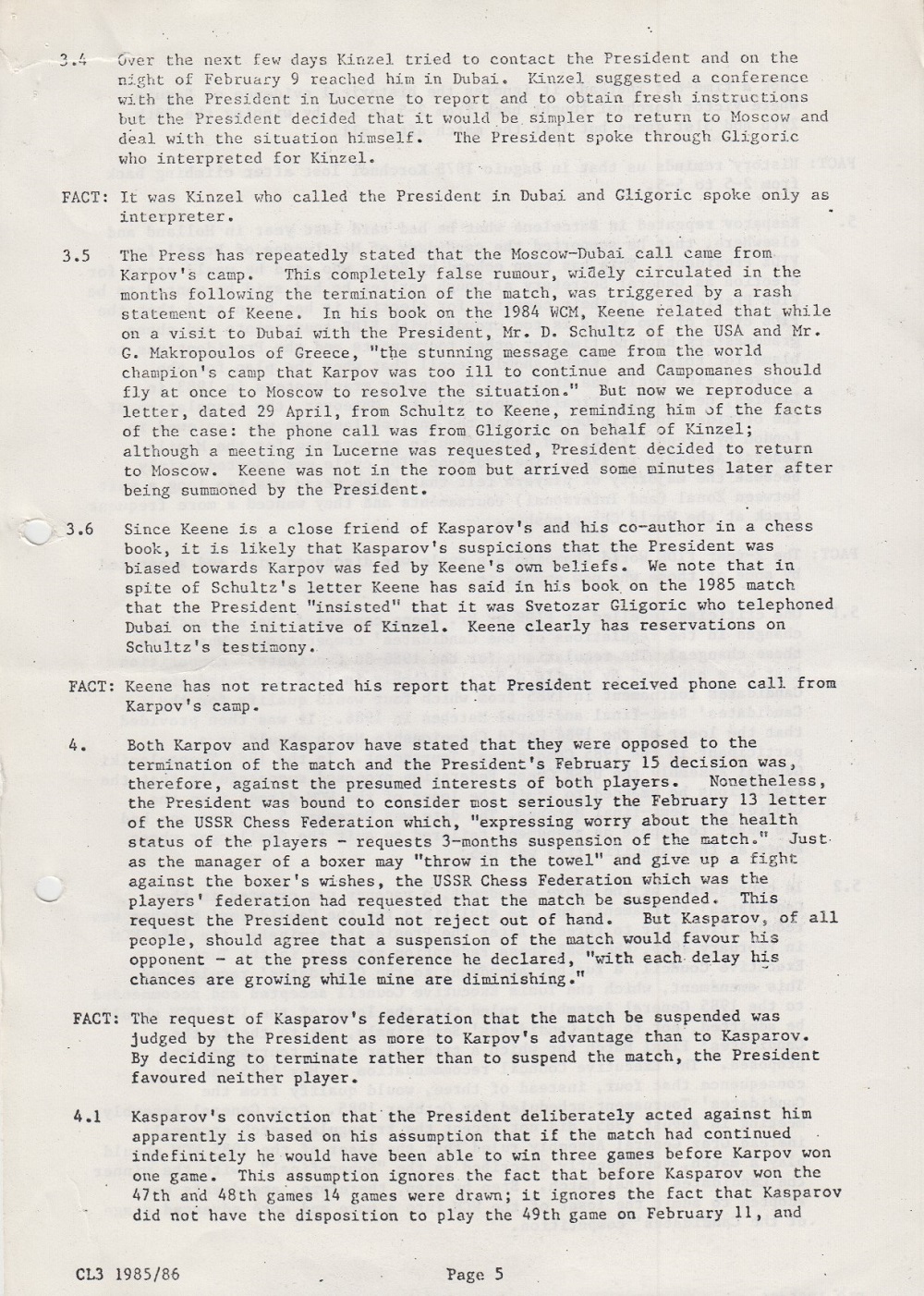
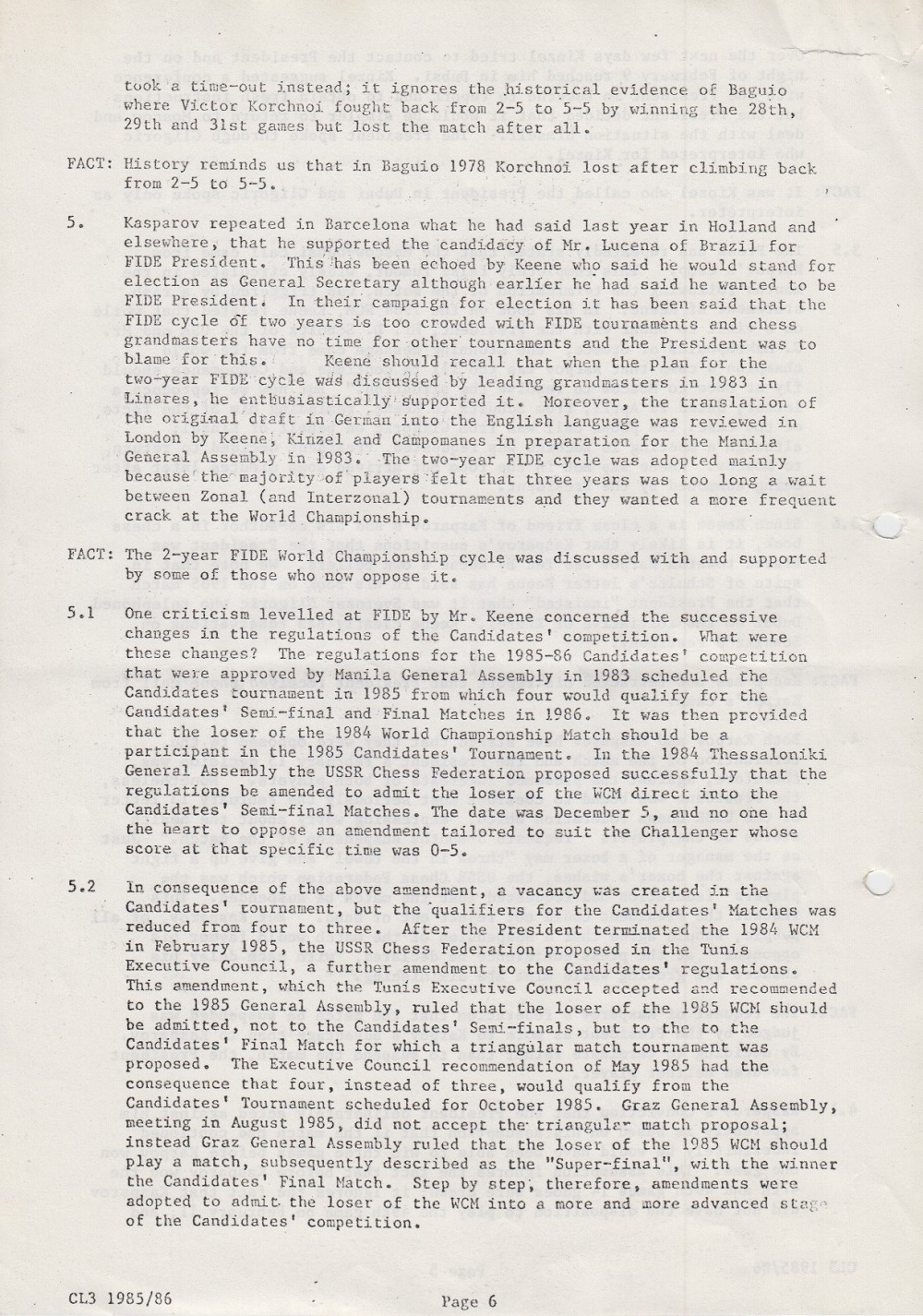
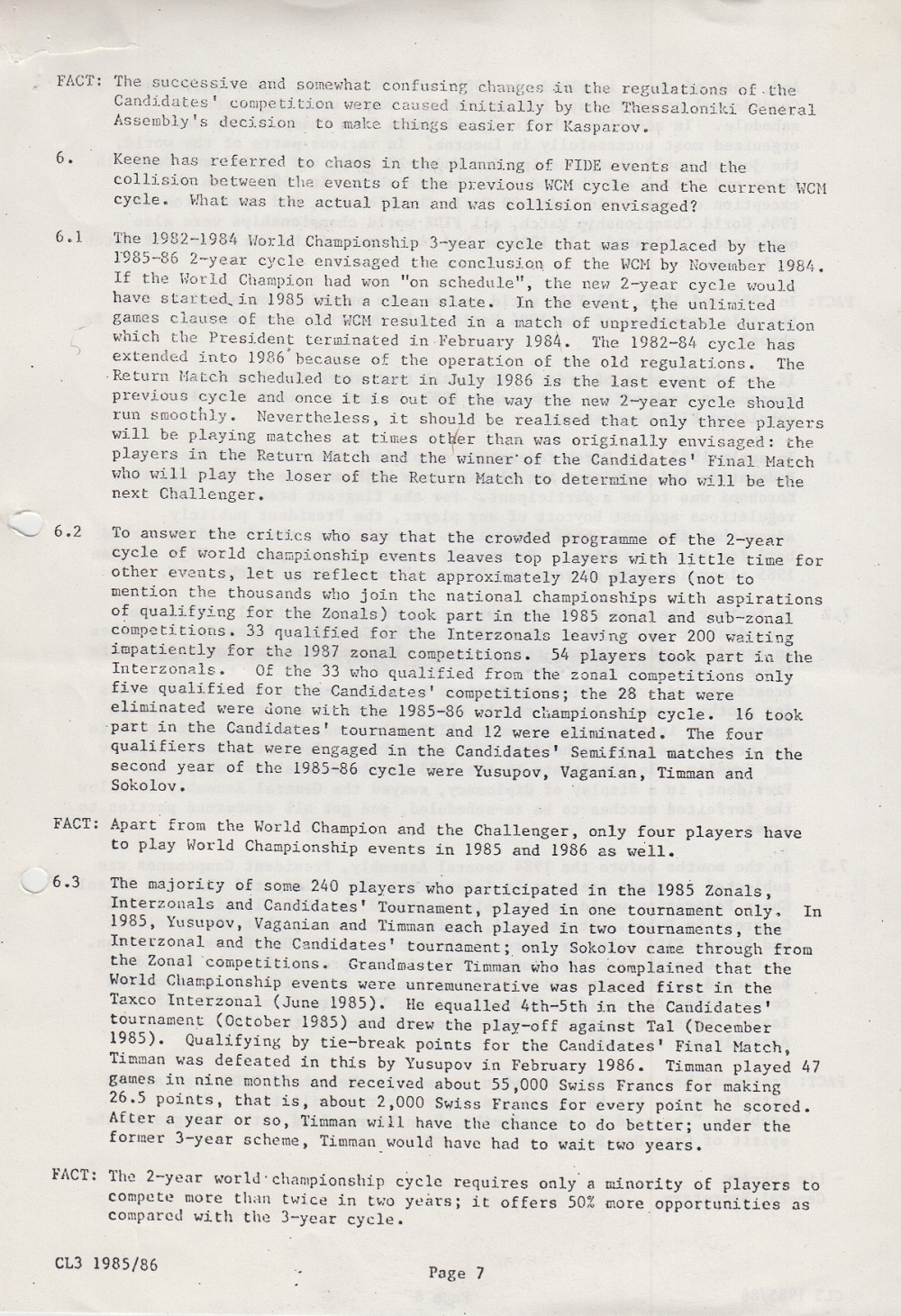
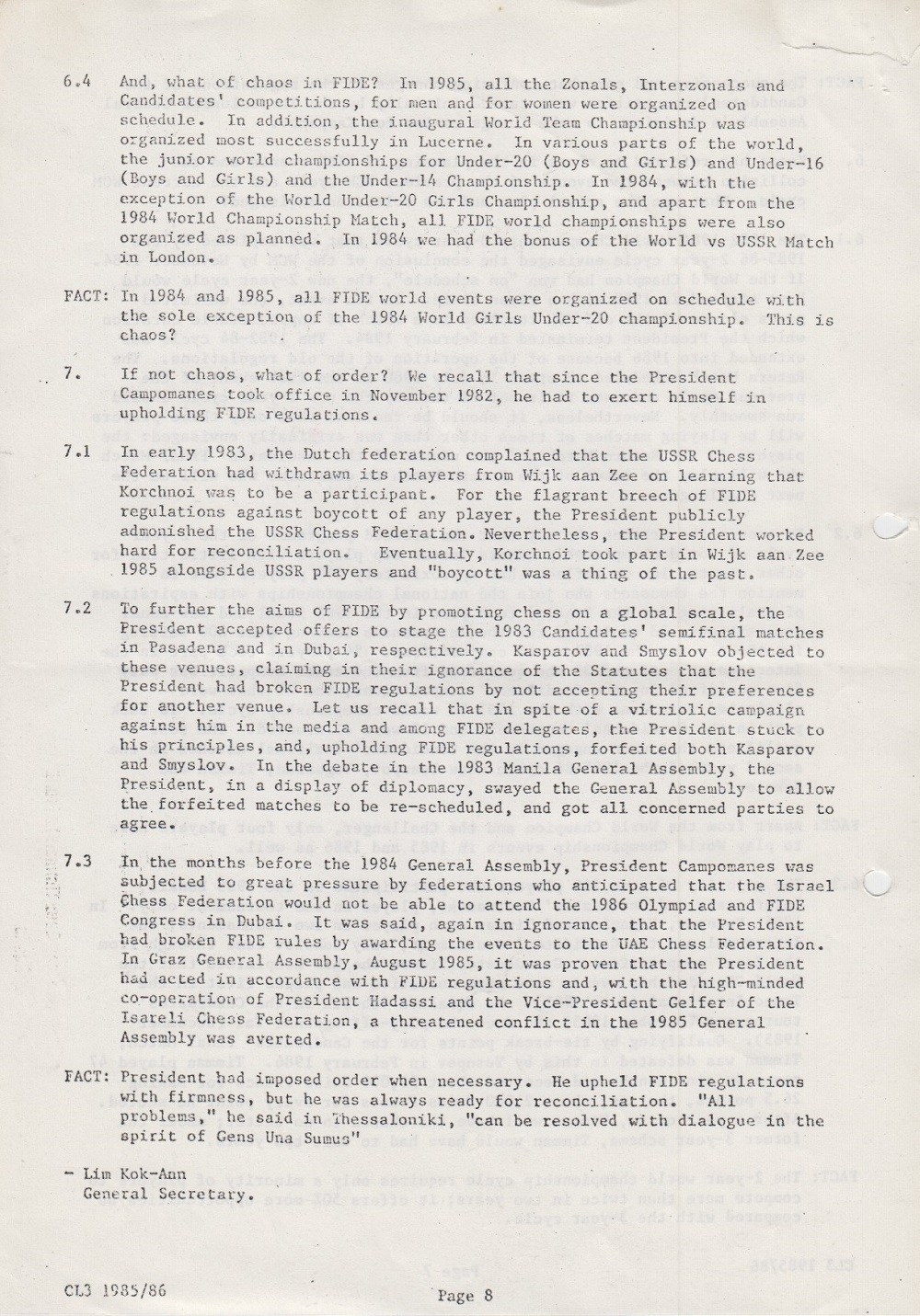
FIDE Facts sheet one above mentioned that Lim Kok-Ann’s text was published in the May 1986 BCM, followed by a response from Raymond Keene (pages 188-195 and 204-208 respectively).
The text below appeared on pages 1-2 of the FIDE President’s Circular Letter No. 4 1985/86, dated 28 April 1986:

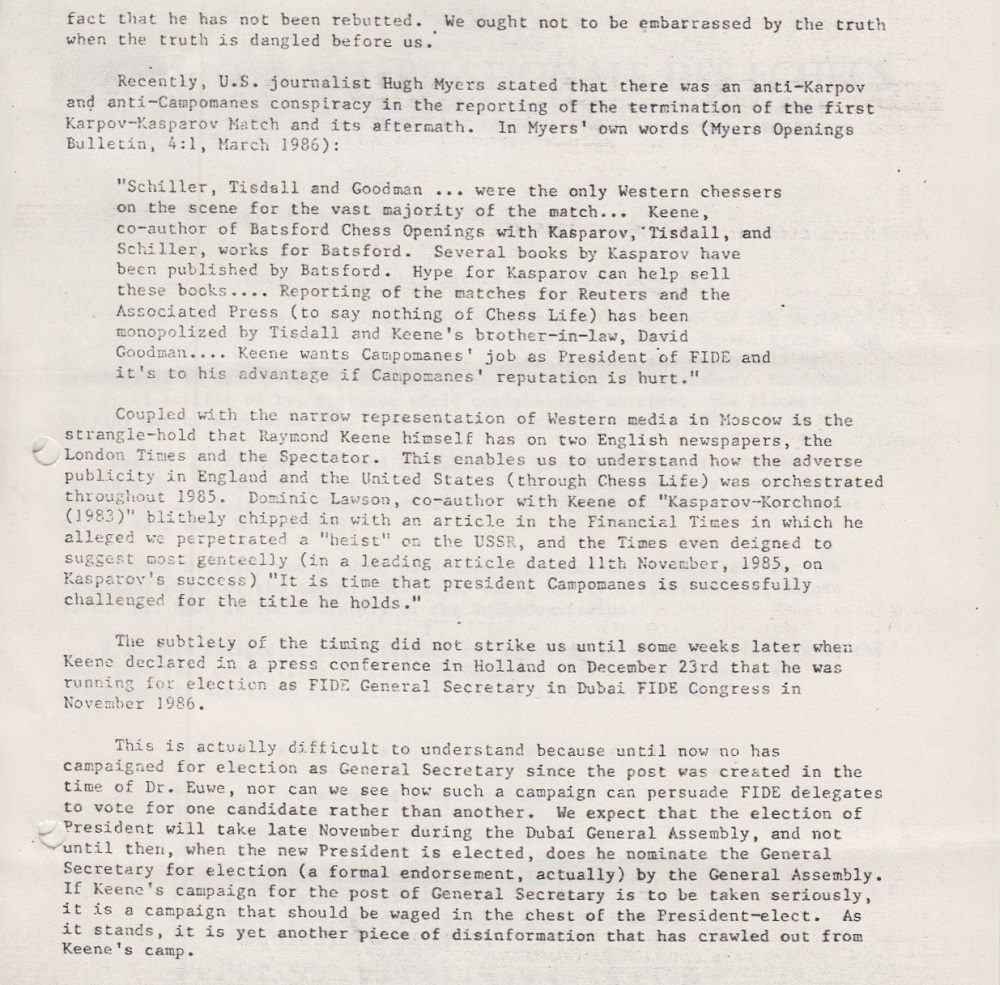
In an interview with Fernando Urías of the Spanish publication Cambio 16, distributed by FIDE to chess federations and journalists on 31 March 1987, Florencio Campomanes answered questions about the 1986 campaign:
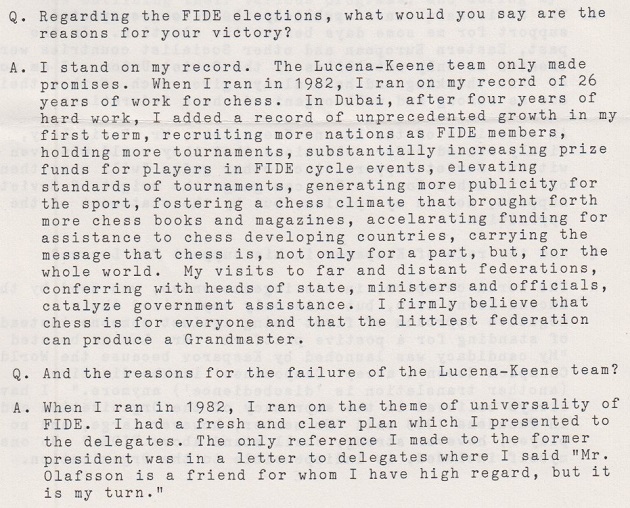
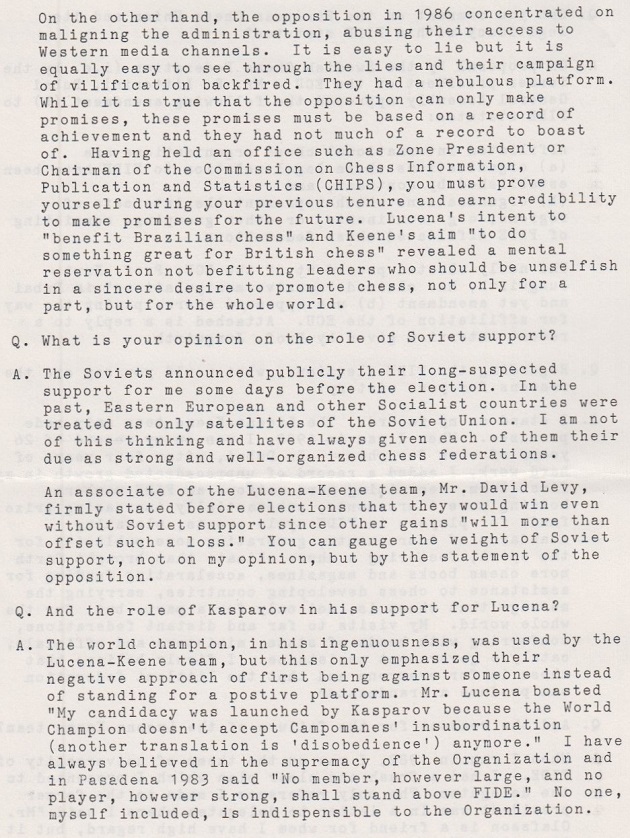
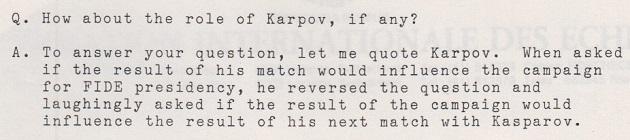
We have found no serious, considered statement by the defeated candidates regarding their last-minute abandonment of the campaign in November 1986. See, however, Comic Relief, which includes this statement by Raymond Keene in an interview on page 202 of the April 2017 BCM:
‘One of the reasons I did not stand a fair chance in 1986 is because we just had a war with Argentina.’
The Falklands War had ended on 14 June 1982.
In an article dated 22 July 2023, Raymond Keene wrote of David Anderton:
‘Anderton was a publicly plausible, but privately slippery character. Having pledged his support, and that of the BCF, for my 1986 election bid, strongly supported by Kasparov, to unseat Florencio Campomanes, the then president of FIDE, the world chess federation, Anderton struck a deal with the Filipino to stab our campaign in the back, in exchange for a top post in Campomanes’ administration.’
Concerning the Commonwealth Women’s Chess Association (see FIDE Facts sheet six), below is a sample from its documentation:
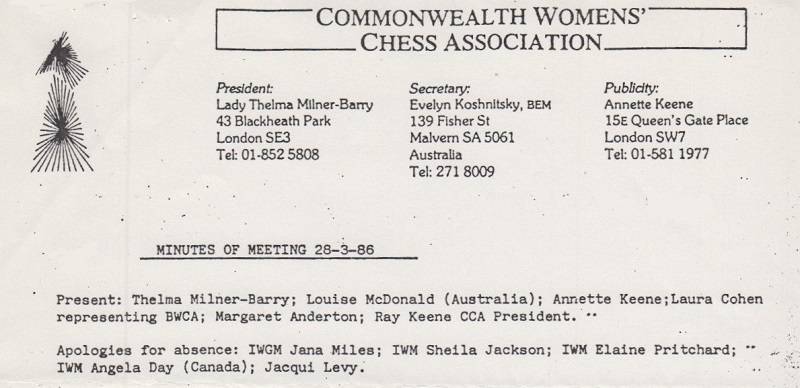
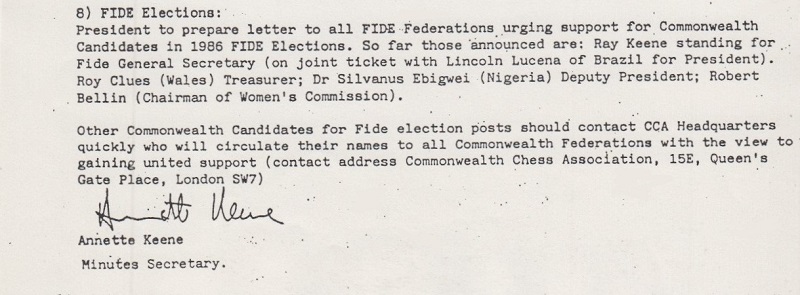
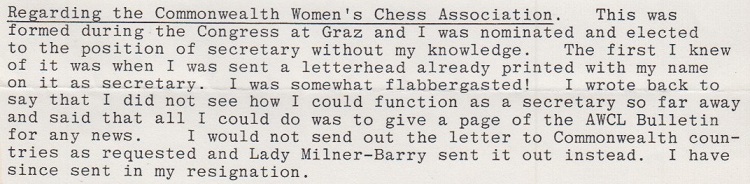
The letterhead even blunders in the title of the Association, but that was not the fault of the supposed Secretary. On 20 June 1986 Evelyn Koshnitsky informed the FIDE Headquarters in Lucerne:
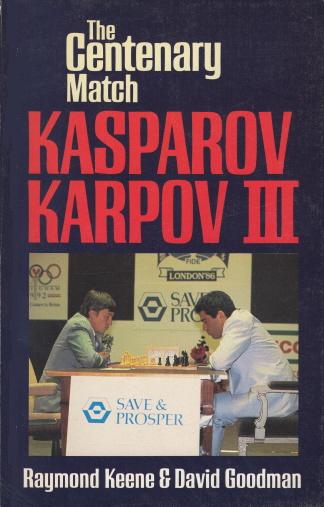
The Centenary Match Kasparov-Karpov III by Raymond Keene and David Goodman (Batsford) was published very shortly after the match finished, though not as shortly afterwards as Kasparov v Karpov (published by Chequers). The annotations in the Batsford book are probably better than those in the same authors’ Manoeuvres in Moscow, but the introductory and background features are just as abysmal. The aim, at least for the GLC Memorial Half, has been to make everything glitter with the trappings of fame and fortune. ‘First to arrive was Karpov in a blue Mercedes. A few minutes later a cream-coloured Ford drew up and Kasparov emerged with his seconds.’
The result is tawdry. Not a detail is missed of the beloved world champion’s arrival in London (otherwise known as ‘Chess Capital of the World’): ‘... Kasparov was presented with small bouquets of flowers, by Leah, four-year-old daughter of match hospitality officer Adrienne Radford, and Sophie, five-year-old daughter of world championship press chief Jane Krivine ...’ Kasparov was then ‘whisked away’ to his ‘secret address’, just like the hero of some corny espionage film. Two days later Karpov arrived and was ‘driven to another secret London address for a champagne supper’. The preoccupation with ‘exotic’ nourishment is becoming a notable characteristic of Raymond Keene’s writing. Half of page 9 is taken up with the menu of an 1883 banquet, the information being no more interesting now than when Mr Keene printed it in The Spectator of 26 April 1986. On the last page of the match book it is recorded for future generations that in Leningrad Mr Keene was able to tuck into ‘a sumptuous dinner of caviar, stuffed pike and stuffed turkey’.
We are in a world in which everything is sumptuous, stunning or triumphant, and where nobody is nobody. The match opened with ‘a stunning ceremony in the Grand Ballroom of the Park Lane Hotel, co-ordinated by Major Michael Parker, fresh from his triumphant staging of the Royal Tournament at Earls Court’.
The dispensability of these details is proved by the book itself, for in the Leningrad half the reader is, in the main, spared such frippery. Also absent is a blow-by-blow account of how the Soviet Chess Federation secured its part of the match, what detailed preparations it made, who offered flowers to whom, etc. The impression is thus unwittingly given that what the USSR is able to organize quietly and efficiently can be achieved in London only with top-pitch frenzy. Quite apart from being counter-productive, chauvinism is illogical and distasteful. Why all the talk about ‘British Chess’ during the third Kasparov v Karpov match from people who never once referred to ‘Italian Chess’ at the time of the 1981 ‘Massacre in Merano’?
The co-authors miss no opportunity to criticize Campomanes; since Mr Keene states in the September CHESS that Batsford is supporting his (RDK’s) political campaign, there is no surprise in that. The cover photo (K and K at the board, surrounded by advertising placards) strongly suggests that FIDE will have to tackle the question of whether the dignity of chess is not impaired when venues start to resemble Brands Hatch. Incidentally, it is interesting to note in that photograph that the Greater London Council (which put up over £600,000) receives no exposure at all. Having been disbanded, it is of no further use to ‘British Chess’.
One historical point. As reported in C.N. 1029, we showed in the 1985 BCM that the 1909 Paris match between Lasker and Janowsky was not for the world championship. This was corroborated by Kenneth Whyld in the August 1986 BCM, page 373. And on page 331 of that same issue the Editor gives a list of world title matches and adds that ‘many recent sources give here a ten-game match Lasker v Janowski, Paris 1909, but the best authorities do not include it’. Exactly so. On page 6 of their book Keene and Goodman do.
The reader looking for background features which do not mock his intelligence will need to turn to the Chequers book. Instead of Messrs Keene and Goodman’s pettishness and kitsch we are given little notebook features, impressively objective, entitled ‘Off the Board’. They certainly give the feel of the event, and it is unfortunate that they peter out about half way through the book.
Pergamon has announced that next year [1987] it will be publishing Kasparov’s book on the match. The news is a godsend for anyone who, like us, would hardly dare venture a comparison of the two works that have been published so far. We did note, however, that in the Chequers book the balance of exclamation marks and question marks in Game 13 makes it very difficult to understand why Kasparov only drew.
(1285)
There follows a further example of Raymond Keene’s toxic imprecision.
In the course of an interview with his then brother-in-law, David Levy, on pages 262-266 of the September 1986 CHESS Raymond Keene declared:
‘Just prior to and during the match [Kasparov v Karpov, 1986], a flood of election literature arrived from an organisation called the American friends of FIDE from Edward Winter in Geneva and Hugh Myers in Iowa. It is quite clear, even if Mr Campomanes had the intention of halting electioneering during the match, the friends and organisations who support him didn’t.’
We responded on page 327 of the November 1986 CHESS:
‘1. I have not written, printed or issued election literature of any kind.
2. I have no connection with the American friends of FIDE.
3. I have not been campaigning for Campomanes.
4. I have never spoken to him, corresponded with him, or even set eyes on him.’
Raymond Keene made no retraction of his falsehood.
‘Why is it that you have been so much more successful than other people?’
That question, actually put to a candidate for a FIDE post and published in a chess magazine, is an extreme example of a longstanding problem mentioned in Chess Thoughts: In proper journalism, the interviewer probes, politely but searchingly. In chess journalism, vacuous servility is the norm.
The word is interview, not intervertisement.
(10856)
The annotations in Speed Chess Challenge Kasparov v Short 1987 by Raymond Keene (Batsford) are directed towards inexperienced players. One interesting comment on page 7: ‘In the endgame, when the king can emerge from its fortress to take an active part in the game, he has about the same value as a bishop or a knight.’ Offhand we cannot recall other attempts to evaluate the king in this way. Apart from that, and some fine photographs, the book is mere garishness, with nearly everybody and everything getting a blown-up description. For example, page 11 refers to ‘experienced presenter Tony Bastable, doyen of the Thames Television World Championship coverage’; page 95 of the March 1987 BCM reported that this Experienced Doyen did not even know the chess difference between ‘game’ and ‘match’.
(1405)
From Raymond Keene’s seven-page Introduction to Mikhail Chigorin Selected Games edited by Colin Leach (London, 1987): ‘occassional’, ‘seperated’, ‘Brelau’, ‘St. Petersburgg’, ‘absolutedly’, ‘Pillusbury’, ‘profansation’, ‘but it is not been refuted’ ‘occassions’ ...
(1491)
The 19/26 December 1987 issue of The Spectator contained a chess history/trivia quiz set by Raymond Keene. Of the 30 questions, under half could be called correct. Some were pure fiction, others had more than one answer, and others still were sheer speculation. John Roycroft has kindly authorized us to say that he has no quarrel with this assessment.
We are most grateful to him; after all, Mr Roycroft was one of the three prize-winners.
(1568)
See too C.N. 9476.
The first two books we have received on the 1987 world championship match are Schach WM 87 by Helmut Pfleger, Otto Borik and Michael Kipp-Thomas (Falken Verlag) and Showdown in Seville by Raymond Keene, David Goodman and David Spanier (Batsford). Both occasionally leave the reader puzzled as to why Kasparov did not do better. For example, the 19th match game was drawn, yet Kasparov’s moves are awarded far more exclamation marks. Neither book offers as much detailed analysis as has already appeared in many chess magazines. (Europe Echecs has been particularly strong in this respect.)
The Batsford annotations have a style all of their own – pure rodomontade. A ‘colossally fascinating’ variation here (game 5), an ‘incredibly minor infringement of normal practice’ there (game 7). That the annotator can do better is admirably shown by games 12 and 14.
The 11-page introduction has little to do with the match, but purports to explain why Campomanes was not defeated in Dubai and how the Grandmasters’ Association resulted. Although commendable restraint is shown (Marcos is not mentioned until page 4) the material is a colossally unfascinating and incredibly major infringement of basic justice. The blame for not beating the FIDE President is placed squarely on Lucena’s shoulders: ‘ ... not even Lucena’s warmest admirers could say that he was a strong candidate. He was kind, amiable, well intentioned, yes – but no public speaker, no vote winner’ (page 5). On the following page we learn that Kasparov ‘was evidently somewhat underwhelmed’ by Lucena. In reality, of course, it was Tartuffe rather than Orgon who was the hustings turn-off. But in fairness it must be pointed out that even Kasparov is verbally savaged by our objective chroniclers: ‘Perhaps Kasparov was a shade naive, understandably so, when it came to politics’ (page 7).
The biased and nugatory introductions to individual games use the familiar hint-and-smear technique, emitting just enough smoke to suggest a raging fire. For example, page 92 attempts to persuade the reader that Karpov engineered Tal’s departure from Seville during the match – just one more ‘scandal’ that is dumped in the reader’s lap without a flicker of evidence.
One of the few historical references in the book is on page 62, where we are told that Grünfeld ‘launched the defence which bears his name with a convincing win against the mighty Alekhine’. This, of course, is nonsense. Presumably the allusion is to Alekhine v Grünfeld, Vienna, 18 November 1922, but by that time 1 d4 Nf6 2 c4 g6 3 Nc3 d5 was no longer a novelty. One earlier game, though probably not the first, in which Grünfeld played these moves as Black was against Sämisch in round seven of the Pistyan tournament in April 1922.
At least there is no repetition of Mr Keene’s claim (opening sentence of his report on page 2 of The Times of 21 December 1987) that Kasparov is ‘the first player in more than 75 years to come from behind to win the world chess championship’. (What about the title matches played in 1927, 1935, 1937, 1951, 1954, 1957, 1963, 1969, 1972 and 1985?)
As ever, we are at a loss to describe adequately Mr Keene’s handling of chess history; there is no entry for ‘Midas touch’ in our dictionary of antonyms.
(1582)
Discussing the FIDE General Assembly in Dubai, 1986, the obituary of Florencio Campomanes in The Times, 6 May 2010, page 68, did not mention Raymond Keene’s participation in the 1986 election campaign or the last-minute withdrawal of the Keene/Lucena ticket. Instead, it asserted that Campomanes ‘went on to retain his presidency by a comfortable margin’, falsely implying that there was a vote at the General Assembly.
The obituary also contained these vague claims: ‘... at a time when the majority of the chess world’s enthusiasts were vilifying him as a KGB sympathiser ...’ and ‘... it was widely assumed the [sic] Campomanes had been acting in concert with the KGB ...’
The outcome of the campaign was reported by Don Schultz, the US Delegate to FIDE, on page 53 of Chess Life, March 1987:
‘FIDE President Florencio Campomanes was easily reelected. Contrary to rumors and other statements, his election was never in doubt. I informed our Policy Board several months prior to the election that Lincoln Lucena’s challenge for the FIDE presidency had no chance and that mostly likely he would withdraw his candidacy prior to the voting. This was exactly what happened, and Campo was elected by voice acclamation.’
An endnote on page 270 of Chess Explorations quoted from page 219 of Kasparov’s Unlimited Challenge (Glasgow, 1990):
‘The anti-Campo forces could muster so little support that there wasn’t even a vote.’
The December 1988 CHESS (page 36) published an advertisement soliciting subscriptions to Raymond Keene’s English Chess Association. It featured a quote (about the Association’s good intentions) which was attributed to the ‘Encyclopedia [sic] Britannica’. CHESS readers will doubtless have been impressed that a reference work of such stature has given recognition to the ECA.
The truth is rather different. The quoted words are not from the Encyclopaedia Britannica at all, but from the 1988 Britannica Book of the Year (page 319). The writer there? Raymond Keene.
(1765)
From an English Chess Association press release dated March/April 1989:
‘It is heartening to write of the recognition accorded us by the Encyclopedia Britannica, which states that the aim of the ECA is “to make chess as popular as snooker and bring grass-roots players into closer contact with Grandmasters and masters”.’
This perpetuates the misrepresentation described in C.N. 1765. The reference to the ‘Encyclopedia Britannica’ is an untruth and, in any case, the ‘heartening ... recognition’ was from the pen of none other than the founder of the Association.
No writers or journalists in Britain appear to have published criticism of the ECA for advertising under false pretences. One can imagine the column inches they would have found if FIDE had been the guilty party.
Addition on 8 December 2019: This is still on-line despite Raymond Keene’s journalistic meltdown, at a website entitled The Mother & Child Foundation:
From Raymond Keene’s chess column in The Spectator, 13 May 1989, page 51:
‘In 1847 he was elected MP for Richmond, Yorkshire, a seat he held until 1868, barring a break of two years. ... He played in no further tournaments, although it is said that he retained an interest in chess throughout his life.’
From page 381 of the Oxford Companion to Chess by D. Hooper and K. Whyld (Oxford, 1984):
‘In 1847 he was elected Member of Parliament for Richmond, Yorkshire, a seat he held until 1868 except for a break of two years ... Although he played in no more tournaments he retained an interest in the game throughout his life.’
From page 7 of How to Beat Gary Kasparov by Raymond Keene (London, 1990):
‘Beating Gary Kasparov at chess is considerably more difficult than climbing Mount Everest or becoming a dollar billionaire. In fact when I rang up the British Mountaineering Council I learnt that it was six times easier to reach the peak of Everest, while on contacting Fortune Magazine, I found it was five times easier to acquire more than $1,000,000,000.’
Page 114 of Deep Thinking by Garry Kasparov with Mig Greengard (New York, 2017) quoted that passage, adding a wry comment.
From page 17 of CHESS, November 1990 (Raymond Keene interviewed by Cathy Forbes, concerning Florencio Campomanes):
‘He’s being opposed in the forthcoming elections by Román Torán (President of the Spanish Chess Federation) and the coalition of forces against Campomanes this time looks overwhelming, including the whole of Latin America, most of Europe – Karpov himself is supporting Torán. So I think Campo is doomed this time, he’s absolutely had it.’
From page 5 of CHESS, February 1991 (news report):
‘Florencio Campomanes, Philippines, was re-elected President of FIDE in Novi Sad ... as he collected 79 votes to Román Torán’s 26 and Rabell Méndez’s 9.’
All reference books claim that Frank J. Marshall died in 1944, but the consensus has now been broken by Raymond Keene in The Complete Book of Gambits. Page 81 has a game which is headed ‘Lewitzky-Marshall, Breslau 1991’, and page 184 presents ‘Marshall-Duras, San Sebastian 1991’.
(1944)
Page 268 of Kings, Commoners and Knaves added this footnote:
The book naturally has many other clangers, such as the statement on page 31 that it was Tarrasch, rather than Alekhine, who won their game at Pistyan, 1922.
The entry on Hans Fahrni by Raymond Keene in Golombek’s Encyclopedia (hardback and paperback editions) stated that in 1909 the Swiss player won a tournament in Monaco.
The place in question is Munich. The mix-up presumably stems from Monaco in Italian meaning either Munich or Monaco.
(1978)
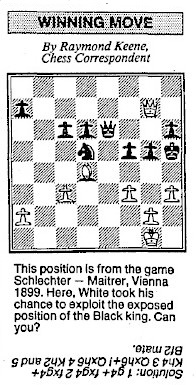
The Times, 19 March 1991, page 22
A mere 39 days later there was a correction of what had been ‘misprinted’ in that ‘recent’ column:
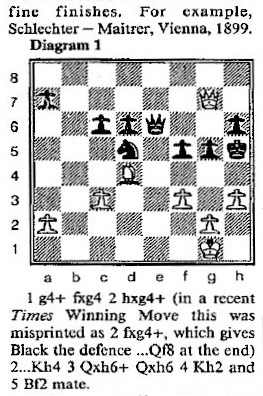
The Times, 27 April 1991, page 54[S]
There was no correction, however, of the bizarre spelling ‘Maitrer’. In this famous Schlechter game Black was Meitner.
A letter to us from Richard O’Brien (London) dated 1 October 1987:
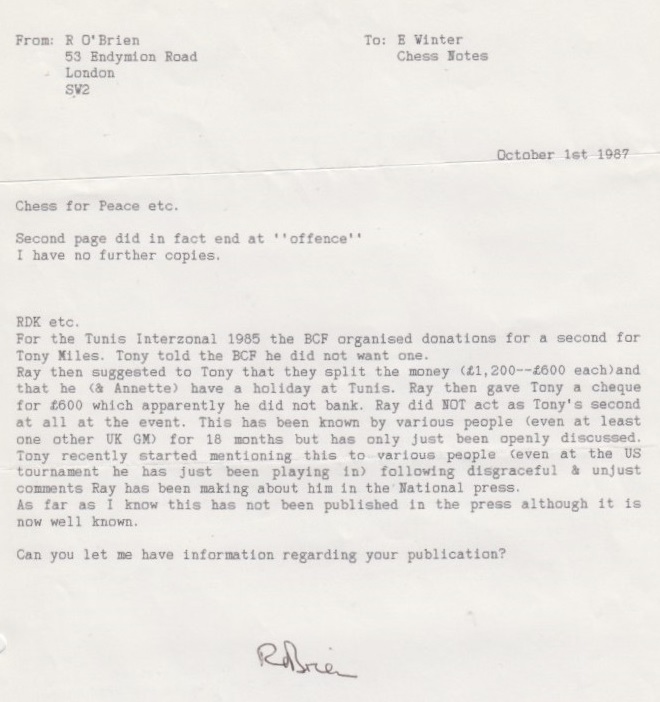
C.N. 7291 referred to a letter from Tony Miles regarding the 1985 Tunis Interzonal affair, on pages 18-19 of the July 1991 CHESS:
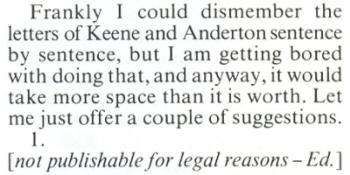
The suggestion which the CHESS Editor considered ‘not publishable’:

As shown in our ChessBase
article posted on 12 November 2011, Tony Miles informed us
in a letter dated 15 July 1989 that he was working on a project
under the inspired title Raymond Keene: A Reappraisal.
From a letter written to us by Tony Miles on 22 August 1989:

Raymond Keene wrote about Miles as follows in his Spectator column of 8 August 1987 (page 44):
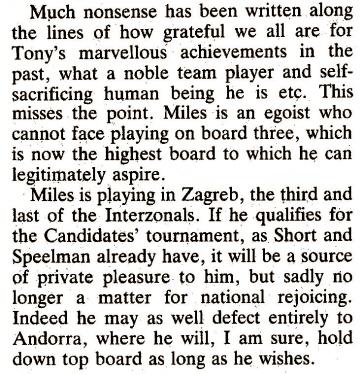
A further attack on Miles came in Raymond Keene’s Spectator column of 3 April 1993, page 44:
‘The [British Chess Federation] press release is co-signed by that well-known patriot and globetrotter Grandmaster Tony Miles, the former top board for Andorra, or was it the US, or Australia, I forget.’
As reported in Tony Miles, on 24 July 1989 he wrote to us:
‘... I spent several months in hospital from the end of September 87 – a result of banging my head against a bureaucratic brick wall ...’
Regarding the 1985 Tunis Interzonal affair, the journalist Nick Pitt who investigated the matter on pages 16-22 of the Sunday Times Magazine, 13 January 1991, wrote on page 19 of CHESS, July 1991:
‘Keene’s own version of events in Tunis, given in an interview conducted by officers of the BCF during a preliminary inquiry, and subsequently in letters and an interview with myself, has changed, and some of his statements on the affair are contradicted by the documentary evidence.’
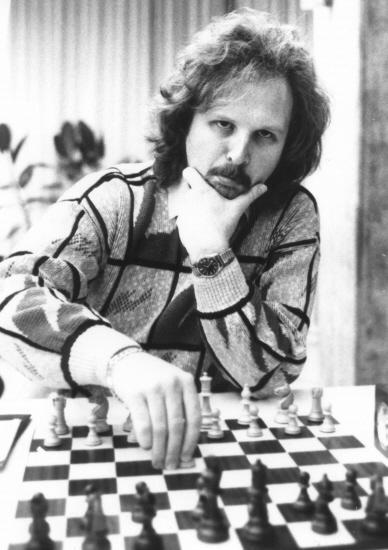
Tony Miles
On 10 October [1987] the Policy Board of the United States Chess Federation decided by a vote of 7-1 to dismiss the editor of Chess Life, Mr Larry Parr.
On 13 October [1987] the British Chess Federation accepted the resignation of Mr Raymond Keene as the BCF’s Publicity Director and FIDE Delegate.
Neither occurrence was premature.
(1506)
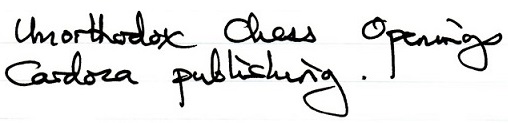
Concerning Tony Miles’ celebrated two-word review in Kingpin of Unorthodox Chess Openings by Eric Schiller, Raymond Keene wrote the following utter piffle on Schiller’s chessgames.com page:

An article (‘It’s a mad, mad world when the checkmate king gives his pretenders a brainwashing’) by Jeff Powell, on page VIII of the Daily Mail, 14 October 1991:
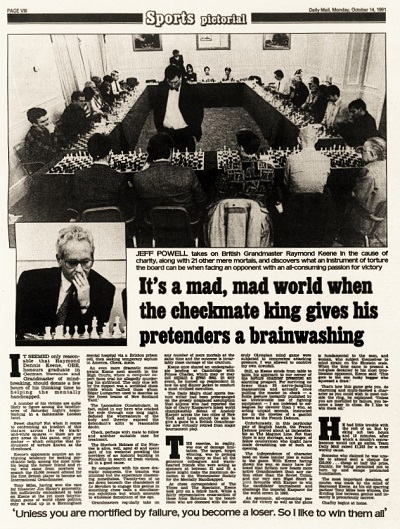
An extract from the early part:
‘Keene’s opponents acquire an intriguing tendency for seeking psychiatric help, among the most notable being the former friend and rival who came from nowhere to snatch the £5,000 reward offered for the first British player to become an International Grandmaster.
Tony Miles, having won the race for financier Jim Slater’s generosity, felt sufficiently emboldened to take on Keene at the yet more labyrinthian game of world chess politics, only to wind up in a Birmingham mental hospital via a Brixton prison cell, then seeking temporary asylum in America. Check, mate.
An even more dramatic success awaits Keene next month in the High Courts, where a computer expert faces trial for allegedly murdering his girlfriend. The only clue left by the suspect was a scribbled chess riddle which baffled those whom Edgar Lustgarten used to describe as “the finest brains of New Scotland Yard”.
The Lancashire Constabulary, in fact, called in our hero who cracked the code through one long night, deduced the whereabouts of the body and thereby exposed the defendant’s alibi to reasonable doubt.
Check, perhaps with mate to follow and another suitable case for treatment.’
In a letter to us dated 20 January 1992 G.H. Diggle commented on the article:
‘I have seldom read such dreadful stuff.’
Quite by chance we have just discovered the following:
‘On Tuesday the chess official who asked Tony to send a cable to London if he became a Grand Master received a laconic telegram which said simply “A cable. Tony Miles.”
The steel behind this casual facade becomes evident in Miles’s dedicated effort at the chessboard. His play is aggressive, precise, and above all fearless of reputations ...’
‘A British chess federation official who had asked Miles to send a cable to London if he ever became a Grandmaster received a laconic telegram which simply read “A cable. Tony Miles”. The steel behind this casual facade becomes evident in Miles’ dedicated effort at the board – aggressive, precise, and above all fearless of reputations.’
‘A British Chess Federation official who had asked Miles to send a cable to London if he ever became a Grandmaster received a laconic telegram which simply read “A cable. Tony Miles”.
The steel behind this casual facade becomes evident in Miles’ dedicated effort at the board – aggressive, precise, and above all fearless of reputations.’
Page 6 of The English Chess Explosion stated, ‘we would like to thank Leonard Barden for permission to quote from his articles in The Guardian and The Financial Times’. The above, of course, is not a case of ‘quotation’.
(8267)
C.N. 8267 reproduced Barden’s full column in the Financial Times of 28 February 1976.
The above-mentioned Sunday Times article occasioned these letters in the newspaper:
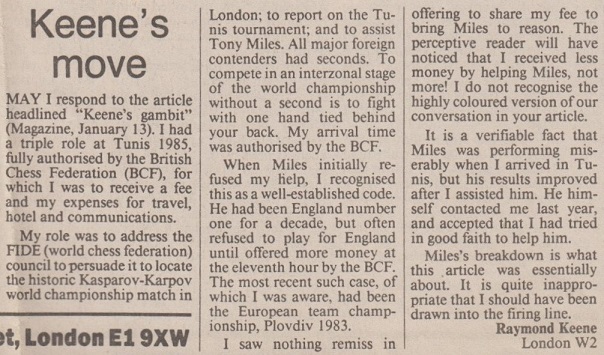
Sunday Times, 10 February 1991, page 20
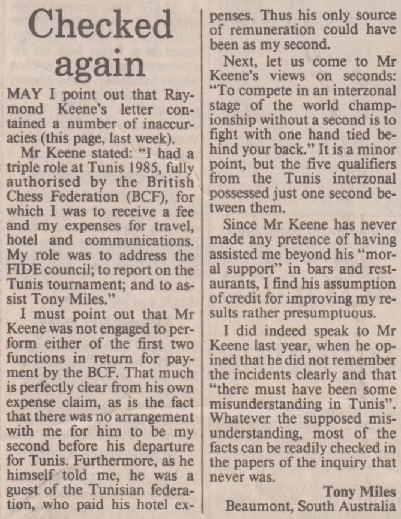
Sunday Times, 17 February 1991, page 23.
How self-sacrificing of Raymond Keene to stress the value of memory, given his history.
‘Chess games were first recorded towards the end of the eighteenth century.’
Raymond Keene, The Times, 16 November 1991 (Saturday Review, page 53).
(Kingpin, 1993)
From Raymond Keene’s column in The Spectator, 1 May 1993, page 52:
‘But what happened in 1928? The answer is amusing. Fidé, recently founded, but with little grip on mainstream world chess events, organised its own “World Chess Championship” in Amsterdam.’
As shown in FIDE Championship (1928), the Federation did not suggest that its tournament was any kind of world chess championship. Moreover, the event took place in The Hague, not Amsterdam.
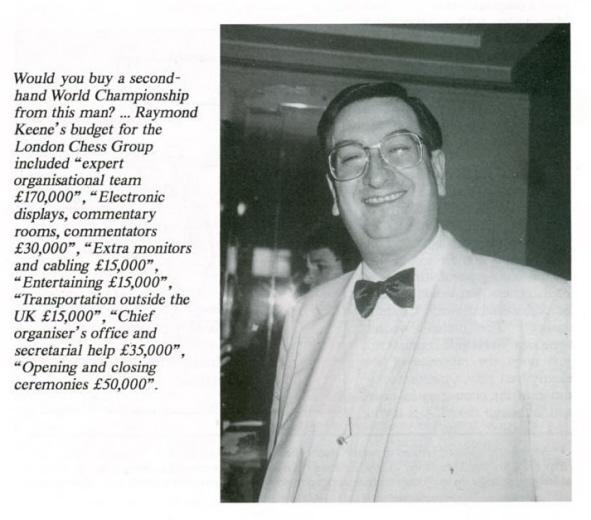
Source: BCM, May 1993, page 231.
C.N. 10841 showed these excerpts from pages 228 and 232 of the same issue, in an article by Murray Chandler and Bernard Cafferty:
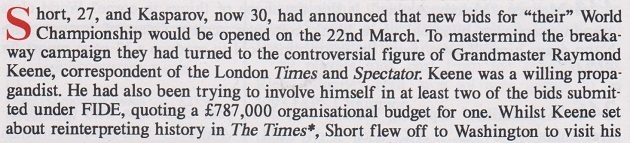

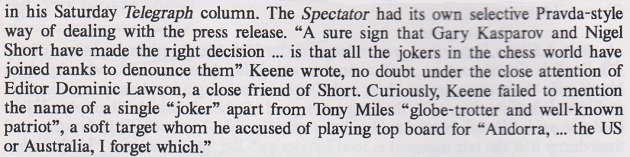
Concerning coverage of Keene-related matters by the BCM in the 1980s, see Rebuttals.
From page 46 of the 3/1993 New in Chess (interview with Anatoly Karpov):
‘You may ask any grandmaster who knows Keene. Everything he is involved in is based on personal interests.’
On page 44 of From Baguio to Merano by A. Karpov and V. Baturinsky (Oxford, 1986) Karpov referred to Raymond Keene’s ‘sharply unpleasant traits’.
The result of Raymond Keene’s attempts at personal advancement is public decline.
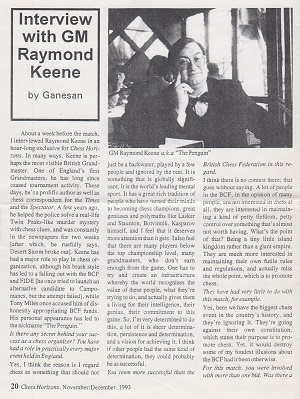
Pages 20-24 of Chess Horizons, November/December 1993 had an interview with Raymond Keene by Ganesan conducted about a week before the start of the Kasparov-Short match in London. On page 21 Raymond Keene discussed the projected television coverage of the match in the United Kingdom:
‘If you look now, we’ve actually achieved a guaranteed total of 77 hours on BBC, Channel 4, and Sky TV covering the match which is a world record for chess coverage. If you compare it to the amount of coverage for the Olympic Games, which is 135 hours, it’s more than half that. That is extraordinary. I told them it would be big but it’s unbelievably big, the amount of TV coverage. 77 hours before it even starts, and that’s not counting news coverage. Almost every newspaper has something about chess. It’s going to get bigger and bigger and bigger, and this is just the tip of the iceberg. It’s a total vindication of the magnitude of the match. I think I can already guarantee that this match will have got more publicity than any other in the history of chess. If you take the TV coverage into account, I would say this match already has more coverage than all the previous matches put together.’
On page 24 Raymond Keene stated that his volume on Nimzowitsch ‘sold around 100,000 copies’ and that, of his books ...
... ‘is the best, easily. That’s a brilliant book. It took five years to research, translations from German and Russian. I’m very pleased with that book, it’s the fruit of many years of deep research. This goes back to your very first question, it’s an undervalued book, the amount of research would have earned me a Ph.D. in many subjects, it’s just that chess is ignored.’
As stated on its final page, the 1986 Russian translation of the Nimzowitsch book had a print-run of 100,000 copies.
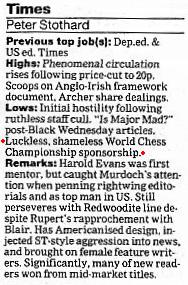
In a letter to us dated 23 July 1993, the Editor of The Times, Mr Peter Stothard, professed that it was his newspaper’s practice to correct errors in print. When, however, further factual inaccuracies were brought to his attention, Mr Stothard became uncommunicative.
An example of how The Times’ preference for propaganda rather than facts has already contaminated chess books is offered by the following passage:
‘By 1922 The Times had become so closely linked with world class chess that it was involved with José Capablanca, the Cuban master, in creating what became known as the London Statutes, which set out the rules under which championship matches were played. These lasted until 1946, when the international chess federation FIDE took over organising games as the new world governing body ...’
Source: article by Ian Murray on page 4 of The Times, 18 May 1993.
In reality, the London Rules (not ‘London Statutes’) were used for only one match, Capablanca v Alekhine in 1927, and The Times’ involvement in their preparation was negligible, but that did not stop The Times from including the following in a sequence of advertising puffs in The Even More Complete Chess Addict by M. Fox and R. James (London, 1993):
‘By 1922 The Times was so synonymous with chess that it was involved with the creation of Capablanca’s World Championship Match rules. These rules, which became known as the London Statutes, were in force, with minor modifications, until 1946 when FIDE took over the title for itself.’
The hammering continued on page 11 of Kasparov v Short by Raymond Keene (London, 1993):
‘By 1922 The Times was so central to the world of chess that it was involved with the creation of Capablanca’s World Championship Match rules ... These rules, which became known as the London Statutes, were in force, with minor modifications, until 1946 when FIDE took over the title for itself.’
(Kingpin, 1993-94)
The text by Ian Murray was also reproduced on pages 5-6 of The Times Winning Chess by R. Keene (London, 1995). In the United States that book was published under the title How to Win at Chess (New York, 1995).
An example of the prose in Kasparov v Short (pages 46-47):
‘Nigel is now three and a half points to a half down, his aides are in panic and he must pull himself back quickly from the brink in order to avoid total mental decimation by a champion who is increasingly looking not just like the most powerful champion in the history of chess but a merciless and Protean monster of the mind.’
In Staunton’s City by R. Keene and B. Martin (Aylesbeare, 2004 and 2005) – see pages 79 and 60 respectively – it is stated:
‘[The London Rules] stipulated that the challenger had to raise a minimum prize fund of $10,000 dollars in gold.’
Flatly untrue.
See The London Rules for further details of Raymond Keene’s repeated slovenliness over this ‘gold’ matter.
In C.N. 583 Mr Raymond Keene acknowledged that Fighting Chess, published by Batsford, ‘should have appeared under the joint authorship of Bob Wade and Gary Kasparov ... in future I will try to amend Bob’s position to co-author on the jacket to reflect accurately the colossal amount of work he put into this.’
That did indeed occur, but now the bibliography of a new Batsford book lists ‘Gary Kasparov – Fighting Chess (Batsford). Kasparov’s own collection of his games’, with no mention of Wade. The new book in question is Chess for Absolute Beginners by, of course, Raymond Keene.
In that bibliography, the name of the ‘co-author’ is nonetheless remembered in the case of Batsford Chess Openings. Mention of BCO brings to mind a further example of Batsford’s behaviour. Reviewing the original edition, the BCM (February 1983, page 51) made a number of criticisms but described it as ‘a definite event in chess publishing’. Batsford’s publicity material has systematically misquoted this as ‘a definitive event in chess publishing’.
(Kingpin, 1993-94)
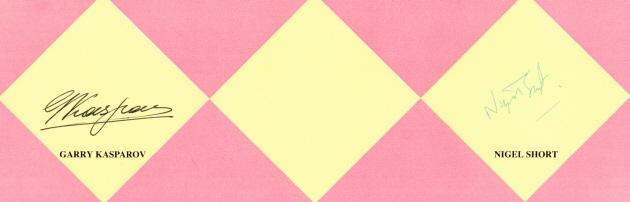
Inscriptions on the front cover of the 1993 Kasparov v Short match bulletins
On page 11 of the 7/1993 New in Chess, Hans Ree described The Times’ reporting as ‘an embarrassing collection of hype and half-truths’. But what about the outright untruths too? A few examples follow.
The newspaper’s (premature) announcement, by Daniel Johnson on 31 March 1993, that it had secured the Kasparov v Short match asserted that The Times had offered ‘the largest prize fund in the history of chess’. In fact, it was smaller than the purses for Kasparov v Karpov, 1990 and Fischer v Spassky, 1992.
The Times’ frequent references to the closing stages of the 1984-85 Karpov v Kasparov match were flatly false. On 27 February Raymond Keene wrote that ‘Kasparov revived and began to win game after game’. On 1 April Walter Ellis claimed that Campomanes had stopped that match as Kasparov ‘began to move ahead of the “approved” champion, Anatoly Karpov’, while a leading article the same day affirmed that the match was stopped ‘after Kasparov had won several games in a row’.
[Addition on page 271 of Kings, Commoners and Knaves: The misinformation has continued. On page 49 of Man v Machine by Raymond Keene and Byron Jacobs with Tony Buzan, we are told that the match was stopped ‘just as Kasparov had started to win a series of games’.]
General chess history fared no better. On 26 June Raymond Keene wrote that one of Reuben Fine’s triumphs in the 1930s was ‘share of first prize with Capablanca at Nottingham, 1936’; on 21 August his column claimed that Gustav Neumann won a tournament four years after he had died; on 9 September he erred by 30 years regarding the origins of the Marshall Gambit in the Ruy López.
The Times even proved unreliable about itself. On 18 May Ian Murray, after showing total ignorance about the conditions for pre-Second World War world title matches, blundered about the identity of the newspaper’s own chess correspondent in the 1930s.
Throughout the Kasparov v Short match, The Times claimed to be publishing annotations by Short, but page 224 of The Inner Game by Dominic Lawson, a close friend of Short’s, reveals: ‘Nigel Short, however, never once bothered to speak to the Times man about the games the day after they were played. Instead, he wou1d delegate one of his seconds, usually Jon Speelman, to give the newspaper some analysis to satisfy its readers, and it was this which would duly appear, masquerading as the unintermediated voice of Nigel Short.’
Incidentally, the same book reports (page 146) that during the match Times staff ‘privately told Short that they would pay for any grandmaster in the world to be flown to London to help him recover from his four-game deficit. What Kasparov would have thought, let alone said, had he discovered that the organisers of the match were prepared financially to back one of the participants against the other – him – defies exact prediction. It would certainly have been a spectacular Azerbaizhani outburst.’
(Letter from us on pages 4-5 of the 1/1994 New in Chess)
Concerning the Neumann matter, see too C.N. 9791.
Some comments on the 1993 London match by Colin Crouch (in a letter to us dated 22 October 1993) are reproduced in Royal Walkabouts.
The Guardian, 28 August 1995, page A12, published a feature, ‘The big league,’ on the editors of British national newspapers. The entry for Peter Stothard of The Times:
Raymond Keene’s book on the 1993 Kasparov v Short match was reviewed by Leonard Barden on page A56 of the Guardian, 20 November 1993. Barden criticized the ‘hype’, as well as ‘much gloating’ about the financial problems of the rival Karpov v Timman match.
On page 68 of the Spectator, 27 November 1993 Raymond Keene ignored the book critique and picked out just two words of Barden’s: the statement, perfectly true in its context, that the Karpov v Timman match had been ‘completed normally’. Professing to be amazed by this remark, Keene wrote:
As regards the planet on which Raymond Keene was living, the day when the ‘Professional Chess Association’ was set up, 24 February 1993, was ‘one of the best days of my life. This is fantastic. ... It will go down in history this day.’‘On what planet are these people living?’
Source: transcript of a telephone conversation between Keene and Kasparov on page 17 of the above-mentioned Kasparov v Short match book. The heading on page 15 was: ‘An Historic Conversation.’
Page 3 of Kasparov v Short (Moscow, 1993) stated regarding the Professional Chess Association, ‘this body was grounded in May 1993’.
As documented in C.N. 5375, Kasparov later described his decision to break away from FIDE as ‘a terrible blunder, the worst of my career’.
Page 12 of The Times, 18 May 1993 had a full-page advertisement headed ‘25,000 1993 world championship chess bonds’ which included this offer:
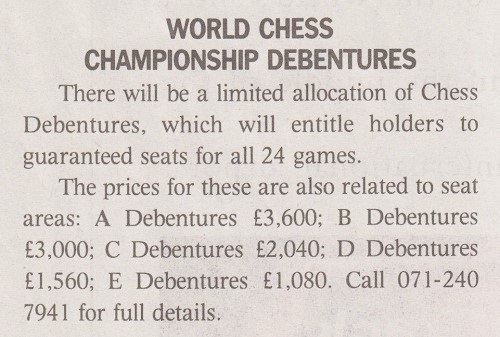
On page 17 of the same edition, chess was the subject of the main leading article:
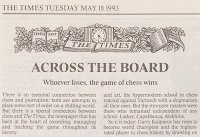
Already the opening paragraph was drivel:
‘There is an essential connection between chess and journalism: both are attempts to place some sort of order on a shifting world. But there is a special connection between chess and The Times, the newspaper that has been at the heart of recording, managing and teaching the game throughout its history.’
There was much familiar old patter, such as this:
‘The cultivation of positional play by Wilhelm Steinitz in the latter half of the nineteenth century was influenced by parallel changes in military technique, which eventually led to trench warfare.’
Over the subsequent months, coverage became increasingly frantic and mendacious. From our reading, no newspaper’s treatment of chess has ever attained the level of crassness found in The Times throughout 1993. The feature article ‘Cuttings’ shows many examples, and more will be added in due course.
(9981)
From page 67 of Duels of the Mind by Raymond Keene (London, 1991):
‘This incredible game has been hailed as the “Immortal Zugzwang Game”. Chess is a game symbolic of warfare. Once this is accepted, is it too fanciful to imagine that Nimzowitsch’s conduct of this wonderful game was influenced by the trench warfare, the blockades which characterized World War I?’
Yes.
In The Times of 12 March 1994, page 31 [S1] Raymond Keene stated that there was a grandmaster named Archangelski. After we pointed out this inaccuracy to the newspaper, a letter dated 24 May 1994 from the Deputy Managing Editor, Mr David Hopkinson, forwarded to us Mr Keene’s response:

(Kingpin, 1994)
The Times’ policy of warding off accuracy in its chess pages is shown by an episode resulting from a letter we sent to the newspaper on 16 January 1991:
‘With regard to recent Winning Move chess features in The Times.
Monday, 7 January: the position claimed to be from a game between Bogoljubow and Alekhine is fictitious (as indeed was the one based on the same game which was published by The Times on 28 December 1990).
Wednesday, 9 January: the position allegedly from Capablanca v Thomas never occurred. The same day’s feature also gives the impossible move 2 Rxa2 in the solution to Tuesday’s column.
Finally, in the solution published on Thursday, 10 January, the reference to “2 Rb8 mate” is erroneous; it is not checkmate because Black can reply 2...Qe8.
In short, your chess correspondent is running true to form.’
The Times published no correction, but ten weeks later we received the following reply (quoted here in full) from Mr Keene:
‘Thank you for your recent letter to The Times concerning the Bogoljubow-Alekhine and Capablanca-Thomas Winning Move positions. It seems to me that the positions and variations have been quoted before, but if you have any information to the contrary, I would be most interested to see it.’
Where is the logic or sense in that?
In the meantime, Mr Keene blunders on. On 29 August 1994 his Winning Move feature published an incorrect position from Mannheim, 1914 and then gave as the actual finish a line that never happened. (The real game lasted over 30 moves more.) For good measure he also mangled the winner’s name, putting ‘Farin’ instead of Fahrni. All that in one little puzzle. What is the solution to the Keene problem?
(Kingpin, 1994)
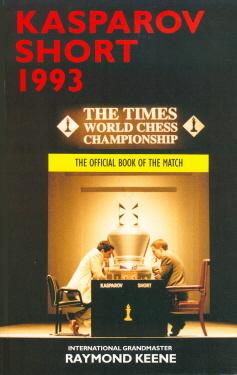
With regard to the interview in your 94/8 issue, Mr Bob Rice’s knowledge of chess and/or sense of fairness may be measured by his assertion on page 9 of the Batsford book on the 1993 Kasparov v Short match:
‘Although the World Championship matches have been arranged by many different organizations, the lineage of the 13 Champions has been recognized by all, including the World Chess Federation (FIDE), a group of national amateur bodies that arranged the last several matches.’
‘Last several’ means ‘last seventeen’.
(Letter from us on pages 8-9 of the 1/1995 New in Chess)
The sole worth of Raymond Keene’s output is to show who will pretend that it is worth putting out.
From page 10 of The Times, 4 February 1995:
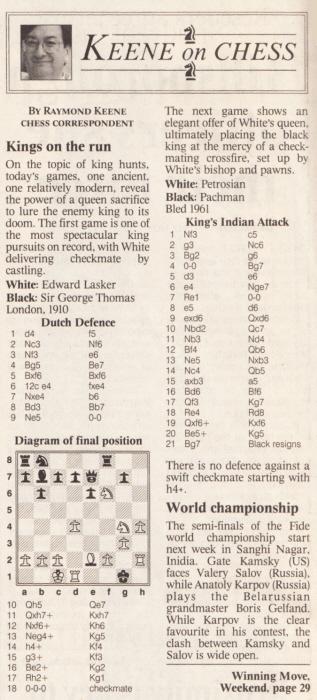
Quite apart from the mistakes about the Lasker v Thomas game (it was played in 1912 and not 1910, White’s sixth move was not ‘6 12c e4’, and it is hardly an example of ‘White delivering checkmate by castling’, given that Lasker played 18 Kd2), as well as the reference to ‘Gate Kamsky’, a general idea may merit reflection.
Game-scores are sometimes accompanied by details of the time consumed by the players. A similar indication would be helpful in each column by Raymond Keene. The one above could be slung together from scratch by almost anybody in the chess world in 15 minutes flat. The difference, of course, is that hardly anybody in the chess world would consider it printworthy.
Raymond Keene is less a journalist or columnist than a copyist, propagandist, egotist, fabulist and contortionist. His column-hogging has done immeasurable harm to chess, to his employers and to himself.
A mystery body is the ‘International Chess Writers Association’, and the following report on page 278 of Kings, Commoners and Knaves summarizes how the ‘Association’ conducts itself:
‘The Times of 22 April 1995 (page 20) reported in all seriousness that Mr Raymond Keene had been named Chess Journalist of 1994. A photograph showed him receiving an engraved statuette from “Demetri Djelica” (sic), who was described as the Director of the “International Chess Writers Association”. No information was offered, then or later, about the origins or composition of this hitherto unknown set-up.’
Page 279 of Kings, Commoners and Knaves (published in 1999) included a comment also written in 1995: ‘Mr Keene will surely triumph again if another such award is offered. Who else would even consider accepting it?’ From 1995 onwards the ‘Association’ lay low, but it unabashedly turned up again on page 25 of the December 2000 CHESS, which published another photograph of Mr Keene once more receiving a trophy from the egregious Mr Bjelica. The object was described by CHESS as ‘the “Chess Journalist of the Year” Oscar’, and the magazine’s extensive photo caption indicated that it did not for one moment take the award seriously. Our records contain no other information on the ‘International Chess Writers Association’ (e.g. its statutes, officers, membership list, voting rules, etc.).
Further details are provided in Chess Awards.
See C.N. 927 in Chess Jottings.
On page 121 of Chess An Illustrated History (Oxford, 1990) Raymond Keene describes David Levy, his brother-in-law, as ‘President of the International Chess Association’.
(Kingpin, 1995)
In the same book Mr Keene presented some cigarette cards with a chess theme, of which he wrote (page 76): ‘A praiseworthy attempt to assimilate chess into popular culture in cigarette cards of the 1930s. The backs of the cards incorporate quite advanced information about the game.’
A cigarette card illustration on the following page shows what passes for ‘quite advanced information’ in Mr Keene’s mind:
‘J.R. Capablanca. Greatest of all chess players. Champion of the world in 1923, having opposed fifty players at once.’
(Kings, Commoners and Knaves, page 279)
The Capablanca card was shown in C.N. 11629:
And from page 88 of Chess An Illustrated History:
As shown in C.N. 3626, and as is well known, the remark dates back to Studies of Chess by P. Pratt (London, 1803), page iii:
The activities and statements of Raymond Keene need to be chronicled rigorously and uncompromisingly.
Prime requisites for any journalist are an eye, nose and ear for cant, and an important function of journalism is pest control.
Keene on Kasparov:
‘Legend has it that at fours [sic] years old – before he had been taught the moves – he was already solving problems which baffled his seniors, he had just picked up the patterns from watching adults play.’
Source: Sunday Times ‘1000 Makers of the Twentieth
Century’, 1991, 13 October 1991.
Kasparov on Kasparov (four years previously):
‘One spring evening, just before my sixth birthday, my parents were trying to solve a chess problem in the newspaper set by the old master Abramian. I had never played chess …’
Source: Child of Change, page 14.
(Kings, Commoners and Knaves, page 302)
In his Times column on 1 October 1999 Raymond Keene wrote, in amongst all the customary blank space, that Howard Staunton ‘had also embarked on a history of the English Public School system that remained unfinished when Staunton died in 1874’.
However, before us lies the first edition of The Great Schools of England, a 517-page book which was published in London in 1865.
(Kingpin, 1999)
For our full Kingpin item see Howard Staunton.
G.A. MacDonnell is not to be confused with A. McDonnell, affirmed Raymond Keene on page 139 of The Complete Book of Gambits (a steal at £14.50), yet Mr Keene twice misspelt G.A. MacDonnell’s name as ‘McDonnell’ on that same page.
(Kingpin, 2000)
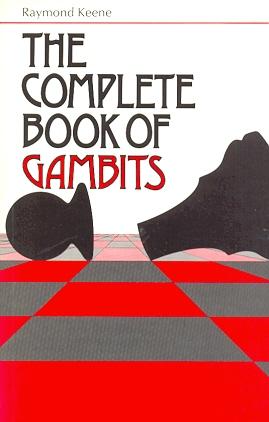
The book is no bargain. For the justification of the word ‘steal’, see Copying.
In a letter to us dated 7 October 1992 David Hooper expressed dismay at the dwindling quality of Batsford’s chess books:
‘I see little hope from Batsfords (what a fall from their great days of the past) or from BCM, to which I no longer subscribe.’
He added that the sole published chess news he saw was in William Hartston’s column in The Independent. On 18 May 1992 he had indicated that he shared our view of N. Divinsky’s catastrophic Batsford Chess Encyclopedia, and on 20 November 1992 he told us that he had submitted a letter which ‘severely criticized Batsford for its poor quality’. However, ‘I don’t think my letter had much effect, as Batsfords appear to believe all their books are good’. Also on 20 November 1992 he told us that the entry on ‘pseudo-opposition’ in the second edition of the Companion contained ‘our little joke’ (cf. the entry on ‘opposition’ in Divinsky’s book). In the same letter he intimated that part of the Companion’s write-up on Batsford’s then chess adviser was intended to be negative (‘anyone who reads between the lines must surely see our point’), but in a postcard dated 5 March 1993 he acknowledged that the entry had been ‘over-subtle’. [These were references to Raymond Keene, about whom David Hooper wrote to us on 4 April 1993: ‘He is a capable organizer, at any rate, notwithstanding many faults. In any case he will dig his own grave (is that the expression I want?) in due course.’]
(3227)
See too David Hooper (1915-98)
Below are two contributions that we made to the Bulletin Board of the Chess Café after a reader enquired about chess federations, associations or companies which Raymond Keene (and Garry Kasparov) had been involved in setting up:
25 October 2000:
One such body was the ‘English Chess Association’, which Raymond Keene founded in 1987, immediately after his egress from the British Chess Federation in the wake of the Tunis Interzonal scandal (misappropriation of appeal funds).
The ECA’s creation was announced so inaccurately in Keene’s newspaper, the London Times (14 October 1987), that even the nascent association’s chairman, Alexander Kennaway, felt obliged to send a telefax of correction to Times Newspapers: ‘The item was gleaned from an early morning interview with Ray Keene – I did not speak to any member of The Times … It contains several factual errors concerning me.’ In short, a typical media manipulation mess by Keene.
The Times affirmed that the ECA would be ‘working in addition to, and not in competition with, the existing British Chess Federation’, but Keene’s real intentions were indicated by his Pocket Book of Chess (published by Kingfisher in 1988). On page 174 he advised readers to ‘contact your national chess association’ and gave the addresses and telephone numbers of six such bodies. First on the list was his ECA, but no mention whatsoever was made of the British Chess Federation, which was simply airbrushed out in best Pravda style.
Deceitful propaganda was a hallmark of the ECA. For example, in its promotional literature it expressed pride at having received recognition in the Encyclopaedia Britannica. In truth the ‘recognition’ was merely in the Britannica Book of the Year, where the writer had been – yes, of course – Raymond Keene himself.
28 October 2000:
The aim of Keene’s ‘English Chess Association’ was purportedly to help develop chess in England, but already by 1989 he was casting about for more profitable vistas. He thus sent four pages of auto-hype to the American Chess Foundation, offering to put the United States on the chess map. His scheme was to ‘carry out preliminary probes in London’, to take a budget for subsequent work in the US (‘plus travel, entertainment, food ...’) and to pocket a percentage (15% was suggested) of the total budget for each event organized as a result of his efforts. What the ACF (and the ECA) made of all that is not difficult to imagine.
So Keene tried something else. A press release dated 1 February 1990 announced that he had joined ‘World Chess Ltd.’, billed as ‘the world’s top agency for providing grandmasters and chess experts for any chess function’. It should not, of course, be confused with the ‘World Chess Council’, Kasparov’s organization of the late 1990s. Barring accidents, it is the latter which is currently being sued by Shirov.
In the mid-1980s Keene had been the ‘Founder-President’ of yet another organization, the ‘Commonwealth Chess Association’. But this too resulted in disappointment, failing to deliver the political support he needed in the 1986 FIDE election, despite his duplicitous claims to the contrary during the campaign. See, in particular, CHESS, September 1986, page 265 and November 1986, pages 323-324. Experienced Keene-watchers still relish that CHESS ‘interview’ which he constructed with his then brother-in-law, David Levy, as a spectacularly inept attempt at media manipulation.
More recently, of course, there have been ‘Mind Sports Olympiad Ltd.’ and ‘Mind Sports Organization Worldwide Ltd.’; Keene and Levy worked together in them, but not for as long as Levy imagined at the time. And so earlier this year came Levy’s Great Awakening.
A contribution that we made to the Chess Café Bulletin Board on 6 November 2000:
Floccipaucinihilipilification
As if all the trashy hype were not enough, the website of Brain Games and The Times newspaper (chess editor: Raymond Keene) have, throughout the Kasparov-Kramnik match, shown their expected contempt for plain facts. Below are some random examples.
In addition to the execrable press releases, the Brain Games site ran a series of daily competition puzzles. Among the notable howlers was the wrong opponent’s name and faulty conclusion to a famous Alekhine blindfold game. Another example was an alleged position from ‘Spielmann v Rubinstein, Vienna, 1933’ which was a shambles (black pawn missing at d5, white pawn at h5 instead of h4 and, not surprisingly, an impossible combination). The list of world championship matches at the site has included Lasker v Janowsky, Paris, 1909, which, as often demonstrated, was not for the world title at all. The ‘tribute’ to Howard Staunton was lifted, almost word for word, from the Foreword to the Keene/Coles book on Staunton published in 1975, without any attribution.
Although Schiller was supposed to be an impartial official, a post-match report in The Times (3 November) described him as not only ‘Kasparov’s co-author and a friend for 20 years’ but also, more interestingly, as ‘a member of his camp’. The same day, i.e. after Kramnik had won the match, Keene called Kasparov ‘the champion’. The writer of the newspaper’s chess column on 18 October (a grand total of five lines of text) was ‘Raymod Keane’. Edward Winter [11-6-00]
Page 237 of the Complete Book of Beginning Chess by Raymond Keene (New York, 2003) asserts that Capablanca’s 1921 feat of winning the world championship without losing a game ‘has never since been repeated’. (What about Kasparov v Kramnik in 2000?) The same book also contains, on page 241, the following information about Alekhine: ‘b. 1882 in Mocow’.
(3343)

From page 304:
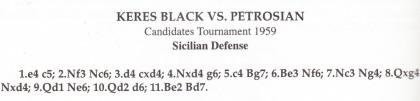
In that game Keres was White versus Petrosian.
Editorially, the book is a shambles. For example, Rudolf Spielmann on page 70, but Rudolph Spielmann on page 187. Adolph Anderssen on pages 228, 231 and 261, but Adolf Anderssen on page 275. As so often in Raymond Keene’s output, there is the spelling Kieseritsky (page 228). The book messes up foreign accents. On pages 66, 176 and 177: Rèti. Page 278 refers to tactical melèes. Many names requiring accents do not have them (there are two instances on page 249). Page 73 has this: ‘It is amazing, but true, that one sides’ entire position in a chess game can utterly collapse ...’, while page 234 has ‘The forward of his biography’. From page 195: ‘I subdivide this section up into the following ...’ Page 257: ‘The greatest player in the history of chess? In my opinion, either be Fischer or Garry Kasparov.’
Page 310 has the conclusion of Spassky v Fischer, Siegen Olympiad, 1970:
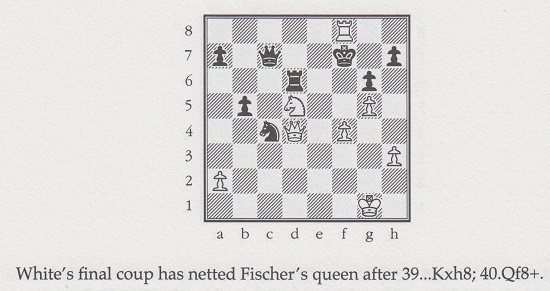
‘A highly original position, possibly unique in the annals of
chess’ is Raymond Keene’s remark on page 86, in the game Kasparov
v Karpov, Tilburg, 1991:
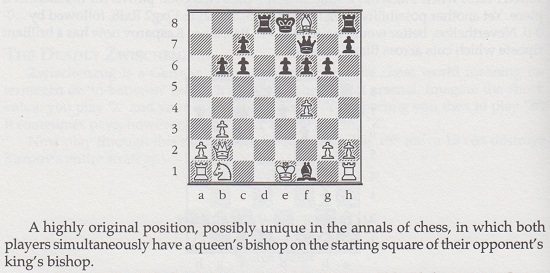
A two-minute check of FatBase 2000 yields a list of games with a white bishop on f8 and a black bishop on f1, and there are 279 of them. Some, though, are duplicates, an example being István Csom’s victory at Esbjerg, 1981 over Raymond Keene.
Many further examples of the book’s incompetence are shown on other C.N. pages.
No volume entitled Complete Book of Chess History is ever likely to be published, for obvious sound reasons, but the word ‘complete’ is widely tolerated in the titles of beginners’ chess books.
Cardoza Publishing, Las Vegas has just brought out a new edition of Complete Book of Beginning Chess by Raymond Keene. As shown in ‘Cuttings’ and on other C.N. pages, the previous edition (2003) had innumerable factual errors, such as this double mishap on page 241:

‘I’m not good at attention to detail’, stated Mr Keene uncontroversially on page 17 of the November 1990 CHESS. Since he is hopeless at chess history, the innumerable factual errors in the 2003 edition of Complete Book of Beginning Chess were mostly, though by no means only, in the last 100 or so pages, in the chapters entitled ‘The Heroes of Chess’, ‘The History of Chess’ and ‘The Best Games Ever Played’.
In the 2018 editionno textual amendments have been made anywhere (‘Rèti’ is still the spelling passim), except that, gratifyingly, those three final chapters have been silently removed.
There remains the logical conundrum of how the 2003 title Complete Book of Beginning Chess could be retained in 2018 for a new edition which is under half the weight of its predecessor and has deleted about one third of the content completely.
The title page of the 2018 edition of Complete Book of Beginning Chess states concerning Raymond Keene:
‘He has been the chess correspondent for the Spectator, London since 1977, and Thames Television since 1986.’
Thames Television closed down in 1992.
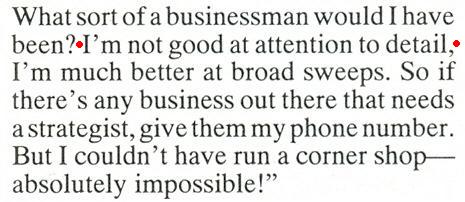
From an interview with Raymond Keene, CHESS, November 1990, page 17. (See Historical Havoc.)
We have it on the authority of Raymond Keene that after the fourth game of the 2004 Kramnik v Leko match in Brissago Peter Leko declared:
‘My cousin Sammy told me a true slugger – a Szeged slugger – will always swing for the fences, and that is exactly what I am going to do. I am going to knock Kramnik out of the room with my “home run punch”. My trainer and I have been developing it in camp. I just hope Vladimir’s head is screwed on tight or it may end up on top of the demonstration board!’
After quoting these words, on page 114 of his book World Chess Championship Kramnik vs. Leko, Mr Keene reported:
‘Kramnik made a face – and a fist – but chose to reserve a fuller reply for the chessboard.’
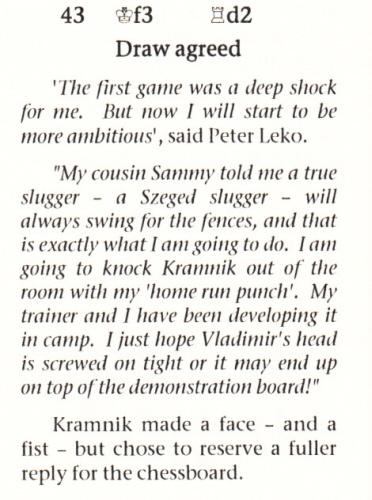
But did Leko, a gentleman, speak any of those words attributed to him by Mr Keene? Drawing this matter to our attention, Alan O’Brien (Mitcham, England) writes:
‘It struck me that this mix of boxing and baseball terminology sounded unusual coming from a Hungarian, so I decided to trace the source of the quote. The first time I have found it mentioned is at http://www.chessgames.com/perl/chessgame?gid=1306947&kpage=59. In a posting dated 3 October 2004 somebody using the pseudonym “Offramp” asserted that the words quoted above (completed with “I will knock Kramnik senseless. He is going down in game five. And he is going down HARD!”) had been spoken by Leko during a press conference after game 4.
Incidentally, Raymond Keene mentions the www.chessgames.com site many times in his book on the match, but not in this case.
I was curious as to where “Offramp” had obtained the quote, and at the webpage http://www.eastsideboxing.com/news/sternburg2210.php I found the following text:
“Sosa: ‘I’m Going to Knock Manfredy Out of the Park!’
… Dominican national lightweight champion Victoriano Sosa predicted a ‘home run-style’ knockout against former WBU champion Angel Manfredy when they rumble, Saturday, 9 November, on the pay-per-view extravaganza ‘Real Fights!’ …
Sosa, the cousin of Chicago Cub home run king Sammy Sosa, spoke today from his training camp outside Chicago …
‘My cousin Sammy told me a true slugger – a Sosa slugger – will always swing for the fences’, said Sosa. ‘And that is exactly what I am going to do. I am going to knock Angel out of the ring with my “home run punch”. My trainer and I have been developing it in camp. I just hope Manfredy’s head is screwed on tight or it may end up in the bleachers!’ …
‘I will knock Manfredy senseless. He is going down in five. And he is going down HARD!’”’
Yet another memorable episode …
Raymond Keene will take many things, but not pains.
Commenting in his Times column of 24 June 1978 (page 19) about Raymond Keene’s book on the 1977-78 Korchnoi v Spassky Candidates’ match, Harry Golombek wrote that the account ‘is so partial as to fail to carry any real conviction’.
(5215)
A) Below is the text of C.N. 4682 (posted on 29 October 2006):
‘“The world’s biggest-selling book” is the boast on the back cover of Guinness World Records 2007 (London, 2006). Two pages include entries on chess: page 99 has a couple of dozen words about Sergei Karjakin being the youngest grandmaster, while page 137 offers brief features on the smallest and largest chess sets, as well as the following: “On 25 June 2005, 12,388 simultaneous games of chess were played at the Ben Gurion Cultural Park in Pachuca, Hidalgo, Mexico.” That is all. The four entries from the 2006 edition have been dropped.
Although poker has five entries on page 136, games such as draughts and bridge receive no treatment at all, and the editorial team’s interests are evidently on a different plane. For example, pages 8-9 document such pivotal attainments as “most heads shaved in 24 hours”, “fastest time to drink a 500-ml milkshake”, “longest tandem bungee jump”, “fastest carrot chopping”, “largest underpants”, “most socks worn on one foot’ and “fastest person with a pricing gun”.’
B) From an article ‘Densa and Densa’ (chessville.com) by Raymond Keene (posted on the Internet on 21 September 2008):
‘I therefore decided to take a look for myself to ascertain whether Guinness is dumbing down or not, and to discover if their response is an honest appraisal of the situation or pure hypocritical cant?
“The world’s biggest-selling book” is the boast on the back cover of “Guinness World Records 2007”. Seven pages in total include entries on Mind Sports: a couple of dozen words about Sergei Karjakin being the youngest chess Grandmaster, while another page offers brief features on the smallest and largest chess sets, as well as the following: “On 25 June 2005, 13,388 simultaneous games of chess were played at the Ben Gurion Cultural Park in Pachuca, Hidalgo, Mexico.”
Although poker has five entries, games such as draughts and bridge receive no treatment at all. For example, it documents such pivotal attainments as “most heads shaved in 24 hours”; “fastest time to drink a 500ml milkshake”; “longest tandem bungee jump”; “fastest carrot chopping”; “largest underpants”; “most socks worn on one foot” and “fastest person with a pricing gun”.’
Raymond Keene’s plagiarism of our work (C.N.s 3493 and 4682) at chessville.com:
The image below highlights in red the only bits written by Mr Keene when he tried to pass off our writing as his own:
The matter has been investigated in detail at the website of the Streatham & Brixton Chess Club (reports dated 30 September, 8 October and 10 October 2008). It may be noted, in particular, that:
a) Mr Keene has made various attempts to explain his copying, and they have been proven untrue;
b) The website to which we referred in C.N. 5771 has now removed from Mr Keene’s article our paragraphs about chess;
c) Mr Keene’s article originally appeared in his weekly column in The Spectator (page 64 of the 7 June 2008 issue);
d) Over a third of ‘his’ article in The Spectator was, in fact, written by us.
(5795)
Below is Mr Keene’s column with our text blacked out:
Our writing as it appeared in The Spectator:
An apology was too much to expect, of course. There are no limits to what Raymond Keene will shrug off.
While the rest of us are reading a new chess book, Raymond Keene is casing the joint.
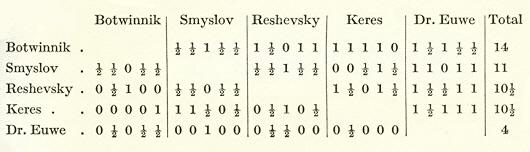
The above crosstable (reproduced from page 5 of Golombek’s book on the event) shows that there were, of course, five players and that they played each other five times. But ...

Page 10 of Raymond Keene’s book on the 2004 Kramnik v Leko match.

Page 7 of Raymond Keene’s book on the 2007 world championship match-tournament.

Page 11 of Raymond Keene’s book on the 2008 Anand v Kramnik match.
(5987)
Raymond Keene no longer makes an effort even to pretend that he is making an effort.
On 3 May 2010, the day Florencio Campomanes died, Eric Schiller posted the following message at chessgames.com:
‘An evil man who is not going to be missed. Thoroughly corrupt persecutor of those who wanted chess to move forward. Destroyer of our beloved World Championship.
Some champagne with dinner tonight to wish him good riddance!’
‘The isolated queen’s pawn is an important learning element in chess strategy. The late Bob Wade first coined the term IQP in his 1963 book on the World Championship match between Botvinnik and Petrosian.’
Source: Raymond Keene, in his chess column in The Times, 11 April 2009.
With Google Books it takes about ten seconds to find earlier occurrences of ‘IQP’, one instance being in The Return of Alekhine by C.J.S. Purdy (Sydney, 1938). We add that the text in question, concerning the nineteenth match-game between Euwe and Alekhine, had already appeared on page 349 of Purdy’s Australasian Chess Review, 20 December 1937:
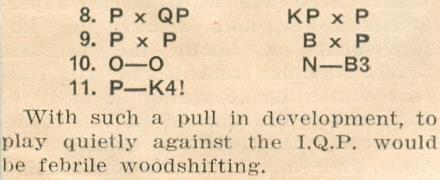
For our part, we would never claim that even Purdy ‘first coined the term IQP’ (or that it was only in 1937 that he first used it).
(6074)
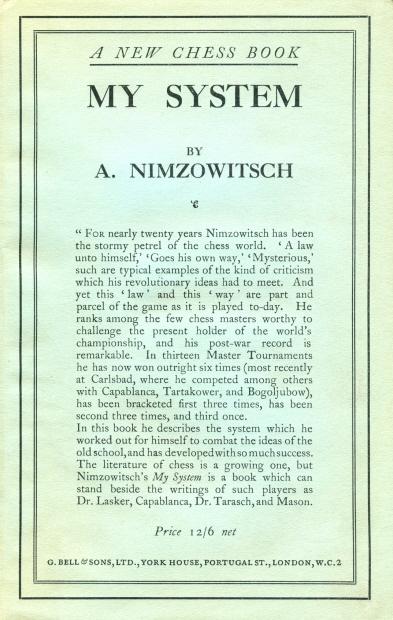
Dust-jacket front (1929)
Nimzowitsch’s My System was first published by G. Bell and Sons, Ltd. in 1929 (302 pages), and the company also issued a two-page errata list. Some, though not all, of the corrections were included by Bell many years later in a reset version (265 pages).
In 1987 B.T. Batsford Ltd. chose to reprint the 1929 original, but the company’s then ‘Adviser’, Raymond Keene, did not realize this. He added a Foreword (‘Batsford are proud to present this new edition ...’) which mentioned page numbers corresponding to the other Bell edition. The Batsford reprint furthermore revealed ignorance of the errata list.
In 2003 Hardinge Simpole brought out a reprint of My System, though it was nothing more than an expensively priced, cheaply produced, reprint of the Batsford reprint, still with ignorance of the errata list, still with the mix-up over the page numbers and, even though Batsford’s name was not mentioned elsewhere, still with Mr Keene’s remark ‘Batsford are proud to present this new edition’.
How pride can come into any of this is unclear.
(6237)
At chessgames.com on 13 July 2009 Raymond Keene stated:
‘i see today that chessbase censored winters comments about susan polgar and took down what winter had written about her-interesting!’
ChessBase has never censored anything written by us. See Hype.
As is well known, Yasser Seirawan was born in Damascus, of a Syrian father and a British mother. However, on page 53 of his book Docklands Encounter (London, 1984) Raymond Keene claimed that Seirawan was ...
‘... born in England of mixed US and Syrian parentage’.
Page 278 of Warriors of the Mind (Brighton, 1989), a book co-bungled with Nathan Divinsky, re-affirmed that Seirawan was ...
‘... born in England of mixed US and Syrian parentage’.
When Warriors of the Mind was re-issued in 2002, the errors were, of course, left untouched.
Four years later, Messrs Keene and Divinsky, together with Jeff Sonas, produced a book entitled Who was the Strongest? Warriors of the Mind II. Page 270 stated that Seirawan was ...
‘... born in England of mixed US and Syrian parents’.
(6292)
One obvious reason why so many of Raymond Keene’s books contain so many gaffes is that he copies so much from so many of his previous books. He is not so much a writer as a repackager.
Regarding the Evergreen Game, the following is on page 136 of Pocket Book of Chess by Raymond Keene (London, 1988):
‘Anderssen’s opponent, Jean Dufresne, was actually a German player and writer whose real name was E.S. Freund.’
Jean Dufresne’s real name was Jean Dufresne. E.S. Freund was his pseudonym.
See too C.N. 10155 and, for Raymond Keene’s repetition of the same obvious gaffe, C.N. 11126 (reproduced below in full):
Olimpiu G. Urcan (Singapore) draws our attention to his review of the e-book Carlsen v Caruana: FIDE World Chess Championship, London 2018 by Raymond Keene and Byron Jacobs (London, 2018) and sends us half a dozen lines from the book’s ‘History of the World Championship’ section:
We offer a few comments:
- Anderssen’s opponent in the Immortal Game ‘of London 1851’ was Kieseritzky, a name which Raymond Keene has persisted in misspelling for decades.
- The Evergreen Game was not ‘against the pseudonymous Dufresne (in reality the German player E.S. Freund)’. Dufresne was his name, and E.S. Freund was his pseudonym. Raymond Keene made the same obvious gaffe 30 years ago, on page 136 of his Pocket Book of Chess (London, 1988), as pointed out in C.N. 10155. See too Cuttings.
- Anderssen v Dufresne was not played in 1856. Our feature article on the game shows that it was published on pages 338-339 of the September 1852 Deutsche Schachzeitung.
- Anderssen v Zukertort was played in Barmen, not Breslau.
Even without primary sources, a quick glance at, for instance, The Oxford Companion to Chess by D. Hooper and K. Whyld (Oxford, 1992) would have sufficed to avoid all these elementary blunders.
***
Under the title ‘As incorrigible as ever’ C.N. 11910 quoted from Raymond Keene’s Article dated 30 July 2022:
‘Anderssen can claim to be one of the supreme tacticians of all time. Three of his wins are of imperishable beauty. On their own they would justify anyone’s devotion to chess. They are his Immortal Game against Kieseritsky (played at Simpsons-in-the-Strand, not the tournament) of London, 1851; his Evergreen game against the pseudonymous Dufresne (in reality the German player E.S. Freund) of Berlin 1856, and his majestic sacrificial masterpiece against Zukertort of Breslau, 1869.’
The pseudo-historical introductions in Raymond Keene’s world championship books are a showcase of his expansive nescience.
‘He is certainly a man inspiring great loyalty.’
Source: CHESS, August 1977, page 331
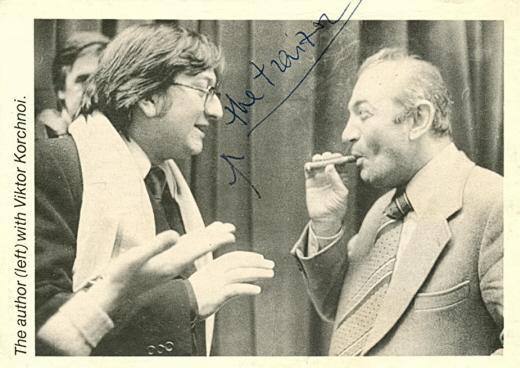
Back-cover inscription by Korchnoi
on one of our copies of Karpov-Korchnoi 1978 by R. Keene
(London, 1978).
In addition to writing ‘the traitor’, Korchnoi signed the title
page. The book was obtained from Korchnoi
in Cape Town on 16 May 1979 by a collector of sports
memorabilia.
Below is an extract from a letter dated 13 September 1979 from Korchnoi to the President of the British Chess Federation, Sir Stuart Milner-Barry, concerning Raymond Keene:
‘How can a man who does not know the meaning of the words “honesty”, “integrity” or “loyalty” be permitted to conduct all manner of business on behalf of the BCF!? A man, who is only interested in his personal well-being, and will undoubtedly use his power to conduct a personal vendetta against anyone, who questions his actions or opposes him in any way!’
Source: CHESS, September 1979, pages 337-338. Below is the complete text:
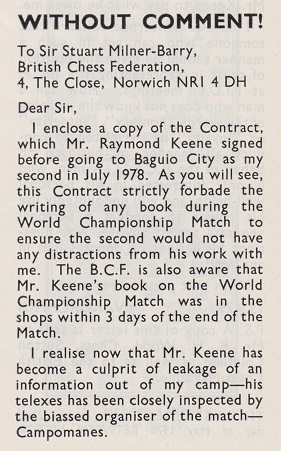
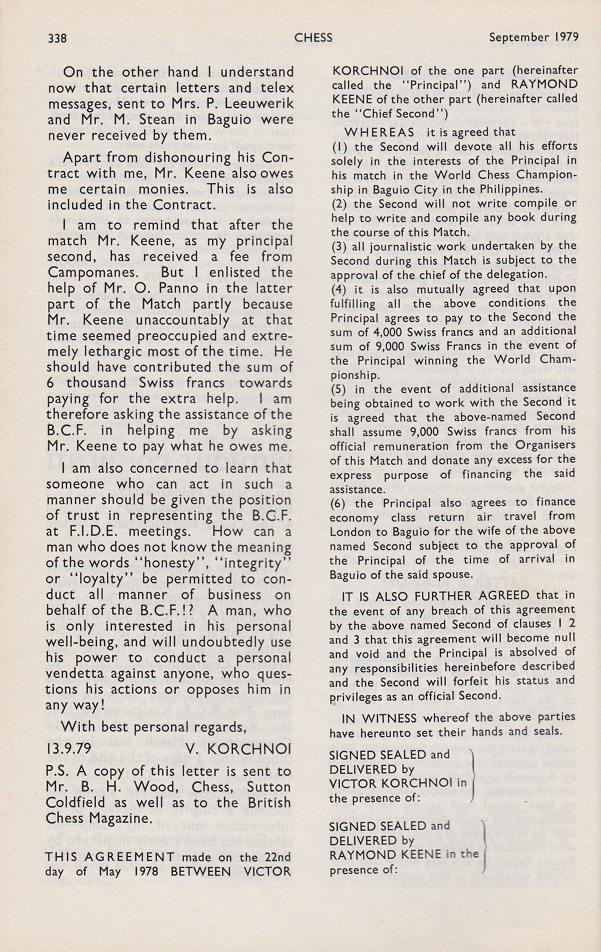
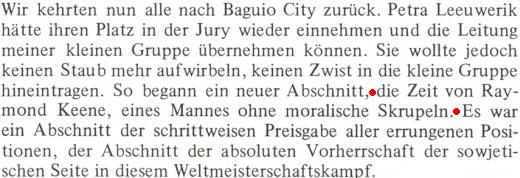
Source: Antischach by V. Korchnoi (Wohlen, 1980), page 109.
From page 61 of the English version, Persona Non Grata by V. Korchnoi with L. Cavallaro (Davenport, 1981):
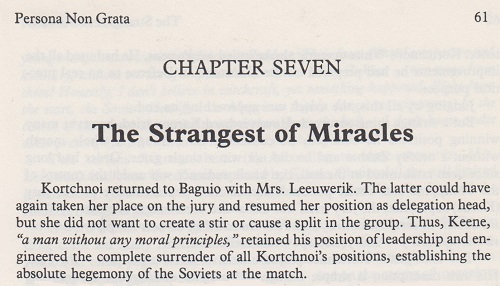
After Raymond Keene left the British Chess Federation in 1987 he attempted to brush it out, in favour of something of his own creation. The following is page 174 of his Pocket Book of Chess (London, 1988):
Botvinnik’s victory over Capablanca in the AVRO tournament is one of the most famous games in chess history. It was played in Rotterdam, and not in Amsterdam as Raymond Keene stated on page 30 of The Sunday Times Book of Chess (Aylesbeare, 2005). The column in question was dated 23 January 2000.
The heading was shown in C.N. 10413:
In a presentation for the Winter 1990 ‘Grandmaster Video Magazine’ Raymond Keene began by saying, ‘This is probably the strangest case I have ever been involved in’. He then reiterated his claim that, on the basis of a drawing, he had cracked a murder mystery (Colin English having been accused of killing Therese Clare Terry, who had disappeared). The following may be noted, from an interview with Mr Keene on pages 4-5 of issue 345 of Jaque, January 1993:
In short, Mr Keene asserted that in August 1990 (July 1990 would be correct) he established the area where the body was located but that the murder case collapsed owing to a legal error by the police. Mr Keene considered that a pity because he could have become a millionaire by writing a book on the subject. He concluded by affirming that the defendant had confessed.
At the end of an article about the case on pages 60-62 of the 6/1990 New in Chess Hans Ree wrote:
‘Keene told me that a publisher had commissioned him to write a book about it.’
When the article was included on pages 279-283 of Ree’s book The Human Comedy of Chess (Milford, 1999), this was amended to:
‘Keene had told me he wanted to write a book about the case. Usually when Keene intends to write a book, it is in the bookstore two weeks later. But this one never materialized.’
The following appeared in The Guardian, 27 November 1991, page 2:
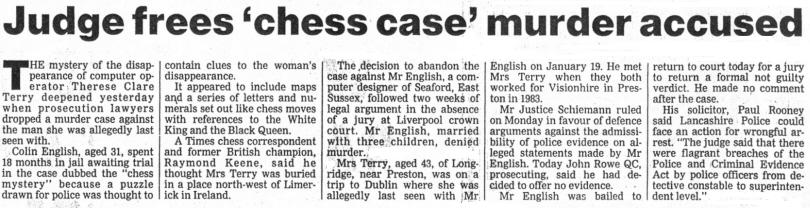
Raymond Keene has often falsely claimed to have cracked the case. For example, the following appeared in a note about him on the back cover of Kasparov-Karpov Battle of the Titans (London, 1991):
‘Recently he played a key role in a celebrated murder investigation by solving a chess-like problem for the police.’
See too the Daily Mail article above by Jeff Powell.
From page 34 of the July 1992 CHESS (in the Addicts Corner column by Mike Fox and Richard James):
From page 132 of The Times Winning Chess by Raymond Keene (London, 1995), in a section entitled ‘Your Questions Answered’:

Quoting that on page 4 of its Winter 1995 issue, Kingpin commented:
‘Fact: At the 1972 No. 1 Zonal Tournament (West European), held at Caorle, near Venice, Raymond Keene was equal 11th-12th with Eising of Germany. At Barcelona, 1975 he was 4th, half a point ahead of that other well-known world championship competitor, Jacobsen of Denmark.’
The lower his self-made pit, the higher his self-made pedestal.
From our commentary on the 1998 Keene/Schiller book World Champion Combinations (published by Cardoza):
Keene, we are solemnly apprised, is ‘considered one of the strongest players in the world’. In reality, he played his last serious chess in the mid-1980s, and on the 1986 rating list he was not among the top ten players in England, let alone the world.
Raymond Keene retired from serious chess playing in 1986, some years after he had retired from serious chess writing.
A remark by us in C.N. 6381 (headed ‘Reprobates’):
Of course, books by ‘known’ writers/players may also be unworthy of a second glance. Nevertheless, for some of chess literature’s reprobates there mysteriously persists a certain fan-base, however insignificant: speed-readers duped by speed-writers.
‘This little man has taught us all how to play chess’ is a famous remark about Steinitz by Adolf Schwarz, as discussed in C.N. 4375. Here we add a nineteenth-century citation, from page 165 of the August 1897 American Chess Magazine:
‘The chess world owes a debt of gratitude to the past-master, and here is an opportunity to partly repay it. At the Vienna tournament of 1882 the noted chess master Adolph Schwartz [sic], pointing to Steinitz, said, “This little man has taught us all to play chess”, and no truer word was ever spoken. He is the father of modern play, and Lasker, Pillsbury, Tarrasch, in fact all who rank high in chess, willingly acknowledge in him their teacher. Paraphrasing a well-known saying, one can stick a pin at random in any handbook and one will find an innovation by Steinitz and adopted since by the chess world. Moreover, he was the pioneer of scientific annotation, and the best analysts of the day are his pupils.’
An alternative version of the remark under discussion:
‘... Dr Emanuel Lasker said, “This little man taught us all we know”.’
Source: page 17 of Ray Keene’s Good Move Guide by R. Keene and A. Whiteley (Oxford, 1982).
(6505)
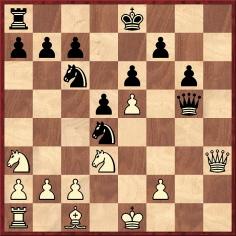
Black to move. Should he castle?
Richard Hervert (Aberdeen, MD, USA) draws attention to this position, which would have arisen in the game Spielmann v Nimzowitsch, Stockholm, 1920 if White had played Nimzowitsch’s suggestion of 17 Nf4-d3 (instead of the move actually played, 17 Be3).
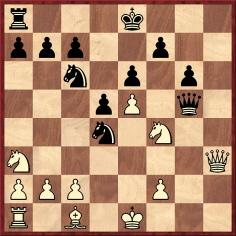
Position after 16...Qg5
On page 364 of The Praxis of My System (London, 1936) Nimzowitsch gave various lines beginning 17 Nd3 Qg1+.
However, Mr Hervert points out that on page 20 of A Complete Defence for Black by Raymond Keene and Byron Jacobs (London, 1996) there is no mention of 17...Qg1+ in reply to 17 Nd3. Instead, the book states in the note to 17 Be3:
‘White’s best is 17 Nd3!, when Black should play quietly with 17...O-O-O! when his prospects are still not bad. He is ahead in development with two pawns for a piece and with White somewhat tied up.’
Except, of course, that White can somewhat untie himself with 18 Bxg5, winning the queen for nothing.
(7210)
Chess researchers soon learn that their work, however painstaking, is liable to be either plagiarized or, conversely, ignored. A familiar Alekhine brilliancy illustrates the latter course:
1 e4 c5 2 Nf3 e6 3 d4 b6 4 d5 d6 5 Nc3 a6 6 a4 Nf6 7 Bd3 h6 8 O-O Be7 9 h3 O-O 10 Re1 exd5 11 Nxd5 Nbd7 12 Bf4 Nxd5 13 exd5 Nf6 14 c4 Re8 15 Bc2 Nh7 16 Qd2 Bd7 17 Bxh6 gxh6 18 Qxh6 f5
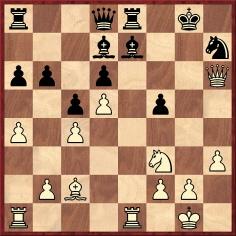
19 Re6 Bxe6 20 Qxe6+ Kg7 21 Qxf5 Nf8 22 Qg4+ Kh6 23 Ra3 Bf6 24 h4 Ra7 25 Ng5 Re1+ 26 Kh2 Qe8 27 Rf3 Qe5+ 28 g3 Qxb2 29 Rf5 Ng6
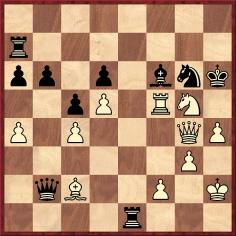
30 Qh5+ Resigns.
When the game was published on page 267 of the June 1934 BCM (‘played in a simultaneous display in Czechoslovakia last year’) Black was named as ‘Ing. Kontay’, and no other details were provided (C.N. 1041). However, pages 479-480 of Alexander Alekhine’s Chess Games, 1902-1946 by L. Skinner and R. Verhoeven (Jefferson, 1998) showed that the exhibition took place in Prague on 20 November 1933 and that Black’s name was Koutný. The source specified was Československý Šach (January 1934, pages 11-12):
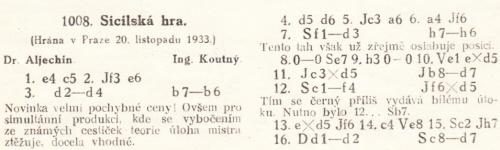
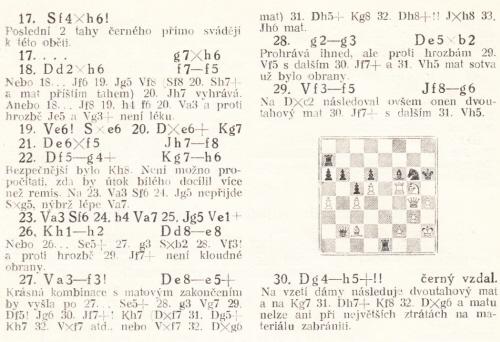
Thus apart from the unrecorded forename of Black (‘Ing.’ means engineer, i.e. inženýr), all key details concerning the game were readily available in 1998.
Readers who recall C.N. 3507 will not be surprised to learn that page 5 of Alexander Alekhine Master of Attack by A. Raetsky and M. Chetverik (London, 2004) went astray, dating the game not 1933 but ‘1935’. A date one further year out (‘1936’) was on page 75 of another Everyman Chess book, The Times Winning Moves by R. Keene and B. Jacobs (London, 2003):
The inaccurate or incomplete references to other Alekhine games in The Times Winning Moves (see pages 29, 33, 35 and 41) could all have been avoided by consulting Alexander Alekhine’s Chess Games, 1902-1946. Below is the last of those four positions, offering a small example of how chess information and knowledge go backwards in the hands of hack writers:
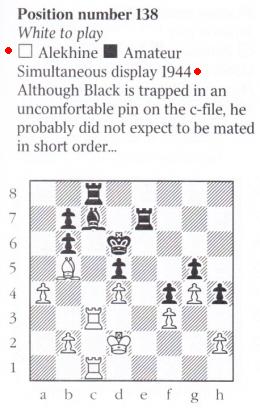
Keene and Jacobs, 2003.
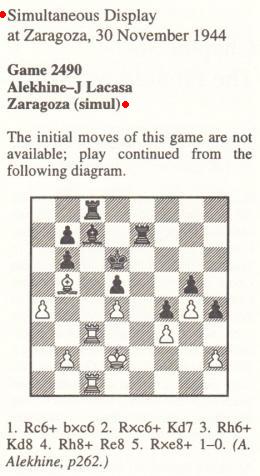
Skinner and Verhoeven, 1998
When this game ending was given in the Spanish and English editions of Pablo Morán’s monograph on Alekhine (see pages 337-338 and 262 respectively), it was pointed out that Black was a well-known figure, Juan Lacasa Lacasa.
A more general point is that many of the other positions in the 2003 Keene/Jacobs book published by Everyman Chess were mere repeats of what had already appeared in two similar volumes by Raymond Keene for Batsford, The Times Winning Moves (1991) and The Times Winning Moves 2 (1996). For instance, ‘Yanowsky v Toriran, Canada, 1953’ is in the second and third books (on, respectively, pages 78 and 57).
(8116)
From page 78 of The Times Winning Moves 2 by Raymond Keene (London, 1996):
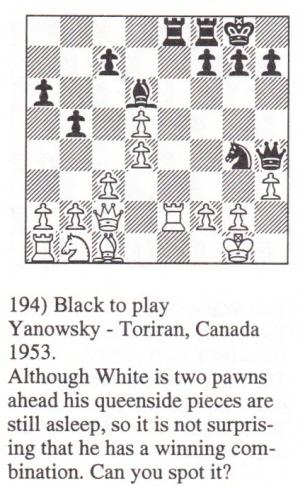
From page 57 of The Times Winning Moves by Raymond Keene and Byron Jacobs (London, 2003):
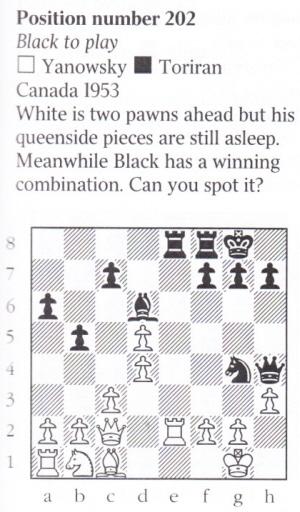
From Dan Scoones (Port Coquitlam, BC, Canada):
‘In citing a chess position it requires a very special talent to garble not only the venue and the date but also the surnames of both players – in other words, everything of significance apart from the actual position and the subsequent moves.’
(8175)
The correct information reference is Yanofsky v Tornerup, Copenhagen, 1947. For the details, see the additional text in C.N. 8175.
In chess lore and history there is often an easy/lazy way and a difficult/worthwhile way, and this is illustrated by an Alekhine position indirectly referred to in C.N. 8116 (see above). From page 33 of The Times Winning Moves by R. Keene and B. Jacobs (London, 2003):
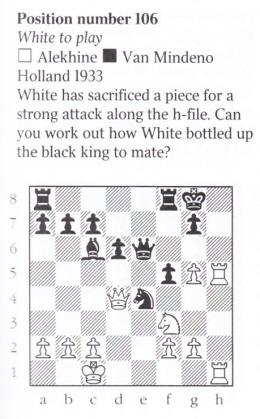
The solution on page 139:

(8203)
Position 32 in Little book of Chess Secrets by Raymond Keene (Glasgow, 2013), where Germany is inexplicably mentioned:
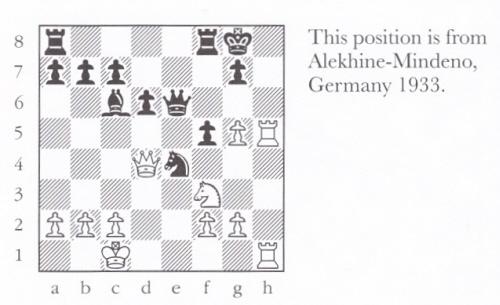
Corrections are one of the few things that Raymond Keene will not copy.
(8396)
For the known facts about this game, see An Alekhine Miniature.
Even when he helps himself to low-hanging fruit, Raymond Keene goes pear-shaped.
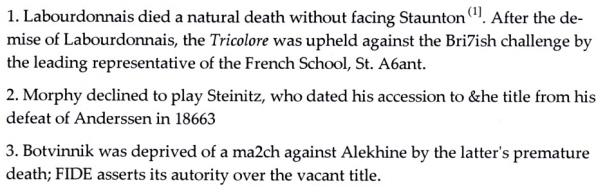
Half a dozen typos in half a dozen lines.
Source: page 12 of a book published by Impala Film Division in 2008: Battle of Bonn (World Chess Championship 2008) by Raymond Keene and Eric Schiller.
(8142)
The final page of the book:
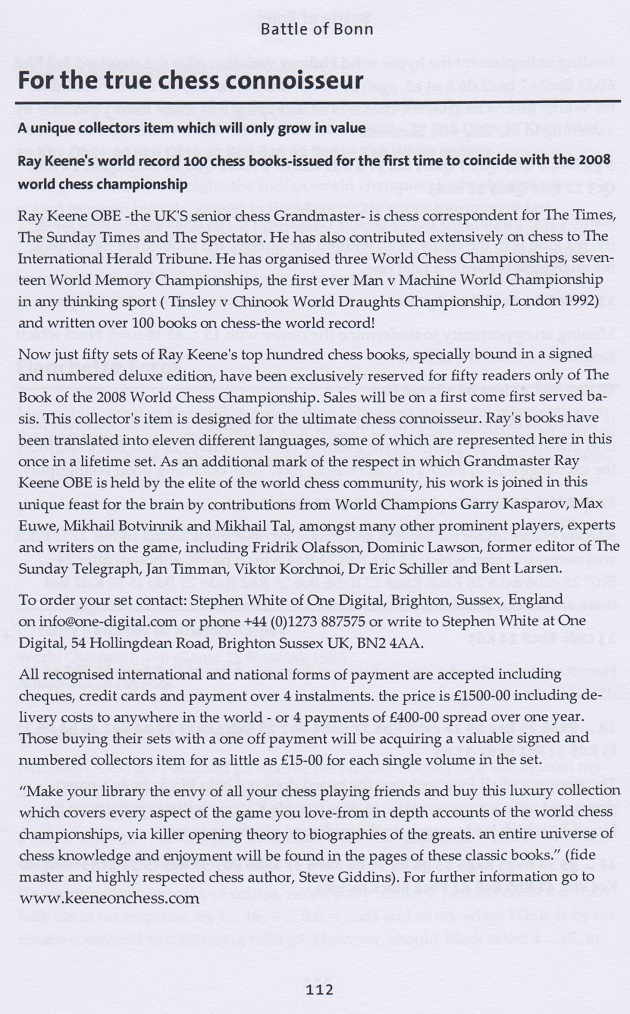
Has anyone ever been taken in by this?
Raymond Keene likes log-rolling, but colluders should be twice shy.
Grandmaster A turns up at the board in an apparent drunken haze and falls asleep (or ‘promptly falls asleep’, as the accounts are more likely to say).
Grandmaster B refuses a pre-game handshake with his opponent because of personal problems between the two players (it is reported that they have ‘a history’).
Grandmaster C is suspected of wiring himself up to an electronic device in an attempt to cheat during a game (the affair is instantly and inevitably baptized any old thing plus the ‘gate’ suffix).
Such happenings in the chess world invariably ignite knee-jerk analysis (‘chat’), offering everyone merciful relief from having to discuss chess. Writers (including those individuals who incongruously combine pseudonymity with self-importance in forum discussions) chew over the rights and wrongs of the case, without knowing the facts or even whether there is a case. We are informed what they feel perhaps happened, what their best guess would be, what they would not be surprised by, what they think they once read somewhere, and what they deem a fitting punishment in view of what they ‘reckon’ occurred. If much of the discussion (dressed up, where possible, as ‘breaking news’) is expressed in prose dashed off without concern for spelling, grammar or anything else, that is a small price to pay for immediacy and the common goal of making the affair ‘go viral’. All the writers can then feel that they have been in on something worthwhile and have done their bit within the chess community.
Should it turn out that, for instance, Grandmaster A’s alcoholic intake was zero and that his drowsiness was caused by problems concerning (‘issues with’) medication, that will not be allowed to put a damper on the fun. Any such correction – not explicitly presented as a correction, of course – will merely open up fresh vistas for comment and speculation from a different angle; after all, drug-taking and drug-testing are notably fertile ground for those wishing to comment and pass judgment, unencumbered by the need to know anything. And so the whole spiel resumes. ‘Freedom of expression’ (i.e. scattergun imputations) can start anew, and a good time is had by all, except by those who care about truth and, more personally, those whose reputations are damaged, or even wrecked, in the maelstrom of misinformation and conjecture.
Now, exeunt Grandmasters A, B and C, and enter Grandmaster D. He is the subject not of gossip or scandal-mongering but of grave, incontrovertible disclosures about his conduct: it has now been demonstrated as a matter of public record that, quite apart from his slew of transgressions over the decades, he has presented other people’s writing as his own not just a few times, as was previously thought, but again and again.
C.N. 8099 briefly referred to Raymond Keene’s plagiarism, but since then the scale of it has become evident from the continuing series of articles by Justin Horton at the Streatham & Brixton website. Readers can examine the eye-popping details for themselves via a convenient ‘plagiarism index’ which is being kept updated.
Executive summary: in addition to shuttling his own writing, or what was imagined to be, from one Times or Spectator column to another (his columns being pale shadows of their former pale shadows), Raymond Keene has often used those outlets to pass off material, particularly from the Kasparov Predecessors books, as his own writing. It is not just occasional phrases, sentences or paragraphs that have been misappropriated, but material to fill entire columns. And, we now know, frequently.
Page 29 of the 28 June-11 July 2013 issue of Private Eye (a feature nearly 90 lines long – shown above in a small format for illustration only) discussed bluntly the behaviour of ‘this absurd comic-book thief’, but what can be said about the chess world’s reaction, or lack thereof, to the affair? To date, it has been a case of ‘lack thereof’. Such pusillanimity is nothing new, there being a longstanding belief among editors (including his employers) that the best place for unsavoury information about Raymond Keene is under the carpet. Now, though, given the sheer extent and seriousness of what he has done, why would any editors or columnists (and not only British ones) wish to continue concealing the facts from their readers? After all, if they were to persist in shielding Raymond Keene, how could they legitimately criticize anybody else for anything?
(8151)
The two most recent issues of Private Eye ask how The Times can possibly continue to employ Raymond Keene, who is described as a ‘bubonic plagiarist’.
Plagiarism is one of the most shameful offences that a writer can commit, and the case against Mr Keene is incontestable. On the other hand, given all his further shortcomings (a whopping euphemism), why would any publication want him even if he had never stolen a single sentence?
(8776)
Raymond Keene is a soiler, not a toiler.
Man versus Machine was brought out by H3 Publications in the United States shortly after Kasparov was defeated by Deep Blue in New York in May 1997. The co-authors (mentioned on the imprint page with regard to ‘entire contents copyright’) were named as David Goodman and Raymond Keene.
Apart from a few differences in topping and tailing, the identical book was published in the United Kingdom by Buzan Centres. That edition specified Tony Buzan as a co-author, even though his name had appeared nowhere in the US book.
(8681)
The previous year this book had appeared:
On page 135 of The Official Biography of Tony Buzan (Croydon, 2013) – a woeful hagiography – Raymond Keene made no mention of David Goodman or Byron Jacobs:

The same text appeared on page 127 of the second (2017) edition, Tony Buzan Mapping the man behind Mind Mapping.
From the ‘About the Author’ feature on page 7 of the 2013 book on Buzan:
And from page 373:
What is the exact origin/source of the remark attributed to The Times? This alleged quote ‘Tony Buzan will do for the brain what Stephen Hawking did for the Universe’ is also in the heading to Chapter 18 (page 241) of the 2017 edition of Raymond Keene’s book on Buzan.
Raymond Keene has made himself Tony Buzan’s claqueur en chef. However, it is far healthier to be the subject of Keene’s vitriol than his treacle.
On page 3 of Lorraine Gill The 10th Muse (Croydon, 2014) Raymond Keene referred to ‘the new Aristotle, Tony Buzan’. Lorraine Gill and Tony Buzan were described as follows on pages 3-4:
‘The association between Lorraine and Tony, practical thinker, philosopher, author, educator, sublime poet and Prime Apostle of Global Mental Literacy, has become one of the defining creative partnerships of the 21st century, each spurring on the other to ever greater heights of achievement, culminating in the award to Lorraine of The Brain Trust Charity BRAIN OF THE YEAR AWARD for 2014.’
On page 5, in the Acknowledgements section, Keene writes, ‘I must thank Professor [sic] Tony Buzan’. His obsession with pseudo-prominenti is laughable.
The dust-jacket of Buzan’s Book of Genius by T. Buzan and R. Keene (London, 1994) stated that Buzan ...
‘... was named in 1994 by Forbes Magazine as one of five top international lecturers along with Mikhail Gorbachev, Henry Kissinger and Margaret Thatcher.’
The exact source and context were not specified; nor was the identity of the fifth lecturer.
A similar claim was made on page 260 of Raymond Keene’s 2013 book on Buzan, although with the strange wording ‘world’s top presenters’:
‘Tony was also featured in Forbes Magazine, being included in the world’s top presenters, alongside Margaret Thatcher, Mikhail Gorbachev and Henry Kissinger.’
A sample of the prose in Raymond Keene’s book on Buzan (2013, page 41; 2017, pages 41-42):
‘In Tony’s staggeringly precocious insight into this anomaly of evaluation, assessment and selection, one observes the very roots, the primeval stirrings of what was destined to become a redefinition, even more, a revolution in the perception and drawing out of the varying and radiantly divergent capacities of the human brain.’
As reported in C.N. 9178 (see above, and also in our feature article on the Guinness World Records book), on page 139 of the first edition of his Buzan volume Raymond Keene plagiarized our writing (the third time that he had stolen the same text):
That entire passage in the ‘World Record’ section was written by us.
Page 379 of the 2013 book on Buzan asserts that the term ‘Mind Map’ yields 103 million results in a Google search:
The same unamended figures were given on page 249 of the 2017 edition.
Below is a claim (about an alleged invitation which Buzan is said to have declined) from page 380 of the 2013 book (repeated on page 250 of the 2017 edition):
Newsnight did not exist until 1980.
On his chessgames.com page (a post dated 17 April 2019) Raymond Keene could not be bothered, following Tony Buzan’s death, to look up a Karpov v Buzan game which he himself had published in the Sunday Times (‘Maybe a search in ST archives wd locate it’).
The game-score was given by Raymond Keene in his Sunday Times column on page 53 of the Supplement, 15 December 1996. After asserting that the Immortal Game between Anderssen and Kieseritsky [sic] was played at Simpson’s in the Strand, for which there is no proof, the column stated (without any further information such as the precise date or occasion) that at Simpson’s in 1995 Anatoly Karpov (‘the World Chess Federation champion’) won the following game against Tony Buzan (‘a well-known author on the brain’): 1 d4 Nf6 2 c4 e6 3 Nf3 b6 4 Nc3 Bb7 5 a3 h6 6 d5 Be7 7 e4 exd5 8 cxd5 d6 9 Bb5+ c6 10 dxc6 Bxc6 11 Bxc6+ Nxc6 12 O-O O-O 13 Bf4 Qd7 14 Rc1 Rfd8 15 Nd5 Nxe4 16 Rxc6 Resigns.
An article entitled ‘Self publishing’ by Justin Horton dated 23 August 2013 shows that in dozens of Spectator chess columns Raymond Keene has advertised the books of Hardinge Simpole without declaring his status as a director of the company.
One extract that caught our eye was the Spectator column of 24 September 2005, which plugged a new book, David Janowski Artist of the Chess Board by Alexander Cherniaev and Alexander Meynell. The extract began:
‘Although a slim tome exists in Russian, and a massive one in German, Janowski has not been rewarded in English-language chess literature with the accolades he deserves.’
The Cherniaev/Meynell book may be regarded as an insult rather than an accolade (even the Foreword begins with an historical blunder), but a brief statistical comparison with the ‘slim tome’ in Russian, published in 1987, will suffice here:
There have come to light no pre-1838 occurrences of the term ‘grand master’ or ‘grandmaster’ in a chess context, or any pre-1984 mentions of the Bell’s Life citation. The Companion [i.e. the 1984 edition of the Oxford Companion to Chess] should thus continue to receive full credit for a significant discovery, and no honest writer would hesitate to give such credit.
Under the title ‘Grandmasterly research’ Raymond Keene wrote on page 5 of The Times, 7 November 1994 about claims that the grandmaster title was created by Tsar Nicholas II at St Petersburg, 1914, and he then added:
‘Following up a clue from the Oxford Companion to Chess, Barry Martin, chess captain of the Chelsea Arts Club, has now demonstrated that the term is considerably older.
Martin’s research shows that in Bells Life [sic], a popular Sunday paper, of February 18, 1838, a leading British player, William Lewis, is referred to as “our past grandmaster” [sic]. Here is a sample of play by the man whom the latest research indicates to have been the first player described as a grandmaster in print.’
Barry Martin had not demonstrated or researched anything. In an article about Staunton in the October 1994 CHESS he had merely given the Bell’s Life quote about Lewis (see page 34), without bothering to acknowledge that it had been published by the Companion a decade previously. Nor was the Companion credited when Martin’s article was reproduced on pages 191-201 of Staunton’s City by Raymond Keene and Barry Martin (Aylesbeare, 2004).
It is also worth dwelling on Keene’s deceitful introductory words in The Times:
‘Following up a clue from the Oxford Companion to Chess, Barry Martin ... has now demonstrated ...’
The Companion did not supply ‘a clue’. It supplied the exact relevant text supported by a precisely dated reference.
Worse was to follow. On page 100 of The Spectator, 4 July 1998 Keene made no mention of the Companion and affirmed flatly:
‘Lewis, according to research by Barry Martin, the secretary of the Staunton Society, was the first player to be described as a grandmaster.’
(8298)
Chess Problems, Play and Personalities by Barry Martin (Beddington, 2018) was discussed briefly in C.N. 11186.
A website named Keenipedia (mentioned in C.N. 8371) provides much information about Raymond Keene, including a comprehensive list of his appearances in Private Eye.
Despite the overwhelming documentary proof, most ‘mainstream chess journalists’ decline to speak out about Raymond Keene. He used to be ‘too powerful’ to criticize, and now he is ‘too insignificant’. What was the intermediate excuse?
Below are the last two names on a list of challengers on page 279 of Keene On Chess by Raymond Keene (New York, 1999):
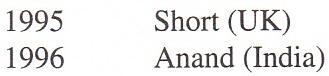
The respective dates should obviously be 1993 and 1995.
Mr Keene, though, stuck to his guns. From page 280 of his Complete Book of Beginning Chess (New York, 2003):
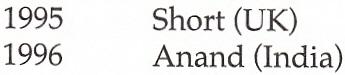
(8434)
An unnumbered page in Little book of Chess Secrets by Raymond Keene (Glasgow, 2013):
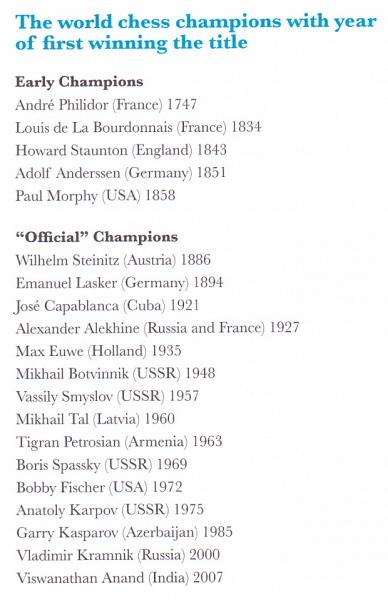
How is the reader to know from such a list that, for instance, Alekhine regained the world title in 1937 and held it until 1946?
Consulting the chart on pages 77-78 of Buzan’s Book of Mental World Records by T. Buzan and R. Keene (Hassocks, 2005) will not help. It has two columns, headed ‘Years’ and ‘Champion’, and includes this sequence:


Yet another Keene shambles over the basic history of the world chess championship.
Pages 215-232 of Curse of Kirsan by Sarah Hurst (Milford, 2002) have an interview with Raymond Keene. From page 220:
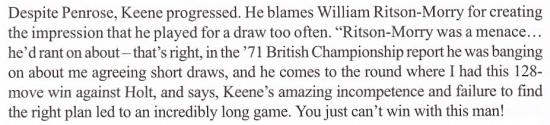
Readers with access to the 1971 BCM will find (September issue, pages 312-320) that W. Ritson Morry wrote very differently. Firstly, most of his criticisms about short draws concerned the players in general. For example, from page 312:
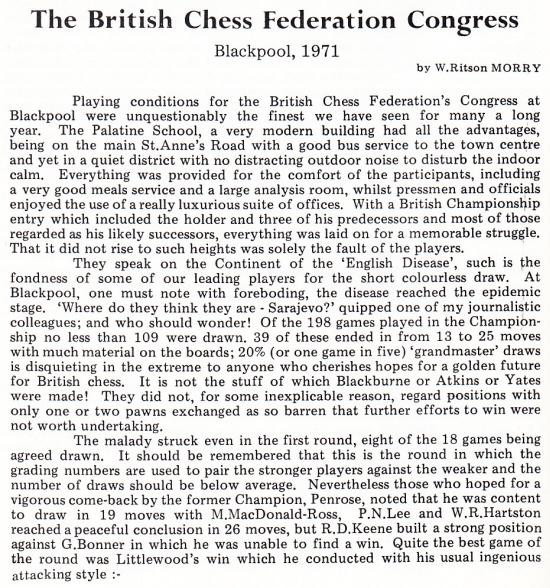
Moreover, what Mr Keene told Sarah Hurst about his game against Holt bears little relation to what Ritson Morry actually wrote in the BCM (page 314):

Pursuing his mendacious vendetta against Ritson Morry, Mr Keene misled readers of chessgames.com (as so often), in a posting dated 23 September 2006:
‘in fact i started out as a very positional player indeed and i made a conscious effort to improve my tactics. a lot of the whingeing about my style was from people like ritson morry who had their own axes to grind-i write about this in my forthcoming book on petrosian-in the context of the criticisms levelled against petrosian in the soviet press after the 1956 candidates tournament.
for example i won the woolacombe international in 1973-the strongest all play all outside hastings in the uk for many years-and in his bcm report ritson morry failed to give any of my wins and only mentioned in passing that i had won the event! the british championship i won included several games of huge length -one over 120 moves- but i was of course criticised by ritson morry for lack of fighting spirit! he was so far off the truth then that there was an outcry and the decline of his influence over the bcm dates from that point.’
It is true that Ritson Morry’s tournament reports did not praise Mr Keene, but that can hardly justify the way the latter banged on about the matter on page 7 of Petrosian vs the Elite (London, 2006):
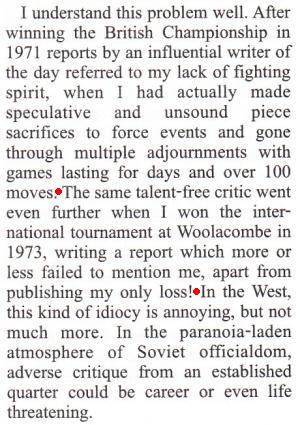
Any reader who consults Ritson Morry’s report (BCM, November 1973, pages 463-467) will find the following:
(8443)
Addition on 16 May 2021:
Despite the above rebuttal, Raymond Keene repeated his same falsehoods in an Article piece dated 8 May 2021:
‘After winning the British Championship in 1971, reports by an influential writer of the day (whose name I shall withhold, according to the formula: de mortuis nihil nisi bonum) referred to my lack of fighting spirit, when I had actually made speculative and unsound sacrifices to force events and gone through multiple adjournments with games lasting for days and over 100 moves. The same, at least in my opinion, talent-free critic went even further when I won the international tournament at Woolacombe in 1973, writing a report which more or less failed to mention me, apart from focusing attention on my only loss! In the West, this kind of idiocy is irritating, annoying even, but not much more. In the paranoia-laden atmosphere of Soviet officialdom, adverse critique from an established quarter could be career or even life-threatening.’
Addition on 18 May 2021:
In a post at the English Chess Forum on 17 May 2021, Olimpiu G. Urcan summarized the matter as follows:
‘With untrue statements, Raymond Keene has repeatedly attacked a deceased chess figure, and has continued recycling those untrue statements even though they have been publicly refuted.’
Addition on 9 March 2024:
Raymond Keene’s output reeks of déjà vu and déjà vaincu.
‘Honesty and openness is always the best policy!’
Source: Raymond Keene, BCM, May 1986, page 208.
From page 98:
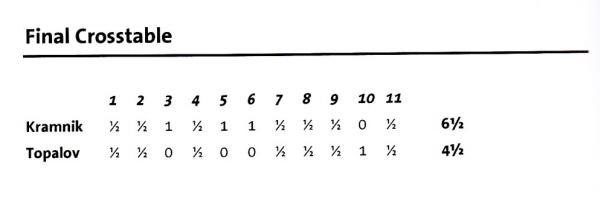
For Kramnik read Anand. For Topalov read Kramnik.
(8476)
Nobody who asserts that Raymond Keene has credibility has credibility.
Raymond Keene: a chess combination of Falstaff, Tartuffe, Gaston Lagaffe, Walter Mitty and the Artful Dodger.
A poacher masquerading as lord of the manor.
A letter from Raymond Keene on page 4 of the 2/1988 New in Chess began:
‘I was most disappointed to read Tim Krabbé’s review of Child of Change in issue 8 of New in Chess. Naturally I disagree with many of his arguments, especially when he refers to the GMA as a waste of time.’
The start of Krabbé’s reply on the same page:
‘Mr Keene should read with more care. I did not say GMA is a waste of time. I said Child of Change was a waste of time.’
BCM, January 1991, page 20
Concerning John Nunn, C.N. 4218 remarked:
As long ago as 1991 he was deploring ‘The Decline of British Chess’ (on pages 20-23 of the January 1991 BCM). His article prompted exchanges in that publication (March 1991, pages 114-115 and April 1991, page 171) and brought him a hands-down victory (against, it must be said, feeble opposition).
The published opposition (March 1991, pages 114-115) came from a single person, Raymond Keene. On page 171 of the April 1991 issue Nunn wrote a demolition which included the following observations:
Keene reverted to the matter 26 years later, on page 204 of the April 2017 BCM, in a pitiful interview with Milan Dinic:
The entire thrust of Raymond Keene’s remarks was, once again, a gross distortion. John Nunn’s article in 1991 (not 1990) was not about predictions and what could or could not be foreseen; it concerned the situation (factual and statistical) of British chess at the time and over the previous decade.
Raymond Keene is not a clever man, and no amount of glibness and guile can conceal that.
In Raymond Keene’s output no waste ever goes to waste.
Like a brazenly dogged tumbler toy, Raymond Keene always comes up for more comeuppance.
Raymond Keene often refers to memory, though never to his own uniquely selective one.
A question for the logician: can Raymond Keene really be called guileful when his guile is so manifest?
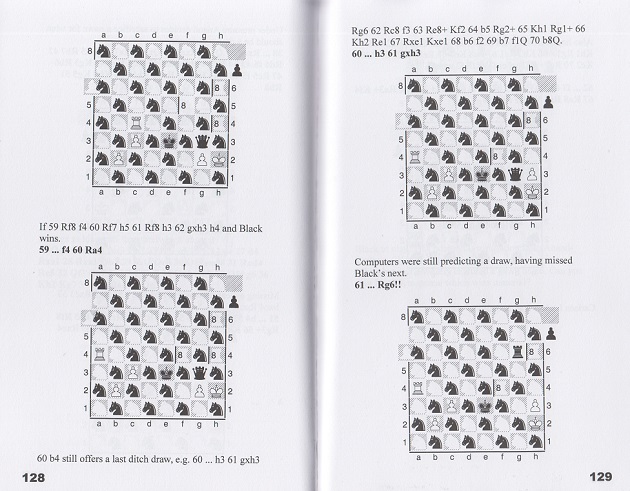
Above are pages 128-129 of Magnus Carlsen – Viswanathan Anand 2014 Re-Match for the World Chess Championship by Raymond Keene (Bronx, 2014).
The book has well over 100 similar diagrams.
A bonus example, from page 190:
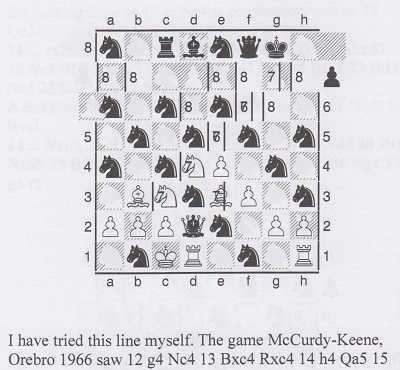
Much of the book duplicates (except that 116 diagrams in that section are now dominated by black knights) what had already appeared in Raymond Keene’s book from the same ‘publisher’, Ishi Press International, on the 2013 match between Carlsen and Anand. Below, for instance, is the entire chess content on, respectively, pages 225 and 157 of the books on the 2013 and 2014 matches:
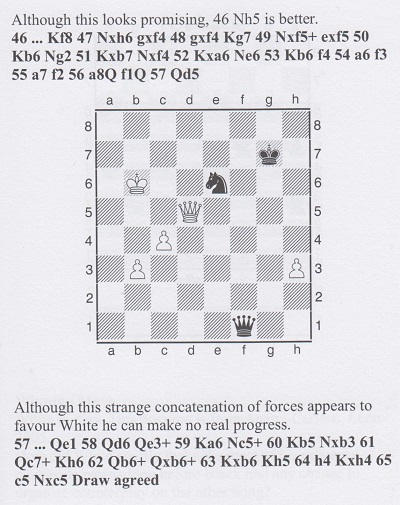
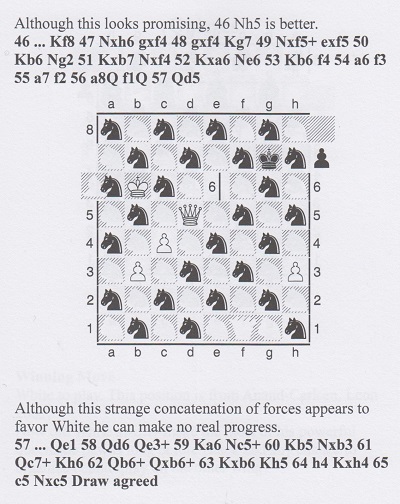
The only reason to buy a book by Raymond Keene is to warn others not to.
People who make do with calling Raymond Keene ‘controversial’ are over 30 years behind the times.
From an article by Peter Ayton (‘a senior lecturer in psychology at the City of London Polytechnic’) on page 29 of the Listener, 28 May 1987, concerning Thames TV’s coverage of the London Docklands speed chess challenge (Kasparov v Short):
‘The style of presentation of the Thames programme seemed to treat chess as if it were a game much like any other shown on television. Having introduced us to the players in the manner of a snooker (or boxing) match, the commentary proceeds as if we were watching football or wrestling. Raymond Keene, a chess grandmaster, delivers his description of “the action” in excited bursts: “He could move that pawn – Yes, he’s done it! My God!”, “This is quite amazing!” and even “Come on Nigel!”’
An extract from C.N. 1387, written in 1987 (see Rebuttals):
The BCM is even capable of dropping a news story half way through if it looks likely to show Mr Keene in unfavourable light. The most recent example concerns a court writ (behind which was Raymond Keene and Thames Television) issued in February against Aly Amin of Chequers. Mr Amin was prevented by the subsequent High Court hearing from bringing out a book on the Kasparov-Short speed chess event until the recordings of all six games had been shown on television. One can appreciate the reasoning behind such a restriction, which aimed to ensure that the suspense of the match was not spoiled for viewers. The BCM clearly considered the story an important one, even discussing it in its March editorial. Its April issue quoted a Thames Television spokesman’s comment on the High Court verdict: ‘This is a significant victory which safeguards delayed transmission of chess on television and will enable us to explore future similar projects’. So far, so good. But on 16 March Mr Keene’s own book on the match was rushed out early. At that time two games had still not been screened, and viewers’ interest was therefore well and truly spoiled – by the very parties who had used the courts to stop Aly Amin from doing the same. So did the fearless BCM draw attention to this hypocrisy? Not at all. The May issue (page 194) reviewed the Keene book – uncritically, of course – but the legal dispute, extensively reported up until then, was quietly dropped.
Roger Lancaster of Chequers, London sends us a copy of a letter written by him to news flash giving further details of the legal dispute regarding books on the Kasparov v Short match. Since the full text is published on page 10 of the 10 July 1987 news flash we give just a brief summary here. On 10 February M.J. Feldman, a Thames Television producer, made an affidavit: “... it was critical that the results and in particular the moves made by the players were not published until each game had been transmitted in order not to spoil the viewers’ interest and enjoyment of the programmes. ... In an accompanying affidavit, Raymond Keene swore that he agreed with Mr Feldman’s statement. However, a copy of Mr Keene’s Batsford/Thames book was in the hands of Chequers’ solicitors when only three of the six match-games had been transmitted. Mr Lancaster puts the central point very well:
‘It will be interesting to know, and indeed the High Court may wish to know, how Messrs Feldman and Keene reasoned that a book written by an outside party would “spoil the viewers’ interest and enjoyment” while a book co-produced by Thames Television and written by Keene would not.’
(1452)
Wanted: specific information on how the court case ended.
On pages 36-37 of the 4/2015 New in Chess Nigel Short has written a follow-up article, ‘A Beautiful Minefield’, discussing reaction to ‘Vive la Différence’ (published on pages 50-51 of the 2/2015 issue). A brief extract:
‘On 20 April an article appeared in The Daily Telegraph entitled “Nigel Short: Girls Just Don’t Have the Brains to Play Chess”. Never mind the fact I didn’t say that, it was a catchy headline to set me up as a misogynist pantomime villain. In extraordinary rapid succession came a whole series of similar articles, in The Guardian, The Times, The Independent, many with totally fabricated quotes and grotesque distortions – such as the Daily Mail’s “Women aren’t smart enough to play chess because the game requires logical thinking, says British Grandmaster”, despite me having said nothing at all about logic.’
Indeed so, notwithstanding Raymond Keene’s assertions in an item for the Spectator placed on-line on 22 April 2015 (i.e. over a month after the 2/2015 issue of New in Chess appeared):
‘According to Short’s comments, the female brain fails in the logic department, hence girls will never be able to match boys over the chessboard ...
Even if Nigel has a point about logic, at least one of the greats of chess history is not on his side. As the brilliant tactician and incandescently creative world champion Alexander Alekhine once said, “chess is not only knowledge and logic!”.’
(What Alekhine ‘once said’ can be found in the final note to his victory over Reshevsky, Kemeri, 1937, in his second volume of Best Games.)
Many so-called journalists, from Raymond Keene upwards, have written about Nigel Short’s ‘Vive la Différence’ article without bothering to read it, but it cannot be assumed that they, or the hordes of unpaid opinionizers on-line, would have had anything worth writing even if they had read it.
A reviewer whose own volumes are notorious for blunders and other defects (plagiarism, for instance) should be neither reviewing nor authoring. Nor, of course, should any writer wish to quote favourable opinions received from such a reviewer. T. Harding rushing to cite R. Keene’s fulsome praise of his Blackburne book was a pathetic spectacle.
(9592)
Having just seen, for once in a long while, a copy of The Times (London), we note that Raymond Keene’s column is still shambling along with its trademark mix of inaccuracy, superficiality and cronyism.
Page 45 of the 26 January 2016 edition has this:
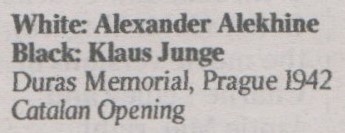
Oldřich Důras died in 1957. The 1942 tournament marked his 60th birthday.
(9705)
Concerning Raymond Keene’s treatment of ‘hanging pawns’ (the origin of the term), see C.N. 9941.
From Olimpiu G. Urcan (Singapore):
‘In today’s Times, page 19 of the second section [29 July 2016], Raymond Keene writes:
“Gordon Cadden’s historical research in the June issue of the British Chess Magazine (see yesterday’s column) performs a further service by correctly establishing not just the correct location of François-André Philidor’s grave but also the accurate time of his death, which had previously been mis-stated as August 24, 1795. In fact, it was August 31 of that year. Cadden’s article contains one unfortunate error in the caption to the match between Howard Staunton and Pierre de Saint Amant in Paris, the contest in which Staunton developed many of Philidor’s theories. This match, of course, took place in 1843 not 1834 as given in the article.”
In reality, it has long been common knowledge that Philidor died on 31 August; C.N. 6006 pointed out that “there was doubt about the correct date until the mid-1920s”. George Cadden’s article on pages 357-362 of the June 2016 BCM, an interesting read, made no claim to have discovered anything new about the date.
Raymond Keene takes nearly 50 words to point out an obvious caption error in the BCM, but when will he correct the many factual blunders which he himself made in his Times and Sunday Times columns over a mere four-day period last month? On 15 June 2016 I wrote a brief article cataloguing them.’
(10046)
Mr Urcan’s article is entitled ‘Keene, the Gaffe Machine’. Indeed. For Raymond Keene, any chess history topic, whether hackneyed or obscure, old or new, is just another banana skin.
On page 127 of World Chess Championship Kramnik vs. Leko (Aylesbeare, 2004) Raymond Keene wrote:
‘... when faced with Marshall’s gambit in the first game of their 1918 match, Capablanca rose to the occasion.’
C.N.s 2032 and 9843 (see Chess Anecdotes) discussed a groundless old yarn about Znosko-Borovsky and Capablanca. Some further citations:
Of Capablanca’s own games it has been written, with justice, that they breathe a serenity, a lucid crystal clarity, a type of model perfection. Indeed, that they are the product of supreme chessboard art.’
Raymond Keene, on page 40 of The Times (Review Section), 19 November 1988;
Of Capablanca’s own games it has been written, with justice, that they breathe a serenity, a lucid crystal clarity, a type of model perfection. Indeed, that they are the product of supreme chessboard art.’
Raymond Keene, on page 236 of Keene On Chess (New York, 1999);
Of Capablanca’s own games it has been written, with justice, that they breathe a serenity, a lucid crystal clarity, a type of model perfection. Indeed, that they are the product of supreme chessboard art.’
Raymond Keene, on page 237 of Complete Book of Beginning Chess (New York, 2003);
Of Capablanca’s own games it has been written, with justice, that they breathe a serenity, a lucid crystal clarity, a type of model perfection. Indeed, that they are the product of supreme chessboard art.’
Raymond Keene, on pages 40-41 of World Chess Championship Kramnik vs. Leko (Aylesbeare, 2004);
Of Capablanca’s own games it has been written, with justice, that they breathe a serenity, a lucid crystal clarity, a type of model perfection. Indeed, that they are the product of supreme chessboard art.’
Raymond Keene, on page 34 of Vishy’s Victory (2007);
Of Capablanca’s own games it has been written, with justice, that they breathe a serenity, a lucid crystal clarity, a type of model perfection. Indeed, that they are the product of supreme chessboard art.’
Raymond Keene, on page 21 of Battle of Bonn (2008);
Of Capablanca’s own games it has been written, with justice, that they breathe a serenity, a lucid crystal clarity, a type of model perfection. Indeed, that they are the product of supreme chessboard art.’
Raymond Keene, on page 58 of Carlsen-Anand Match for the World Chess Championship (Bronx, 2013).
As regards the second paragraph in each of those seven passages, the uncredited writer of the ‘lucid crystal clarity’ remark was Harry Golombek, on page ix of Capablanca’s Hundred Best Games of Chess.
(10316)
On page 84 of Chess An Illustrated History (Oxford, 1990) Raymond Keene gave another version of the quote about Capablanca:
‘Of his games, it has been declared that they breathe “a serenity, a crystal clarity, a perfection which is the result of the highest art”.’
See C.N.s 10423, 11939 and 11992, as well as the following:
Jerry Spinrad (Nashville, TN, USA) informs us that the only simultaneous display by Staunton which he has seen mentioned in the Chess Player’s Chronicle is a very small one at the Rock Ferry Chess Club (July 1853 issue, pages 217-218):
After supper and speeches the games were resumed, but the report did not specify the outcome.‘A special Meeting of this Society was held on the evening of the 5th ult. at the Club Rooms, Rock Ferry Hotel, for the purpose of welcoming to Cheshire Mr Staunton, who, during his short visit, was the guest of Mr Morecroft, of the Manor House ... In the course of the evening there was some very interesting play. Mr Staunton conducted simultaneously two games against the Liverpool gentlemen, in consultation at one board, giving them the odds of pawn and two moves, and against the Rock Ferry gentlemen, at another board, giving them the odds of the knight.’
On Morphy, Jerry Spinrad and John Townsend refer to a simultaneous display which is well known. Mr Townsend writes:
‘David Lawson, in Paul Morphy, the Pride and Sorrow of Chess (new edition by Thomas Aiello, 2010), quoted (on pages 213-214) from an account of a simultaneous exhibition which took place at the St James’s Chess Club in London on 26 April 1859, the source being the Illustrated News of the World, of “the following Saturday”:
“A highly interesting assembly met in the splendid saloon of St James’s Hall, on Tuesday evening last [26 April], when Mr Morphy encountered five of the best players in the metropolis.”
The opposition was formidable:
“The first table was occupied by M. de Rivière; the second, by Mr Boden; the third, by Mr Barnes; the fourth, by Mr Bird; and the fifth, by Mr Löwenthal. Mr Morphy played all these gentlemen simultaneously, walking from board to board, and making his replies with extraordinary rapidity and decision. Although we believe that this is the first performance of the kind by Mr Morphy, it is a remarkable fact that he lost but one game. Two other games were won by him and two were drawn.”’
Those reports, one display apiece by Staunton and Morphy, are all that can currently be cited here, although the following may be recalled from C.N. 10423 (concerning Morphy after his match with Anderssen):
‘He confined himself to simultaneous displays, playing 20, 30 and even 40 people at once ...’
Source: page 274 of Keene On Chess by R. Keene (New York, 1999). The identical wording was on page 275 of Complete Book of Beginning Chess by R. Keene (New York, 2003).
(11996)
By chance we have just been re-reading the October 2008 edition of CHESS (Editor: Jimmy Adams. Executive Editor: Malcolm Pein). Among the contents:
About 20 pages ...
(10975)
Raymond Keene has always been a sucker for sycophants.
When declining to deal with various points related to his writing and conduct, Raymond Keene concluded a letter to us dated 26 June 1985 with this extraneous paragraph:
‘For your information, if you are interested, I was awarded the OBE for services to chess in the Queen’s Birthday Honours List of 15 June. I am confident you will find a witty way to present this to your readers if you feel so inclined.’
Our reply of 6 July 1985:
I was aware of the news of your award, from The Spectator of 29 June, but it had not occurred to me to publish my thoughts on it.
The two letters were given verbatim in C.N. 1029.
In his book on Tony Buzan (2013 edition, page 7; 2017 edition, page 5) it is asserted that Raymond Keene received the OBE ‘for services to chess and charity’ [emphasis added].
Olimpiu G. Urcan points out these Twitter exchanges involving Nigel Short and Raymond Keene:
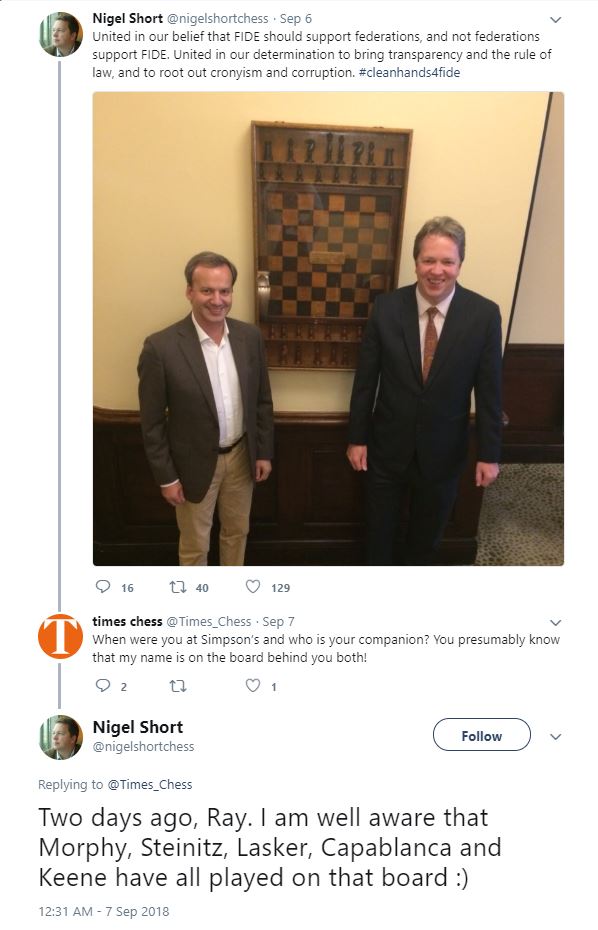
Raymond Keene’s inability to recognize Arkady Dvorkovich is as pitiful as his pride in the defilement of the Simpson’s-in-the-Strand chessboard (as shown on a Kingpin webpage).
(11004)
The Immortal Game demonstrates Raymond Keene’s multi-faceted ignorance about the Anderssen v Kieseritzky brilliancy and quotes this extract from a 5 December 2020 article of his concerning Simpson’s:
‘A famous chess board and pieces situated at the top of the main staircase still commemorates the exploits on the 64 squares of such chessboard immortals as Howard Staunton, Adolph [sic] Anderssen, Paul Morphy and Emanuel Lasker. On my 50th birthday the genius loci Brian Clivaz ... invited me to play a couple of games on this hallowed chessboard turf, and generously inscribed my name on the plaque, along with the gods of the game.’
The plaque does not mention Anderssen.
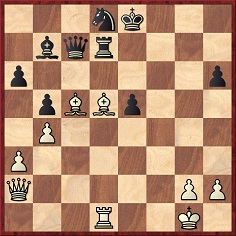
White to move
This position arose in a game won by Charles R. Gurnhill of Sheffield. It was published on page 260 of the Chess Amateur, June 1927, in the Games Department which he edited:
There is no record of many, or any, Chess Amateur readers being baffled by the position or asking why Black did not reply 1...Rxd1+.
From page 39 of Keene On Chess by Raymond Keene (New York, 1999):
That takes up over half of one large page. The same text was repeated on page 39 of Raymond Keene’s Complete Book of Beginning Chess (New York, 2003) and on pages 40-41 of the Las Vegas, 2018 edition.
(11036)
Apish ‘tributes’ to Bobby Fischer on page 21 of Chess Life, March 2008:
‘He was the pride and sorrow of chess.’ (Raymond Keene)
‘Chess was his native tongue.’ (Larry Evans).
(11059)
From the 1974 book The World of Chess by Anthony Saidy and Norman Lessing (page 115):
From the 1990 book Chess An Illustrated History by Raymond Keene (page 80):
Olimpiu G. Urcan draws our attention to his review of the e-book Carlsen v Caruana: FIDE World Chess Championship, London 2018 by Raymond Keene and Byron Jacobs (London, 2018) and sends us half a dozen lines from the book’s ‘History of the World Championship’ section:
We offer a few comments:
Even without primary sources, a quick glance at, for instance, the Oxford Companion to Chess by D. Hooper and K. Whyld (Oxford, 1992) would have sufficed to avoid all these elementary blunders.
(11126)
In addition to its many factual errors, Carlsen v Caruana: FIDE World Chess Championship, London 2018 by Raymond Keene and Byron Jacobs (London, 2018) has much copying from other works by Mr Keene. A note at the end of the review mentioned in C.N. 11126 observes:
‘About 90% of the biographies of Lasker, Capablanca and Alekhine is a direct copy from Keene’s book on the 2000 world championship.’
Another example is the biographical section on Spassky, where even the misspelling ‘he gave full reign’ is repeated. From that section (pages 27-28) we highlight one sentence, concerning the 1972 world championship match:
In reverse chronological order:
Page 35 of The Brain Games World Chess Championship by Raymond Keene and Don Morris (London, 2000).
Page 178 of Samurai Chess by Michael Gelb and Raymond Keene (London, 1997).
Page 21 of part 5 of Raymond Keene’s Men of War publication for The Times during the 1993 Kasparov-Short match.
Page 72 of Chess for Absolute Beginners by Raymond Keene (London, 1993).
Page 10 of Fischer-Spassky II by Raymond Keene (London, 1992).
Page 96 of Chess An Illustrated History by Raymond Keene (London, 1990).
Page 223 of Warriors of the Mind by Raymond Keene and Nathan Divinsky (Brighton, 1989).
A sub-variation:
Page 107 of Carlsen-Anand Match for the World Chess Championship by Raymond Keene (New York, 2013).
Page 25 of Battle of Bonn by Raymond Keene and Eric Schiller (2008).
Page 50 of Vishy’s Victory by Raymond Keene (2007).
Page 58 of World Chess Championship Kramnik vs. Leko by Raymond Keene (Aylesbeare, 2004).
(11142)
On 18 May 2019 Olimpiu G. Urcan informed us that his review of the 2018 Carlsen v Caruana match book had prompted an 11-page article by Jimmy Adams in the May 2019 BCM (pages 297-307) which attempted to defend Raymond Keene – incompetently, with, for instance, 23 occurrences of the misspelling ‘Olympiu’.
Jimmy Adams has an assured place on any list of chess writers who have discredited themselves by defending the indefensible.
(See too Breyer and the Last Throes.)
Raymond Keene is his own worst enemy. Next come his so-called friends. In the chess world, the number of such ‘friends’ has dwindled dramatically, for obvious reasons. Raymond Keene: a tribal chess writer now bereft of a chess tribe.
An unfathomable claim about FIDE [‘before the death of Alekhine in 1946’] on pages 288-289 of Who Was The Strongest? by Raymond Keene, Nathan Divinsky and Jeff Sonas (Aylesbeare, 2006):
‘Three years later [in 1993] Kasparov annihilated Nigel Short in a match that was held outside the auspices of FIDE, the World Chess Federation, which had shown itself increasingly incompetent to handle events at the highest level. FIDE soldiered gamely on with its own championship, much as it did before the death of Alekhine in 1946, but FIDE always had to make do without the world’s top two players at any given time.’
(11169)
In his Spectator column of 28 September 2019 Raymond Keene wrote:
‘After 42 years without missing a week, this is my last column for The Spectator.’
The assertion about not missing a week is untrue. For instance (as reported by Olimpiu G. Urcan at the English Chess Forum), in 1985 nine Spectator chess columns were by writers other than Raymond Keene. In a run of six columns in October-November 1986 four were written by other people.
In his Times column of 1 November 2019 Raymond Keene wrote:
‘Today I announce my retirement from writing The Times chess column. I shall be standing down at the end of November ...’
On his Twitter page on 31 July 2020 Raymond Keene wrote, misleadingly and ungrammatically:
‘I am 72. Last year, at the age of 71, both The Spectator and The Times fired me after respectively serving for 42 years and 34 years without missing a single column. And frequently topping the poll for most read chess column. So good luck youngsters!!’
Age was indeed the problem – the age of his material.
Summary regarding Raymond Keene’s chess columns:
Sunday Times: terminated in August 2017;
The Spectator: terminated in September 2019;
The Times: terminated in November 2019.
Tributes by Raymond Keene are tributaries into tributes to Raymond Keene.
‘He is capable of claiming anything on the flimsiest evidence.’
We quoted that remark in C.N. 1388.
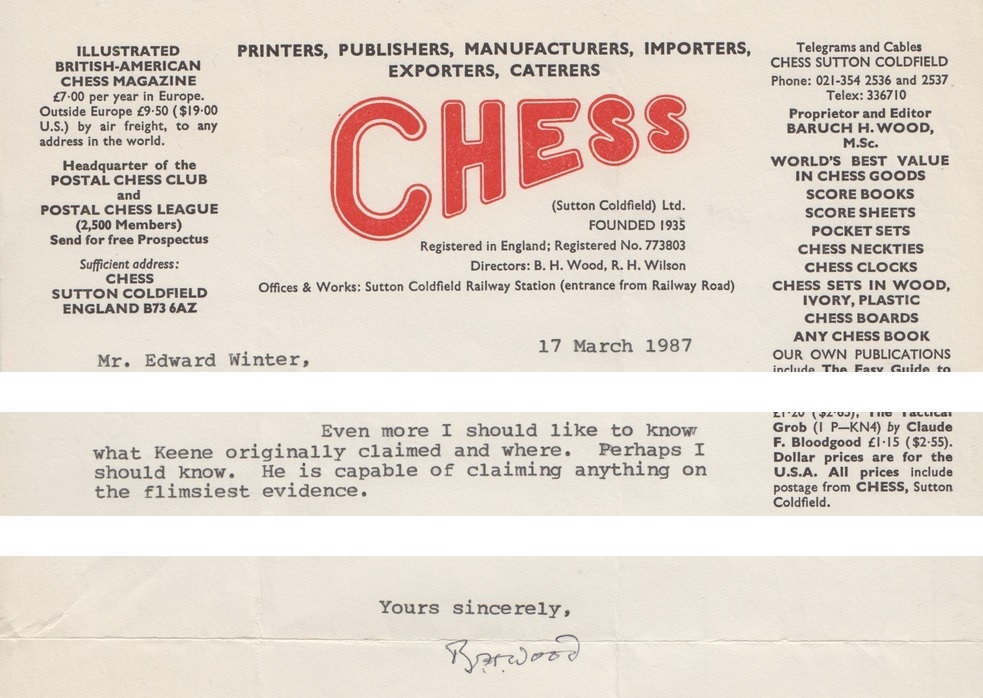
As regards Golombek’s further education, the following unsourced assertion was made by Raymond Keene on page 422 of the July 2019 BCM:
‘Golombek enjoyed a superlative gift for conveying the drama of battles on the chessboard, elevating chess commentary to the literary level of the Icelandic epic sagas which he had studied for his Doctorate.’
The assertion, still unsourced, was reproduced on page 214 of his book Fifty Shades of Ray (Edinburgh, 2021).
We skimmed the chess content of Fifty Shades of Ray for about an hour, ignoring all the recycling and re-recycling of games. With a tally of over 100 errors, misspellings, typos and inconsistencies we gave up in disgust.

On 18 May 2021 we added to ‘Cuttings’ the remark below concerning a book compilation of material by Raymond Keene most recently published in The Article and in the BCM (though often in other unnamed places previously):
We skimmed the chess content of Fifty Shades of Ray for about an hour, ignoring all the recycling and re-recycling of games. With a tally of over 100 errors, misspellings, typos and inconsistencies we gave up in disgust.
Now, a few days later, a second reluctant examination has revealed, unsurprisingly, a vastly higher tally.
It is a calamitous book, even by Raymond Keene’s standards. A dozen or so proper names are spelt two or more ways, and in some cases on the same page (e.g. Loewenthal and Löwenthal on page 32, and Lowenthal on page 44); page 42 has both Vinyoles and Vinoles, concerning a game whose first note says that White ‘could have plated 6. Bx7+’. General editing, lay-out, punctuation, italicization, etc. are a fiasco. Already on pages ix-xii, the list of contents and the list of games have dozens of mistakes. Elsewhere there is the amateurish spectacle of a comma at the beginning of a line, and a line consisting of some 65 letters with no spaces between words. On page 128 Raymond Keene professes an academic knowledge of French, but nearly 20 French words and names are rendered inaccurately in the book. The only picture, occupying half of page 266, is the top part of a tournament crosstable; it is illegible.
Some sections gave us the impression of being the first person ever to read, or even skim, them in their current form, despite Raymond Keene’s affirmation in the Introduction that the columns have been edited (by C.J. de Mooi) and proofread (by Julian Hardinge). The Introduction also expresses thanks to four family members ‘for invaluable assistance in honing the original contributions from which this volume is composed’. Goodness knows what the unhoned versions looked like.
C.J. de Mooi’s syrupy Foreword could easily be picked apart, but here we quote just one paragraph:
‘... that old enemy time moves inexorably forward and the old are usurped by the young. After over three decades as the chess correspondent for both The Times and The Spectator he was unceremoniously replaced.’
This echoes Raymond Keene’s own untruthful and ungrammatical words on his Twitter page, 31 July 2020 (quoted in full in ‘Cuttings’):
‘I am 72. Last year, at the age of 71, both The Spectator and The Times fired me after respectively serving for 42 years and 34 years without missing a single column ...’
At present, therefore, it is The Article and the BCM that showcase, so to speak, his output, although large swathes of the output are input from past writings, copy-pasted with no attempt to rectify their obvious defects, even when they have been pointed out publicly.
Our feature article The Immortal Game (Anderssen v Kieseritzky) shows how, over the years, Raymond Keene has rehashed various factual blunders about the 1851 brilliancy. Far from taking account of chess historians’ investigations, discoveries, corrections and conclusions, Fifty Shades of Ray remains incompetent over the most basic matters: yet again, for instance, the players are named as ‘Adolph’ Anderssen (also ‘Andersen’ on the same page, where we find too ‘the Ruy Lopex’) and ‘Kieseritsky’. The game, incidentally, features a ‘gradiose’ combination.
The scrappy sections on Alekhine and the Nazi articles are illogical and self-contradictory. Raymond Keene, the antithesis of a chess historian, seldom offers sources, preferring bare assertion as if he, of all people, can be taken on trust. Page 109 has categorical statements about how exactly Alekhine died (which nobody knows) and when he died (‘on the evening of March 25, 1946’). As shown in our feature article on the subject, Alekhine’s death had been reported worldwide the previous day.
Sloppiness pervades Fifty Shades of Ray with, even, mistakes and inconsistencies in the names of Raymond Keene’s present publisher, present employer, former publisher and former newspaper; and in the titles of a book which he co-authored and one to which he contributed. To be liked by him is a burden carrying no guarantee of a correctly printed name, as Dominic O’Brien will find on page 207 (two mentions, both with typesetting mishaps).
Leaden repetition of titles is embarrassingly frequent (see, for instance, how Nigel Short has the misfortune of being referred to), and never more embarrassing or frequent than when Raymond Keene is presenting himself:
(11864)
The imprint page:
From page 288:
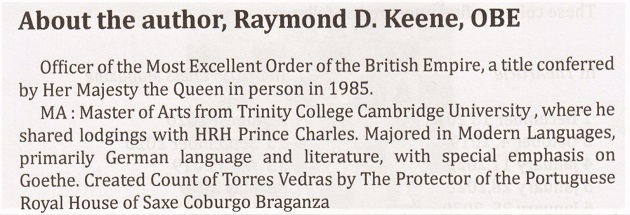
Addition on 28 May 2021:
Leaden repetition of titles is embarrassingly frequent (see, for instance, how Nigel Short has the misfortune of being referred to) ...
Concerning that remark of ours above (C.N. 11864), we add here a series of such references in Fifty Shades of Ray:
(Nigel Short is one of 12 FIDE Vice Presidents.)
(Afterword: on 30 September 2022 FIDE announced that Nigel Short had been appointed ‘Director for Chess Development’.)
Addition on 12 March 2024:
Below is part of a post by Raymond Keene on X/Twitter on 9 March 2024:

Although the assertion ‘I spent my 3rd year living with future King Charles III in Great Court’ surpasses Mr Keene’s phraseology on innumerable previous occasions, who would exclude the possibility that he will go even further next time?
Addition on 30 March 2024:
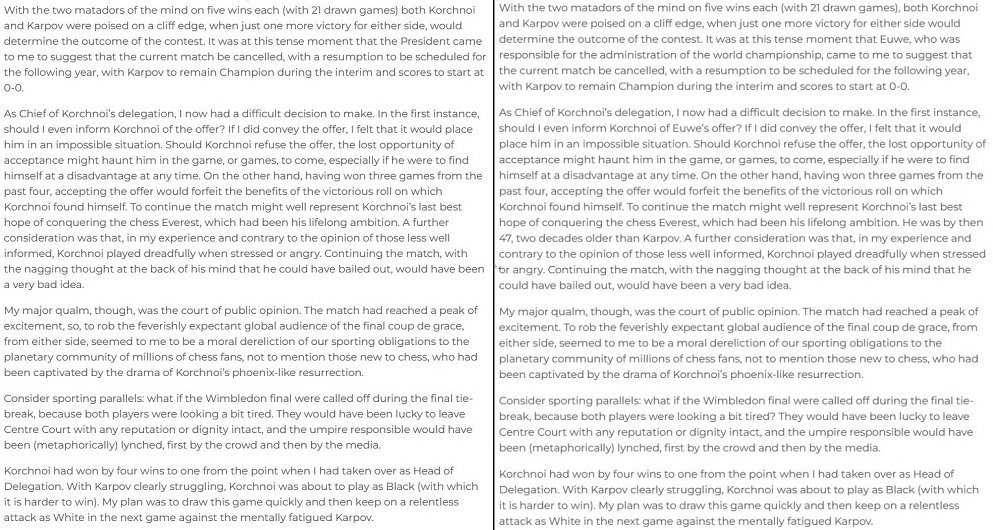
Left: from an article by Raymond Keene posted on 23 January 2021. Right: his contribution to the same website on 30 March 2024.
Addition on 13 April 2024:
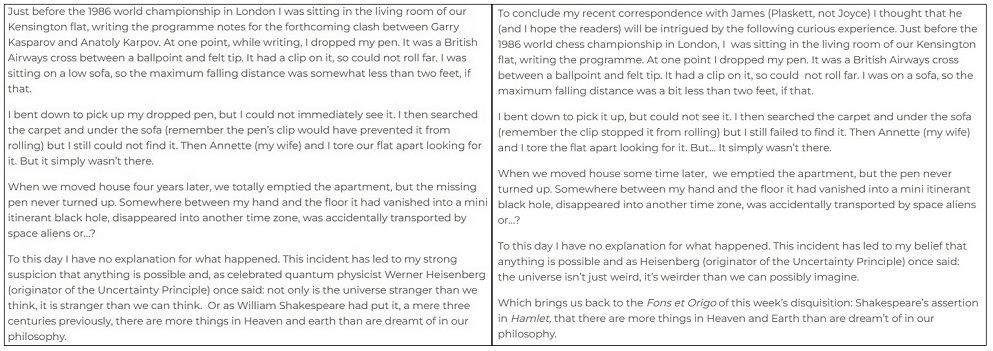
Left: posted by Raymond Keene on ‘TheArticle’, 17 February 2024. Right: posted by him on the same website on 13 April 2024.
Addition on 14 April 2024:
Some further examples of copying (Acknowledgement: keene-watchers):
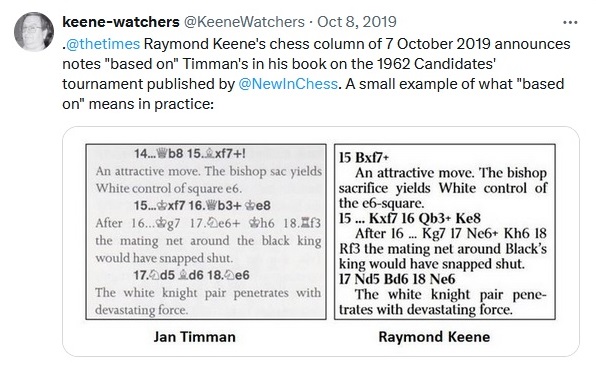
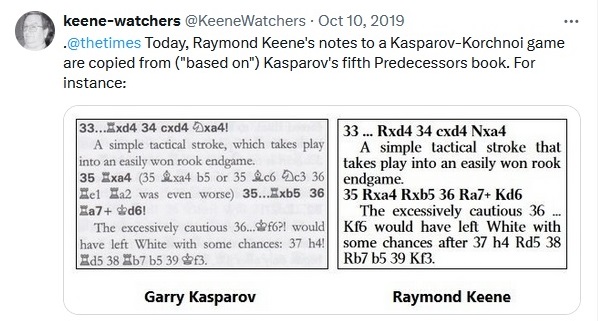
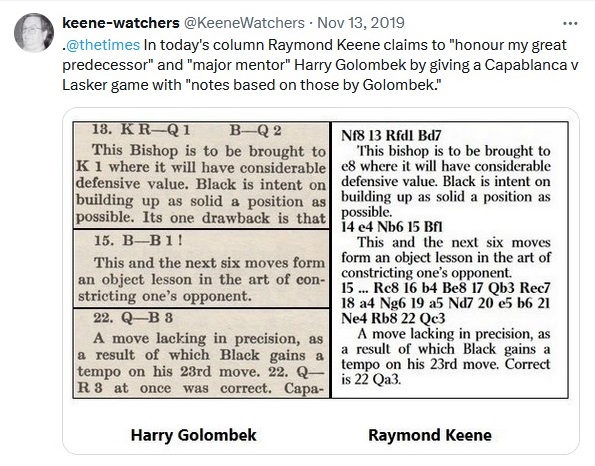
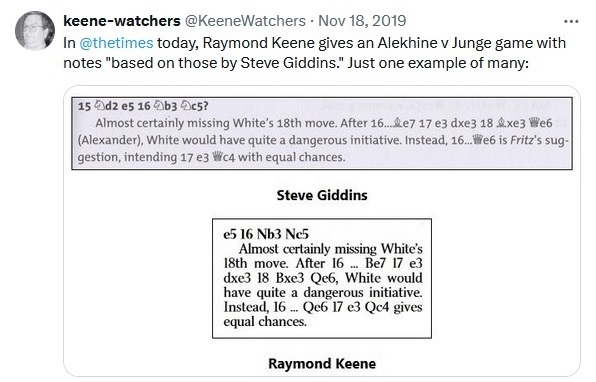
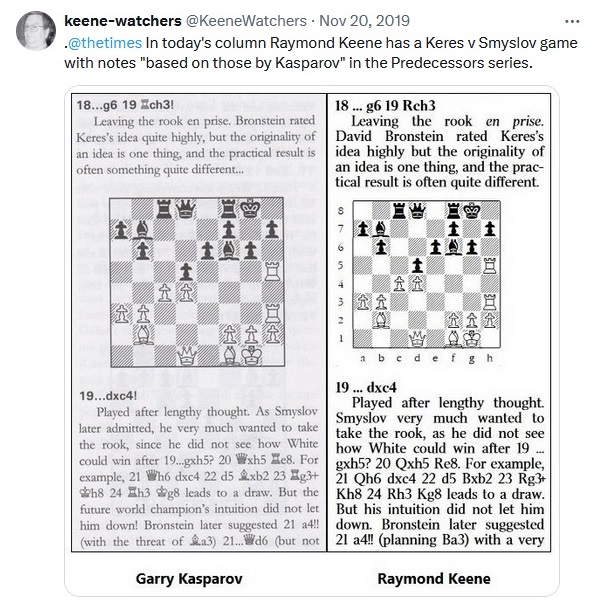
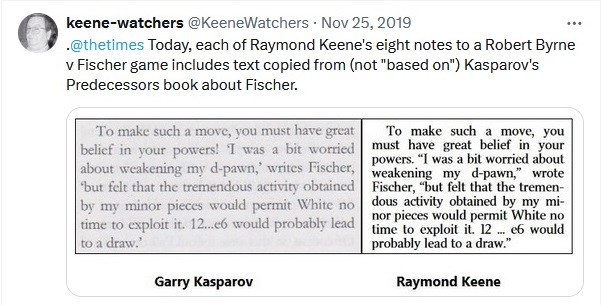
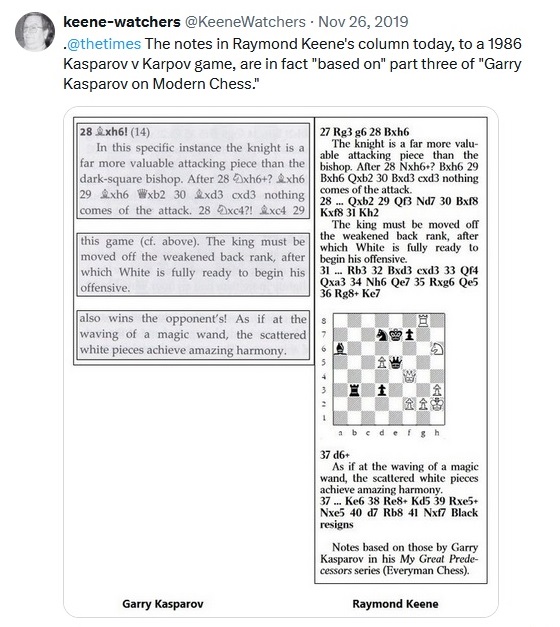
Addition on 14 April 2024 regarding the telex sent to Florencio Campomanes on 15 February 1985 (as given, for example, in The 1986 FIDE Presidential Election):
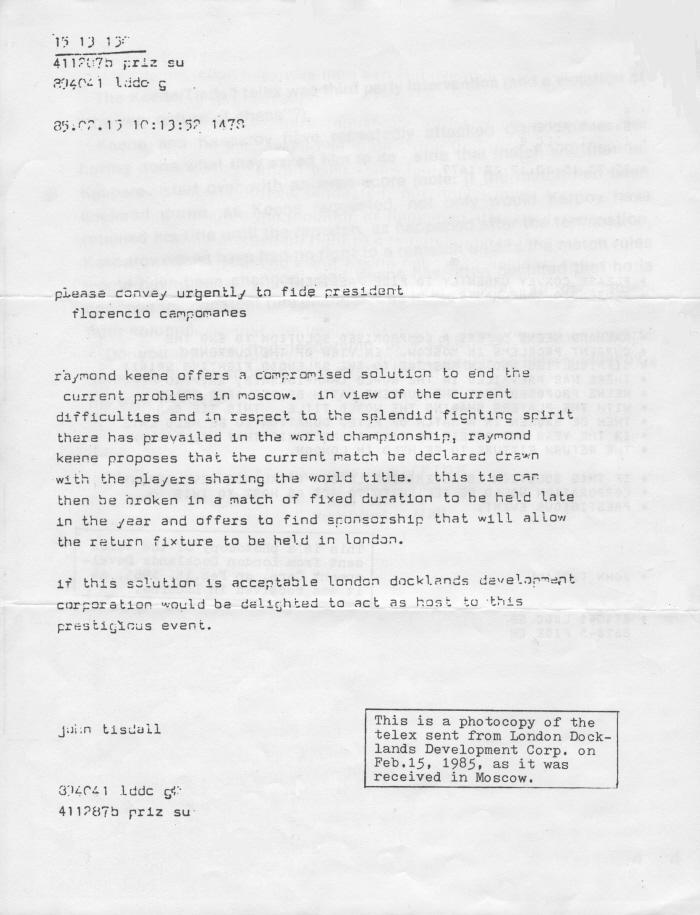
As shown in the above-mentioned feature article, Jonathan (not ‘John’) Tisdall has stated that he was unaware of the existence of the telex until 2021.
However, our article on the Termination quotes the following from pages 263-264 of Moscow Marathon by J. Speelman and J. Tisdall (London, 1985):
‘General speculation filled in the silence while play was again postponed on the 13th (Campomanes time-out) and Keene called me to draft a proposal that the players be declared co-champions with a rematch of fixed duration to be held in London with the help of the London Docklands. After hurried consultation, this was done and the message telexed to Moscow.’
A Times tweet posted by Raymond Keene on 16 January 2013:
Further articles:
World Champion Combinations
Copying
Warriors of the Mind
A Sorry Case
The Termination
Chess Awards
Over and Out
The 1986 FIDE Presidential Election
A Unique Chess Writer
Comic Relief
An Alekhine Blindfold Game
An Alekhine Miniature
A Chess Mess.
To the Chess Notes main page.
To the Archives for other feature articles.
Copyright: Edward Winter. All rights reserved.